For fifteen years, the heart of every road-going McLaren was built somewhere other than Woking. That’s about to change, and it may matter more to the brand than the SUV everyone will talk about.
McLaren Automotive has committed roughly £500 million to expanding its British operations. The package covers a new UK vehicle assembly facility, a bigger footprint in South Yorkshire, a performance SUV, and something the company has never done before: designing and building its own engines. The UK government’s Downing Street release, published September 16, says the programme should create 1,000 new jobs by 2032 and up to 3,000 more across the wider sector.
Prime Minister Andy Burnham visited the McLaren Technology Centre and summed up the government’s pitch in a single sentence: “McLaren is doubling down on Britain, keeping the design, the engineering and the building of every future car here, and taking on a thousand more people to do it.”
The engine story is the real headline
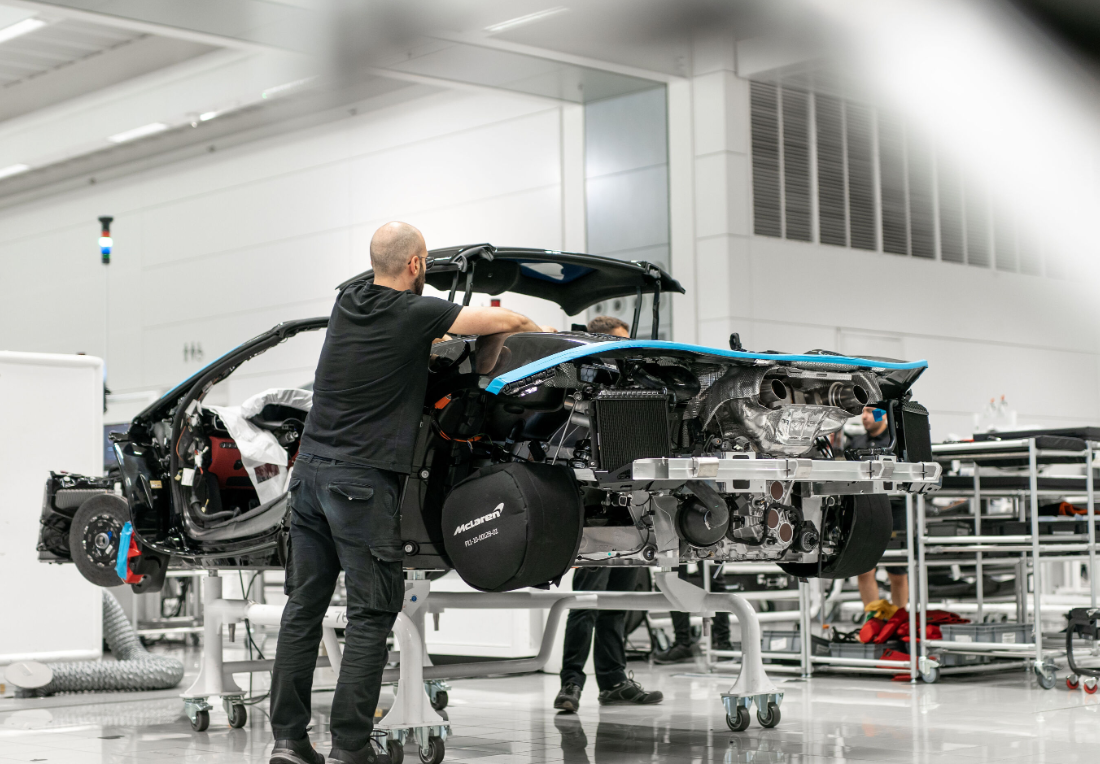
To see why in-house powertrains are a big deal, look at who has been building McLaren engines until now. According to engine partner Ricardo’s 2023 announcement, Ricardo has assembled more than 34,000 McLaren powertrains since the 12C launched in 2011. That work happens at a dedicated plant in Shoreham-by-Sea, and the finished engines are shipped to Woking.
Related Articles
- NASCAR’s Playoff Field Will Race Wearing Dolly Parton’s Butterfly at Bristol — Here’s How That Decal Actually Happened
- Toyota GR GT And GR GT3 Laguna Seca Laps: What The Specs Reveal
There’s a wrinkle, though. That same 2023 release says McLaren’s own powertrain team already designed the next-generation hybrid V8. Ricardo signed on to build it under a long-term, multi-year agreement, with both companies putting more money into Shoreham. So McLaren was already doing the design work. What’s actually new is McLaren building engines itself.
That raises an obvious question neither company has publicly answered: what happens to the Ricardo contract? A supply deal described as multi-year doesn’t end cleanly just because the customer builds its own factory. Expect a handover period in which Ricardo-built engines keep flowing while McLaren gets its own line running.
For owners, that handover matters. Engines built under the existing Ricardo arrangement will need parts, service knowledge and warranty support for years. Anyone buying a current or recent McLaren should confirm that dealer support for those powertrains doesn’t depend on a supplier relationship that’s winding down.
Why take on the cost at all? Engine manufacturing is capital-intensive, and ownership brings control: over the intellectual property, over the build schedule, and over how quickly a hybrid system can be changed. The government release says McLaren intends to manufacture future engines in-house for the first time. For a company whose rivals have always built their own engines, closing that gap is overdue.
Where the money lands
According to the government release, the investment will expand McLaren’s R&D and production site in South Yorkshire and add a new vehicle production facility elsewhere in the UK. McLaren hasn’t said where that facility will be. The release also mentions a new design and innovation centre in Bicester and an engineering, testing and development site at MIRA in the Midlands.
The South Yorkshire site has an interesting history. When McLaren first announced it in 2017, the government’s own release described a £50 million composites centre to develop carbon fibre chassis. Production was moving back from Austria, where it had been outsourced, with estimated savings of around £10 million. McLaren’s then-CEO wrote on a government industrial strategy blog that the centre officially opened on November 14, 2018.
That’s the pattern here: first the carbon tubs came home, now the engines are following. McLaren is gradually building a supply chain it controls, one major component at a time.
Follow the ownership
This money isn’t coming from McLaren’s own profits. In April 2025, a McLaren investor release confirmed that Abu Dhabi’s CYVN Holdings had completed its purchase of McLaren Automotive, plus a non-controlling stake in McLaren Racing. CYVN merged the carmaker with its British start-up Forseven under a new McLaren Group Holdings, run by chief executive Nick Collins.
That same release said a turnaround plan for the existing McLaren Automotive business was “required and will commence immediately.” It also promised expansion into new product categories. Seventeen months later, that category has a name: performance SUV. McLaren’s announcement describes the funding as part of a broader commitment from shareholder L’IMAD, an Abu Dhabi sovereign investor.
Read those two documents together and the picture is clear. The £500 million isn’t a victory lap for a healthy business. It’s a sovereign-backed owner paying to rebuild a company it admitted needed fixing. That doesn’t make it a bad plan, but it does mean the jobs figures are forecasts, not guarantees.
Collins framed it carefully in the government release: “We are investing in the future of McLaren and in advanced manufacturing in the UK.” The wording is worth noticing. Ministers talked about 1,000 new jobs, while McLaren’s own figures reportedly count direct and indirect roles together, and the target date is 2032. That’s a long window for a company still reshaping itself.
The regulatory safety net
The timing of the hybrid strategy isn’t a coincidence. When the government revised the zero-emission vehicle mandate in April 2025, the transport secretary told the Commons that full hybrids and plug-in hybrids will remain on sale until 2035. She also said small and micro-volume manufacturers will be exempt from the new measures. An opposition MP in the same debate named McLaren as one of the luxury brands that would benefit.
Related Articles
- Defender Dakar Heading To Australia: What The Rally-Bred V8 4×4 Really Costs To Own
- California Car Influencer and Hooters Calendar Girl Identified in McLaren Crash; No Word On Who Was Driving
That exemption is what makes an internal-combustion engine program worth building in 2026. The open question is scale. A high-volume SUV is exactly the kind of product that could push a boutique carmaker toward the volume limits where the rules become less generous. Buyers won’t notice that on a spec sheet, but McLaren’s compliance team will be watching it closely.
What it means if you own or want one
For current owners, not much changes right away. Your Woking-assembled car with its Ricardo-built engine stays exactly what it is. Keep an eye on long-term parts support as engine production changes hands.
For prospective buyers, the first cars with McLaren-built engines will come with first-generation risk. Any new engine program has early production issues, and experienced buyers usually wait a model year before committing. Resale values will depend on how that launch goes.
For the brand, this is the biggest structural change since the 12C. McLaren will soon build its own tubs, its own engines and its own SUV, all in Britain. If it all works, McLaren finally operates like the full-scale carmaker it has claimed to be. If it doesn’t, the investment will look like a very expensive way to confirm the turnaround plan was needed.
About the Author