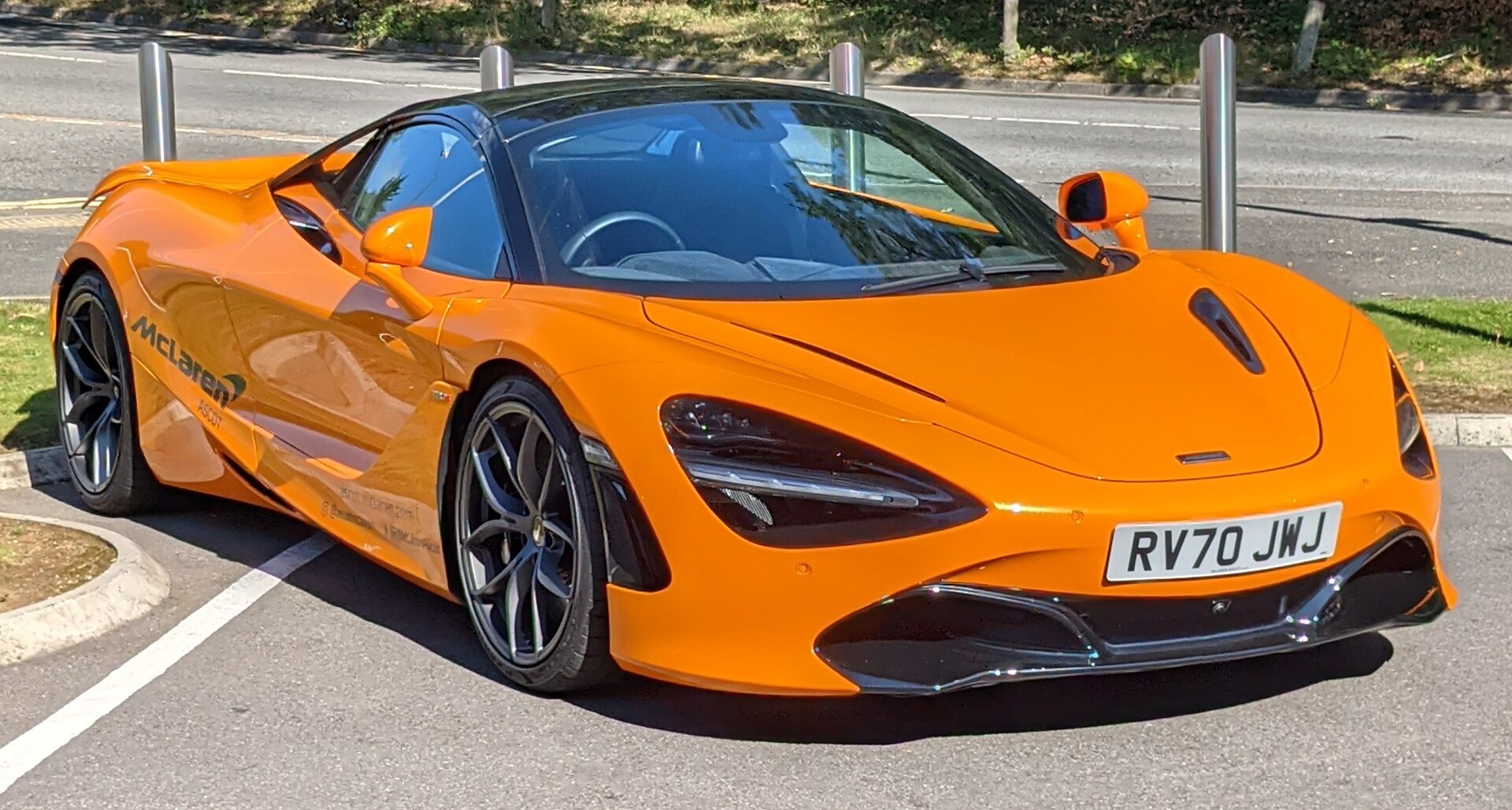
File photo of a McLaren 720S. Irvine police have not released the model of the 2019 McLaren involved in the crash. Photo: Calreyn88, CC BY-SA 4.0, via Wikimedia Commons.
Three days after a 2019 McLaren left Culver Drive and came apart against a tree, both people who died inside it have names. Neither name came from the Orange County Coroner.
Relatives publicly identified the second occupant as Alexis Kramer, a 22-year-old from Florida, a day after the family of James Wehr, founder of South OC Cars and Coffee, confirmed his death in a statement posted to the show’s account. The coroner’s office has confirmed neither identification. The Irvine Police Department’s only published statement on the crash, issued the morning it happened, names nobody at all.
Which leaves the question that actually decides this case wide open: which of the two was driving.
That is not a tabloid question. It is a forensic one, and the tools investigators will use to answer it are more interesting, and considerably more limited, than most people who own a fast car realize.
What the department actually put on paper
The Irvine Police Department’s release runs about four sentences of substance. Officers were dispatched at 12:18 a.m. on Sunday, September 13, to Culver Drive at Deerfield Avenue. The McLaren had stopped northbound at the intersection. When the light turned green, the car traveled north “at a high rate of speed,” the driver lost control, and the car went right, struck a curb and then a tree. It split in two and caught fire. Orange County Fire Authority put the fire out. Two people were found dead inside. The Major Accident Investigation Team has the case.
No model. No speed figure. No names. We went through the structural side of that sequence when the release first landed: why a carbon-tub car separates instead of folding, and why a mature street tree is close to the worst object on any road. This is the other half of the investigation, and it runs on data rather than deformation.
Why the driver question is the entire case
One vehicle, two occupants, no surviving witnesses inside it. In that scenario the identity of the driver determines nearly everything downstream. Civil liability for the passenger’s death attaches to the driver’s estate and whatever policy sits behind it. Wrongful-death claims, insurance payouts and the inevitable carrier-versus-carrier argument all begin with that single fact.
Investigators cannot ask the occupants. A fire severe enough to delay the coroner has also destroyed most of the ordinary tells: clothing fibers transferred to a belt, hand contact on a rim, soft-tissue bruising patterns. What is left is the car’s own memory, and the human remains.
Your car keeps a witness. It remembers about five seconds.
Nearly every new car sold in the United States carries an event data recorder, and almost nobody who owns one has read what it does.
Start with a detail that surprises people: federal law does not require your car to have one. The governing rule, 49 CFR Part 563, applies to passenger vehicles under 8,500 pounds GVWR built on or after September 1, 2012 only “if they are equipped with an event data recorder.” Manufacturers fit them voluntarily, essentially universally, because crash data is useful to them. The regulation then dictates what a fitted recorder has to capture.
The list is narrow and specific. Pre-crash vehicle speed. Accelerator or throttle position. Service brake on or off. Engine RPM. Driver safety belt status, sampled at exactly one second before time zero. Then, during the impact itself, longitudinal delta-V at 100 samples per second for the first quarter of a second.
Under the standard in force when a 2019 car was built, the pre-crash window was five seconds recorded at two samples per second. Ten speed readings. That is the sum total of what the car remembers about the run from the green light.
And here is the limitation that matters most in Irvine: Part 563 also requires the owner’s manual to state that no personal data, specifically naming gender, age and crash location, are recorded. The box will say the car was at full throttle. It will never say whose foot was on the pedal.
NHTSA fixed this. The fix arrives too late for this car.
The five-second window was always thin, and the agency knew it. In a final rule published in December 2024, NHTSA extended the pre-crash recording requirement from five seconds to 20 and raised the sample rate from two per second to ten, across seven data elements including speed, throttle, brake, RPM, stability control and steering input.
General compliance lands September 1, 2027. Small-volume and limited-line manufacturers get until September 1, 2029, and altered or multi-stage vehicles until 2030. Those extensions exist for exactly the reason you would guess: a company building a few thousand cars a year amortizes a software and validation program over a rounding error of volume, the same arithmetic that makes something as basic as a clutch pedal a compliance headache for small sports car builders.
The practical upshot is that the cars with the most performance to explain will be the last ones recording enough data to explain it.
Two problems with the black box in this particular car
The first is heat. Nothing in Part 563 requires a recorder to survive a fire. What the rule requires, in section 563.10, is that the mandated elements still exist and remain retrievable after the federal crash tests, and stay retrievable for at least ten days afterward. Those tests are deceleration events conducted in a lab. A module that reads out cleanly after a 35 mph barrier impact has been certified against nothing resembling a post-crash fuel fire on Culver Drive.
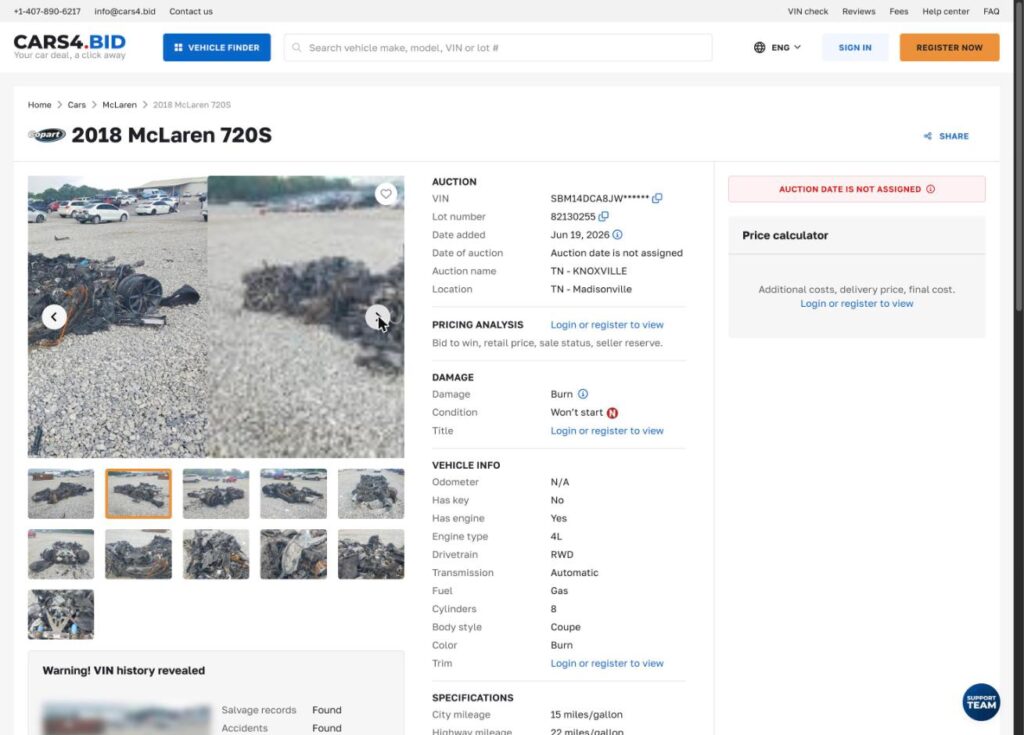
The second problem is the reader. Bosch’s Crash Data Retrieval system is the tool essentially every police reconstructionist in the country owns, and its published vehicle coverage list is the practical boundary of what an investigator can pull on a Tuesday afternoon. McLaren does not appear on it. No universal cable, no supported imaging path, which means retrieval, if the hardware survived at all, likely runs through the manufacturer’s own equipment and personnel. That is a slower and more negotiated process than plugging a laptop into an OBD port.
When the module is gone, biology takes over
There is a genuinely clever technique for this exact problem, and it has been peer-reviewed for two decades. Researchers publishing in the International Journal of Legal Medicine examined 34 deployed driver and passenger airbags recovered from 20 vehicles after frontal collisions, using an alternative light source to locate biological traces. They found traces on roughly 80 percent of the bags, and about 60 percent of samples produced comparable DNA profiles. In every case studied, the results matched the occupants’ own accounts of who had been sitting where.
An airbag is a large, clean fabric surface that arrives in a face at 150-plus mph. It is, forensically speaking, an excellent swab. The obvious caveat for Irvine is that those airbags were not incinerated.
The same escalation applies to identifying the occupants at all. The Orange County Coroner Division’s own policy manual lays out the ladder plainly: every decedent is fingerprinted by one of four methods; dental comparison is performed on anyone not identifiable visually, photographically or by print; DNA comparison is performed on anyone still unidentified after that. That sequence is precisely why families reach a name days before the government does. A relative recognizes a car and a plan for the evening. The county has to prove it.
Physical evidence fills the rest. Seat track position on both sides. Deformation and load marks on the pedals and the steering column. Belt latch and webbing hardware, where loading signatures survive heat far better than fabric does. And occupant kinematics, meaning where each body came to rest relative to the two halves of the car.
In California, nobody simply plugs into your car
There is a statute for this, and it is worth knowing whether or not you ever hit anything.
California Vehicle Code section 9951 requires manufacturers to disclose an EDR in the owner’s manual, and then restricts who may pull the data. Retrieval is permitted only with the registered owner’s consent, under an order from a court with jurisdiction, for anonymized safety or medical research, or by a licensed dealer or certified technician diagnosing, servicing or repairing the vehicle.
When the registered owner has died, consent becomes an estate question, which is exactly the kind of thing that converts a two-day data pull into a two-month one. A court order is usually the faster road, and in a fatal collision investigation it is the expected one.
That statute is also the reason your insurer cannot quietly harvest your car’s crash data on its own initiative. It is a California protection rather than a federal one, and the broader trend runs the other way as vehicles record more and share it more freely. We covered a version of that problem recently with GM’s cabin camera software, where the real exposure was never the automaker watching but the footage becoming discoverable evidence.
Our sister site The Auto Wire has been tracking the regulatory side of the same crash, including how little federal crash testing exists above 50 mph and why a low-volume exotic has no public safety ratings at all.
What this is worth to you, in your own car
Four takeaways that have nothing to do with supercars.
Your car almost certainly has a recorder, and the manual has to say so. It is usually a short paragraph buried near the warranty section. Read it once so you know what your vehicle captures.
The window is short and the data is contextless. Five seconds, or 20 once the new rule bites, of inputs and speed. The EDR cannot show the light phase, the car that cut across, or the deer. It records what your car did, never why.
A dash cam is the cheapest evidence you will ever buy. It is the only thing that fills the context gap the EDR structurally cannot, and in a dispute where the other driver’s account is the only competing record, it is decisive.
If you ever need your own EDR read, act early. Retrieval is regulated, salvage yards do not preserve modules, and a totaled car can be crushed within weeks. The data has a shelf life measured by the wrecking yard, not by the statute of limitations.
Irvine’s investigators will eventually produce a speed and, in all likelihood, a driver. What the past three days have illustrated is how much of that answer rides on a component nobody shops for, governed by a rule nobody reads, in a car built by a manufacturer too small to appear in the standard reader’s database.
Anyone who saw a McLaren on Culver Drive shortly after midnight Sunday, or who has home or business surveillance video near Deerfield Avenue, is asked to contact Detective David Juarez at (949) 724-7047.
Lead image: Calreyn88, CC BY-SA 4.0, via Wikimedia Commons
About the Author