Photo: RM Sotheby's
Most celebrity-owned cars are valuable because a famous name appears on old paperwork. This one is valuable because of a photograph: Ayrton Senna in jeans and a button-down shirt, washing a red NSX with a garden hose. RM isn’t only selling a car here. It’s selling that photo.
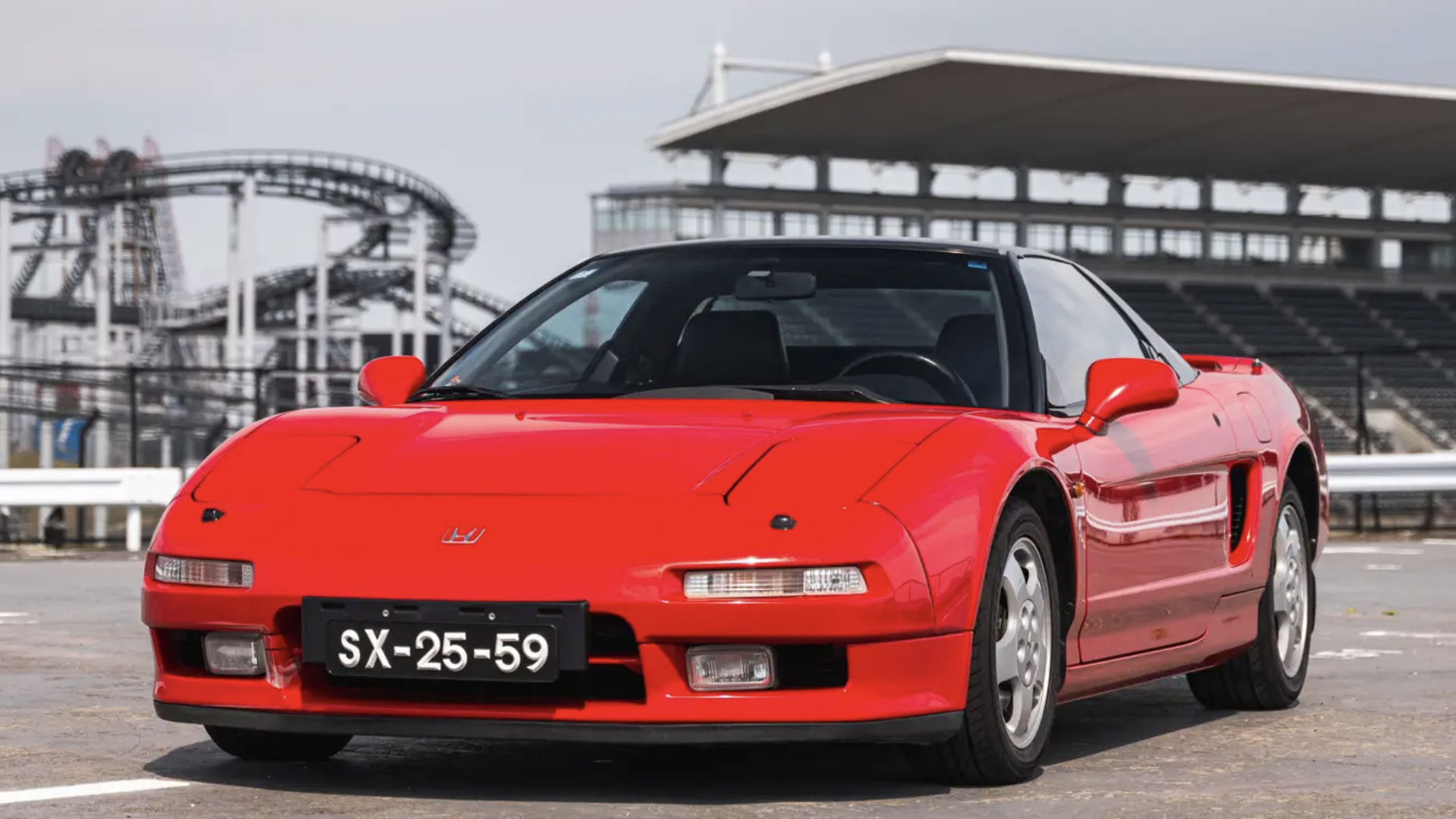
RM Sotheby’s will offer the 1991 Honda NSX, chassis JHMNA11500T000233, at The London Auction 2026 with an estimate of £500,000 to £800,000, which the house converts to €600,000 to €950,000. The sale is on October 31, per the auction lot listing.
What RM is actually claiming
Read the catalog slowly. Every word in it is doing a job. Under an agreement between Honda and Senna, Honda provided an NSX that Senna had access to for personal use, and this red car sat alongside two black ones. In other words, Honda supplied the car for his use. The catalog does not claim Senna bought it.
Related Articles
- Van Hauler Asks 7th Circuit to Halt FMCSA’s Rolling Robotruck Beacon Waiver
- Custom 1974 Funco Buggy Has 10 Kilometers, a Haltech ECU and Push-Button Start
The car is Formula Red with a black roof and black leather. Honda Automobil de Portugal imported it and registered it on 22 March 1991 as “SX-25-59,” and it was kept in Lisbon and brought to Senna whenever he arrived in the country.
The Senna connection is well documented. He drove it to the 1991 Portuguese Grand Prix at Estoril, where he qualified third and finished second, and it appears in the 1992 documentary “Ayrton Senna: Racing Is In My Blood,” with Senna dropping the clutch and spinning the rear tires on camera.
The paper trail after Imola
Provenance is what turns a 35-year-old Honda into a six-figure lot, so the post-1994 history matters as much as the Senna years. Lisbon registry records show the car was registered in February 1995 by Laboa Etablissement. A Honda fax, which Honda Motor Europe has since reaffirmed, places it with the Nipomotor dealership by September 1997.
An Algarve dealer principal bought it in 2009, and Robert McFagan acquired it in 2013 and road-registered it in the UK in May 2016. In 2019 Giancarlo Minardi drove it at Imola to mark 25 years since Senna’s death, and the current consignor bought it in Nagoya in 2024.
Names, dates, documents. That’s what serious bidders are actually paying for.
Why the NSX itself deserves the attention
Remove Senna from the story and this is still an important car. Honda’s own history describes the NSX as the world’s first mass-production car with an all-aluminum monocoque body. The C30A 3.0-liter V6 was developed specifically for the NSX, with DOHC VTEC allowing it to rev to an 8,000-rpm redline.
Senna’s influence on the car is documented too. While testing the prototype, he judged the chassis “a little fragile.” RM states that his feedback led Honda to stiffen the frame by 50 percent and revise the suspension tuning. So the winning bidder gets a car Senna drove, built on a design he helped shape.
The fine print buyers should read twice
Two notes in the listing’s addendum deserve as much attention as the provenance. First, the car is titled as a 2025. Second, it entered the UK on a temporary import bond, which has to be cleared either by exporting the car or by paying VAT and import duties if it stays in the UK.
A 2025 title on a 1991 car is the kind of detail a lawyer will want explained before the hammer falls. The re-registration after it left Japan is the obvious place to start asking.
On tax, a UK buyer has a possible way to soften the bill. UK guidance allows a reduced import valuation for collectors’ vehicles that are at least 30 years old and in original condition, or that were used in a historic event. Whether this car qualifies is HMRC’s decision, not the seller’s. Bidders should budget as if the answer might be no.
Insurance is another early call to make. A standard policy will value this as a 1991 NSX. You need an agreed-value classic policy written around the Senna provenance, and the insurer will want the full document file before the car leaves the saleroom.
Maintenance: the factory option may not apply
Honda runs its own NSX restoration service, but this car may not be eligible. Honda’s Takanezawa restoration program starts at ¥11,550,000 and lists eligible cars as Japanese-market frame numbers NA1-1000001 through NA1-1009999. This car’s European chassis number isn’t in that published range, according to Honda’s restoration page.
Related Articles
- Tom Holland’s Car Collection: The Porsche He Posted, the Audis Spider-Man Got, and the Garage Rumors Nobody Can Prove
- 10 Celebrities Who Race (or Just Can’t Get Enough of Racing)
Any future work will probably fall to independent specialists who understand aluminum. That matters, because a damaged aluminum structure can’t be repaired at an ordinary body shop.
There’s also a practical tension for the next owner. Every non-original part replaced chips away at the originality that justifies the price. Expect the winner to keep it as close to the Estoril-era car as possible and to drive it very little.
The bottom line
At the top of the estimate, a buyer is paying a large premium over an ordinary early NSX for the photograph, the film footage, and the Estoril weekend. Given how rarely a road car with Senna’s fingerprints reaches public auction, that premium is easier to defend than it sounds. Just read the addendum before you raise your paddle. Would you pay a Senna premium for a car he borrowed and hosed down, or is provenance only worth it when the driver signed the title?
Images Via: RM Sotheby’s
About the Author