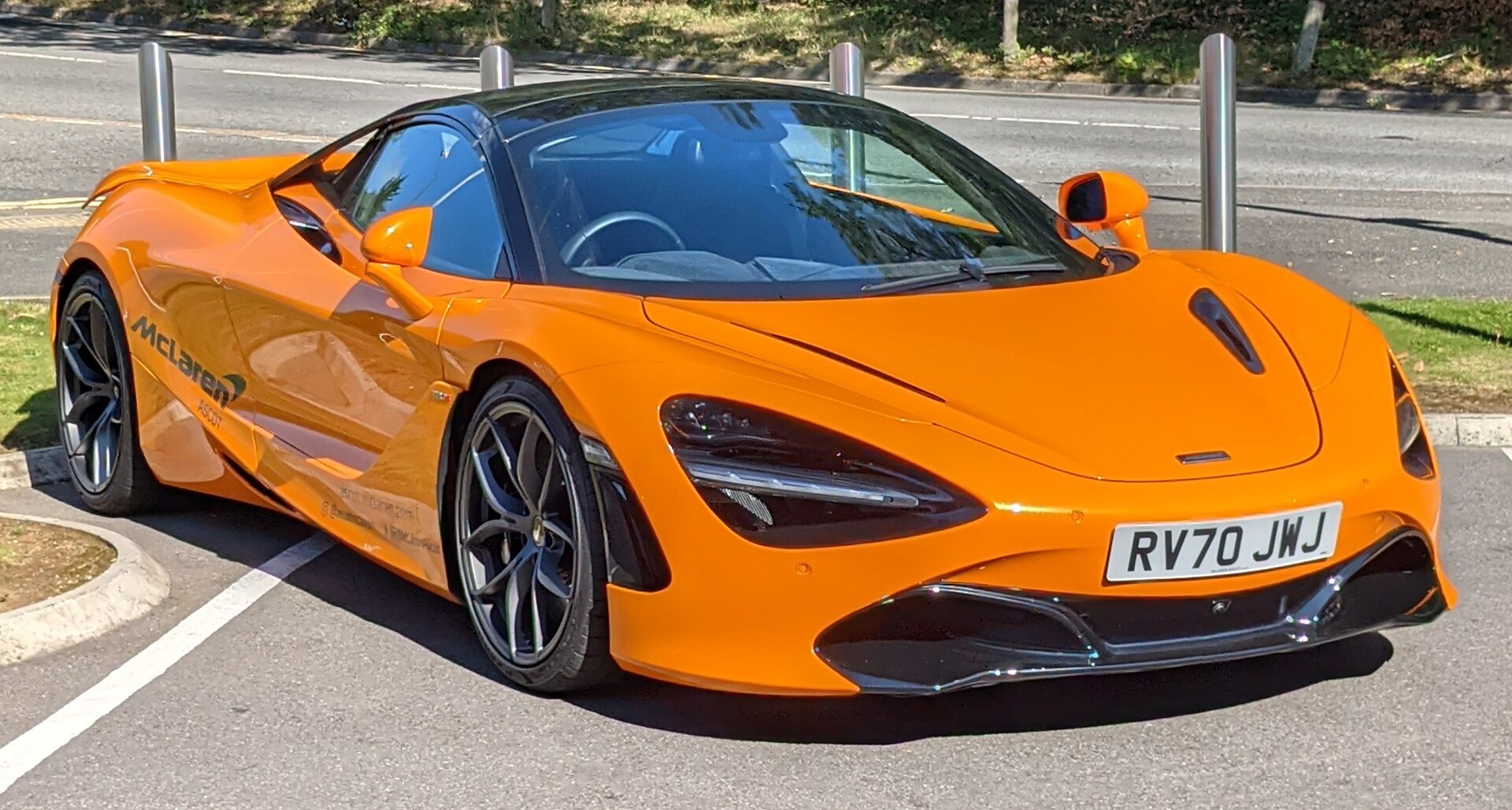
File photo of a McLaren 720S. Irvine police have not released the model of the 2019 McLaren involved in the crash. Photo: Calreyn88, CC BY-SA 4.0, via Wikimedia Commons.
The call came in at 12:18 a.m. Sunday. By the time Irvine police and Orange County Fire Authority crews reached Culver Drive at Deerfield Avenue, the 2019 McLaren that had been sitting at a red light moments earlier was in two pieces and burning. Both people inside were dead.
The Irvine Police Department’s account of what happened in between is brutally compact. The McLaren “had stopped northbound on Culver Drive at Deerfield Avenue,” the release states. “When the traffic light turned green, the car traveled northbound at a high rate of speed.” The driver lost control, struck a curb, then a tree. The car split in two and caught fire.
That is the entire official record so far. No model, no names, no speed figure. Everything else worth knowing has to be reasoned out of the wreckage — and out of a small computer module that may or may not have survived the fire. This is not the first McLaren to come apart at a city intersection: The Auto Wire covered a McLaren torn in two in a fatal Dallas crash and a Chicago chain-reaction wreck blamed on a driver who allegedly ran a red light.
The names police have not released
Irvine police are withholding both identities pending family notification, and the department’s Major Accident Investigation Team has the case.
Separately, the official Instagram account of South OC Cars and Coffee posted a family statement early Sunday announcing a death. “This morning, just after midnight, we lost our darling son and brother James, in a motor accident,” it reads, before asking for privacy. The same account’s profile credits the show’s founding to the handle @wehr — the personal account of James Wehr, who lists himself there as 27 years old and owner of South OC Cars and Coffee.
If you have never been, the scale is hard to convey. The show runs every Saturday from 9 to 11 a.m. at the Outlets at San Clemente, bills itself as the largest weekly car show in the world, and its own site describes a typical morning as 500 to 600 hypercars, supercars, exotics, vintage and classic iron, muscle, hot rods, rat rods, pickups, 4x4s and motorcycles. It is not a club. It is closer to civic infrastructure for Southern California car culture, built on free admission and years of Saturdays.
“Split in two” is a structural description, not a turn of phrase
Every McLaren road car built in the last fifteen years shares one idea: a single-piece carbon fibre tub with aluminium structures bolted to the front and rear of it. McLaren’s own specification sheet for the 600LT lists the body structure as nothing more elaborate than “Carbon Fibre Monocell II,” alongside a dry weight as low as 1,247 kg.
That is how a car with a 3.8-litre twin-turbo V8 weighs less than a mid-size sedan and still clears crash regulations. It is also why separation is the predictable failure mode once an impact goes far enough past the design envelope. The tub is the survival cell and it does not crush. The aluminium ends are sacrificial, they are fastened on, and past a certain energy level they stop deforming and start leaving. A steel unibody folds into a new shape. A carbon-tub supercar comes apart along the lines where it was assembled.
The math that separates a tree from a crash test
Federal frontal crash standards and NHTSA’s own star-rating program are run in the 30-to-40 mph band, into a flat barrier that spreads the load across the width of the car. Kinetic energy, however, scales with the square of velocity, and that is the whole story here.
Run the numbers on a roughly 1,400 kg McLaren. At 40 mph it carries about 224 kilojoules. At 100 mph it carries roughly 1.4 megajoules — two and a half times the speed, six and a quarter times the energy to dissipate. Crash structures do not scale that way. They have a finite stroke and a finite crush force, and once that stroke is used up, the remaining energy goes into whatever is behind it.
Then there is the shape of the thing being hit. A barrier is flat and wide. A mature street tree is a narrow column, and a narrow column concentrates the entire load into a section of the car that may be inches wide — capable of slipping past the longitudinal rails entirely and loading the tub at an angle no regulation validates. Police say the McLaren struck a curb before the tree, which strongly implies the car was already rotating when it arrived. An oblique or side-on tree strike is among the least survivable impact geometries that exists, in any vehicle at any price.
Why it burned
Mid-engine packaging puts fuel and a twin-turbocharged V8 within a couple of feet of each other, immediately behind the cabin, and wraps both in the structure that just tore apart. Turbochargers operate at temperatures that ignite fuel on contact. Once the structure separates and a line or tank is breached, the ignition source is already there and already glowing.
Post-crash fire is also the variable that turns survivable impacts into fatal ones, which is why racing spends so much money on fuel cells and extraction — and why a rival driver, not a safety crew, was the one pulling Ollie Millroy out of a burning Ferrari in Shanghai. Carbon behaves differently than steel in a fire: the epoxy matrix cooks off, the skins go, and what remains is a blackened but structurally recognizable tub. We have watched that exact object show up on the salvage market before, when a 720S burned down to its carbon skeleton and still drew bidders.
Five seconds will decide this investigation
Here is the part that usually gets skipped. Under 49 CFR Part 563, any light vehicle of this vintage sold in the United States and fitted with an event data recorder must capture a defined list of elements: vehicle speed, accelerator position, service brake status, engine RPM, seat belt status, and delta-V sampled 100 times per second. For a 2019 car, the pre-crash recording window is five seconds. The same rule obligates the manufacturer to make a retrieval tool commercially available.
Five seconds happens to be exactly the length of the event. A standing start that ends in a loss of control does not take longer than that. If Irvine’s investigators can extract the module, they will have a second-by-second speed trace, a throttle trace, and a definitive answer on whether anyone touched the brakes.
The obstacle is legal rather than technical. California Vehicle Code 9951 bars anyone other than the registered owner from downloading that data unless the owner consents, a court orders it, or a narrow exception applies. In a fatal collision with no surviving driver, that usually means investigators go get a court order first. Vehicle-generated evidence is only becoming more central to cases like this — the data a modern car quietly keeps is increasingly the most credible witness in the room.
If the module is too heat-damaged to read, the reconstruction still happens the old way: tire marks, the length and spread of the debris field, crush measurements, damage to the tree, and the distance between the curb strike and the impact point. That method works. It just produces a range instead of a number, and it takes months instead of an afternoon.
One practical note for owners
Exotics of this class are usually written on agreed-value policies rather than actual cash value, and the difference is not academic. Agreed value locks in a settlement figure when the policy is issued. Actual cash value hands the number to an adjuster reading a depreciation curve, and the curve on 2019-era McLarens has been unkind. Owners who bought at a strong number and never revisited their declarations page tend to find that out at the worst possible moment. Check which one you have before you need to know. After damage at this level the car is a parts donor, and the salvage listing is the last chapter.
The uncomfortable part
NHTSA counted 11,775 speeding-related deaths in 2023, 29 percent of every traffic fatality in the country. The nighttime split is sharper than most enthusiasts assume: 21 percent of drivers in fatal crashes after dark were speeding, against 16 percent in daylight, and weekend nights run higher still at 23 percent.
What the statistics do not explain is why a green light on a suburban arterial is the worst possible environment for a 600-plus horsepower car. Not because the car cannot do it. Because every margin a supercar depends on is missing. The tires are cold and nowhere near their operating window. The brakes are cold. There is no run-off, no gravel, no tire wall — just a curb line and mature landscaping planted within a few feet of the travel lane because someone in planning thought it would look good. On a circuit, that tree is a gravel trap. On Culver Drive it is a fixed object with a foundation.
Stability control and traction management on a car like this are calibrated around available grip. Give them cold rubber, cold asphalt and full throttle from a standstill, and they are not preventing anything. They are managing a slide that has already started.
If you saw it
Irvine’s Major Accident Investigation Team is asking anyone who witnessed the collision, or who saw the McLaren before it reached Culver and Deerfield, to contact Detective David Juarez at 949-724-7047. Reconstructions built on physical evidence alone take the longest to close, and a single witness with a dash cam can shorten that by months.
Whatever the data eventually says, the Saturday morning show at San Clemente exists because a handful of people decided years ago that it should. It will be a different room this weekend.
Lead image: Calreyn88, CC BY-SA 4.0, via Wikimedia Commons
About the Author