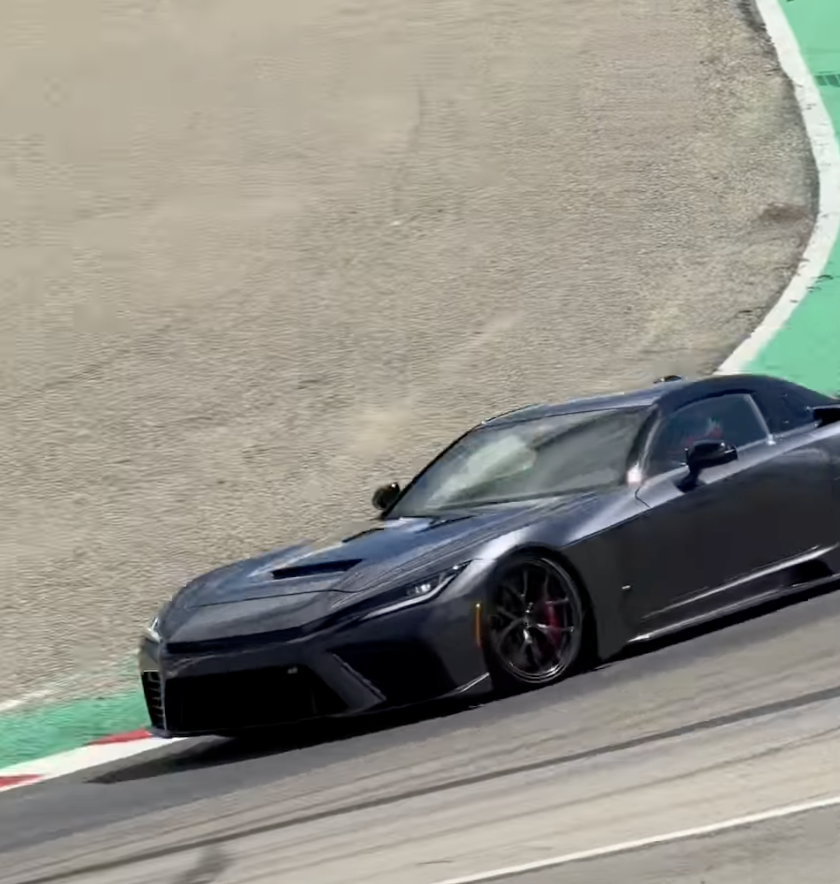
Photo: Japanifornia / Instagram
Toyota’s GR GT And Its Race Car Twin Traded Places At Laguna Seca, And The Spec Sheet Explains Why
A phone clip has been circulating over the past week showing Toyota’s GR GT and GR GT3 prototypes working their way around WeatherTech Raceway Laguna Seca in matching paint, swapping running order mid-lap. Photographer Mike Garrett, who posts as Japanifornia, shot the footage, and GAZOO Racing’s own U.S. accounts have been pushing similar angles. It is the best look yet at two cars Toyota has been extremely stingy about.
The runs themselves weren’t a secret test. Toyota said in advance that both prototypes would turn demonstration laps at the Rolex Monterey Motorsports Reunion on August 14 and 15, with Jack Hawksworth in one car and Tatsuya Kataoka in the other, according to GAZOO Racing’s announcement. Both men are development drivers on the program, so what you’re hearing isn’t a marketing guy doing parade laps.
What you’re also hearing is two different engines, and that’s the part worth slowing down for.
One V8, two very different jobs
Toyota’s December world premiere laid out the road car’s powertrain in unusual detail: a newly developed 3,998cc twin-turbo V8 with an 87.5 x 83.1mm bore and stroke, hot-V turbo placement with one turbo tucked into each bank, dry-sump lubrication and a deliberately shallow oil pan. The short stroke isn’t about revs. Toyota says it exists to reduce the physical height of the engine so the whole car could sit lower.
Related Articles
- Tangent Design Group Turned a 911 Into a Safari Rig, and Its Lift Kit Trick Is the Real Story
- Have This With Your Coffee: Your Backfire News Round-Up for September 11
Now compare that to the GR GT3’s spec table in the same document. Displacement, V8, twin-turbo, front-engine rear-drive. That’s it. No electric motor, no transmission listed beyond a purpose-built racing unit. FIA GT3 regulations have no room for the road car’s hybrid hardware, so the race car throws it away. Same block architecture, different personality, and a decent explanation for why the two cars sound related but not identical when they’re chasing each other through the same corner.
The transaxle is the strange part
Toyota mounts the gearbox at the back and feeds it through a carbon-fiber torque tube. Inside that rear transaxle sits a motor-generator, a new eight-speed automatic that uses a wet starting clutch rather than a torque converter, and a mechanical limited-slip diff. The motor’s job, per Toyota, is to fill the torque hole during turbo lag and gearshifts.
Then it gets genuinely odd. To keep the wheelbase short, power runs to the far end of the transaxle, gets reversed in direction by a conical gear, and comes back through the limited-slip diff to the driveshafts. Toyota describes this as an adaptation of a mechanism normally found in all-wheel-drive vehicles, and says the layout is unique among front-engine, rear-drive cars.
Packaging win, sure. But every extra gear mesh is another wear item, another heat source and another thing a dealer tech has never seen before. Anyone planning to track this car should budget for transaxle fluid service on a schedule closer to a race car’s than a Camry’s, and should expect the hybrid components to complicate any driveline work considerably.
Aluminum body, expensive consequences
The GR GT uses Toyota’s first all-aluminum body frame, built around large castings with extrusions placed around them and joined with what Toyota calls advanced joining technologies. Panels are aluminum and CFRP.
That matters for reasons nobody talks about at reveal events. Structural aluminum repair requires certified equipment, dedicated clean work areas and technicians trained on rivet-bonding and adhesive systems. Large castings frequently cannot be sectioned at all, which means a moderate hit can turn into a structural replacement or a total loss decision. Combine that with carbon-ceramic brakes, bespoke Michelin Pilot Sport Cup 2 rubber in 265/35ZR20 front and 325/30ZR20 rear, and low production volume, and the insurance math points hard toward an agreed-value collector policy rather than standard comprehensive coverage.
What Toyota has actually committed to
Preliminary figures: 641 horsepower or greater, 627 lb-ft or greater, curb weight of 3,858 pounds or lower, 45:55 front-to-rear weight distribution, 199 mph or greater. Note the hedging. Toyota labels these development target values and states plainly that details may change. Buyers waiting on final numbers should treat everything above as a floor, not a promise.
Related Articles
- Ford Let You Order a 425-HP 427 in Its Cheapest Car for 1963 — Only Three Are Known to Survive
- Toyota’s New GR KART Fixes the Boring Problems That Actually Keep Kids
The GT3 measures 188.4 inches long, 80.7 inches wide and 42.9 inches tall, making it 1.4 inches shorter, two inches wider and a full 4.1 inches lower than the road car. Toyota also says the aluminum space frame and both double-wishbone suspension assemblies were designed so that many components carry over between the two.
That shared parts bin is the business case. FIA GT3 is described by Toyota as the top category of production-based customer motorsport, and customer racing is a long-tail parts and service revenue stream, not a one-time sale. Building a road car whose chassis and suspension hardware already live on the race car’s homologation sheet is how you make that arithmetic work. Testing has covered Fuji Speedway, the Nürburgring and Toyota’s Shimoyama proving ground, plus public-road evaluation, per Toyota’s global newsroom.
Launch is still pegged at around 2027. In the meantime, the company has been busy renaming itself from TOYOTA GAZOO Racing back to plain GAZOO Racing, which is a lot of corporate energy for a brand that still hasn’t told us what the car costs.
Images Via: Japanifornia on Instagram
About the Author