Photo: Tangent Design Group
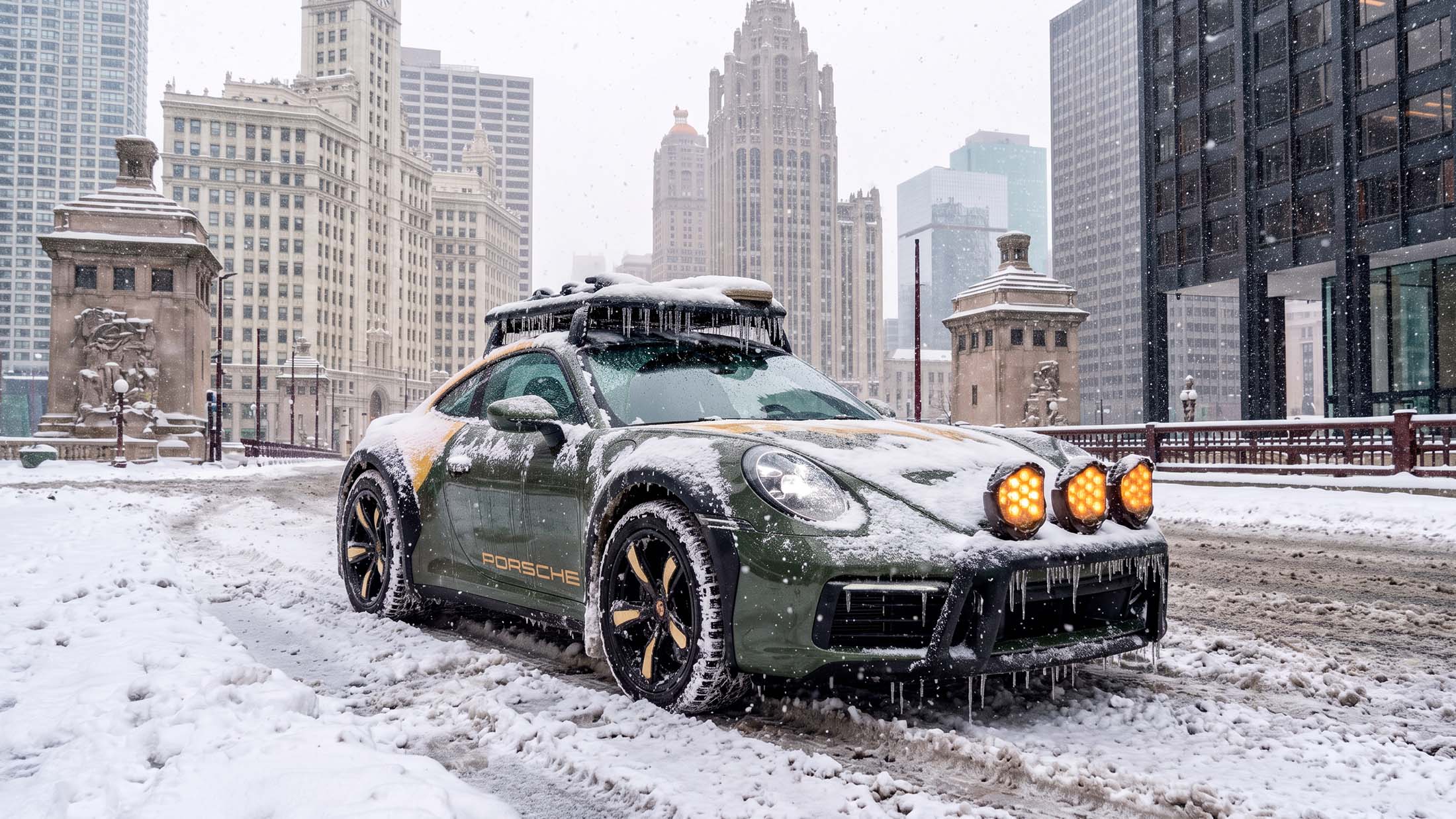
Tangent Design Group spends most of its billable hours designing things that have nothing to do with cars — injection-molded housings, retail displays, product concepts for clients who couldn’t care less about horsepower. So when the Chicago studio decided to build its own Porsche 911, nobody was paying it to do so. There’s no client, no invoice, and as of right now, no price tag. The Urban Safari 911 exists because a group of industrial designers wanted to see if they could out-engineer their own day jobs.
The idea started in 2019, right after Tangent wrapped up a 911-based project for an actual client. Two years later, the shop took delivery of a 2021 911 Carrera 4 — the all-wheel-drive, 992-generation base model — finished in a Paint-to-Sample shade called Black Olive over a tan interior. It’s the kind of spec sheet a Porsche configurator obsessive dreams up at 2 a.m., and Tangent didn’t stop at paint. The car left the factory with a rear windshield wiper, a small detail that matters a lot once you’re actually planning to drive a 911 through Midwest slush instead of just posing in it.
Porsche has shown before that it’s willing to greenlight a single, strange 911 when the mood strikes — the automaker famously built and homologated just one 911 Flachbau RS a few years back. Tangent took a similar one-of-one approach, treating its Carrera 4 less like a tuner project and more like an industrial design brief. Before drawing a single bracket, the team 3D-scanned the bumpers, rocker panels, fenders and engine cover to build a millimeter-accurate CAD model, then used an in-house, large-format 3D printer to produce full-scale prototypes of the bull bar and fender flares before committing to final parts.
That prototyping approach isn’t unique to safari builds — it’s the same rapid-iteration logic behind Czinger’s 3D-printed calipers and uprights, just applied to fender flares instead of structural hypercar components. Print it, test the fit, adjust the file, print again — no tooling costs, no six-week wait on a supplier.
The lift kit is the part worth paying attention to. Raising a modern 911’s ride height usually means fighting the car’s own electronics: adaptive dampers and ride-height sensors are calibrated tightly enough that altering the geometry can throw fault codes or disable driver-assist functions. Tangent describes its 3-inch lift kit as a first-of-its-kind design that leaves the Carrera 4’s factory suspension electronics completely untouched. For scale, Porsche’s own factory-built 911 Dakar — its answer to the 953 that won the 1984 Paris-Dakar Rally — raises ride height 50 millimeters over a standard Carrera and adds another 30 mm with an optional lift system, for roughly 3.1 inches of total travel. Tangent, without Porsche’s R&D budget, landed in the same neighborhood using its own engineering. What a modified 911 is worth afterward is its own market, and Modern Car Collector has watched the high end of it closely, from Theon Design’s $1 million restomod to Kalmar’s $2.15 million 9X9.
The rest of the visual identity comes from a set of bespoke forged wheels co-developed with Los Angeles-based Brixton Forged, wrapped in chunky off-road tires, plus a full ducktail spoiler and a yellow graphics package Tangent designed in-house — styled after Porsche’s rally-era liveries rather than the current crop of safari conversions. Wealthy owners paying to reshape a 911 or a Cayenne into something Porsche never engineered isn’t new; Mark Zuckerberg had a Cayenne turned into a minivan and nobody blinked. Tangent’s version at least has motorsport history to point to.
Underneath the bodywork, Tangent left the mechanical hardware alone. The Carrera 4’s 3.0-liter twin-turbocharged flat-six still makes 379 horsepower and 331 lb-ft of torque, sent through an 8-speed PDK dual-clutch transmission to all four wheels — good for a factory-rated 4.0-second run to 60 mph and a 180-mph top speed. That’s worth noting because a lot of safari-style builds trade away on-road composure for ground clearance. This one keeps the guts of a car serious enough that Formula 1 drivers daily-drive the current 911 GT3 RS on public roads. There’s still a proper sports car under the fender flares.
Tangent has no plans to sell the Urban Safari 911 itself. It’s a one-of-one parked outside the studio’s Chicago Avenue headquarters, and the firm says it’s fielding inquiries from people who want a kit version of their own. Anyone tempted should factor in more than the parts invoice — a lift kit, wide-body panels and forged wheels are one thing, but insurers and DMVs don’t always love heavily modified sports cars, and a factory warranty doesn’t survive a chassis-altering suspension swap. Independent builders have proven that kind of ambition doesn’t require a design studio’s budget, either — a 21-year-old in Ontario turned a Dodge Charger into a truck-faced ‘TRX’ with nothing but talent and eight months of spare time. Tangent just happened to bring a 3D printer and two decades of industrial design experience to the same impulse.
Lead image: Tangent Design Group
About the Author