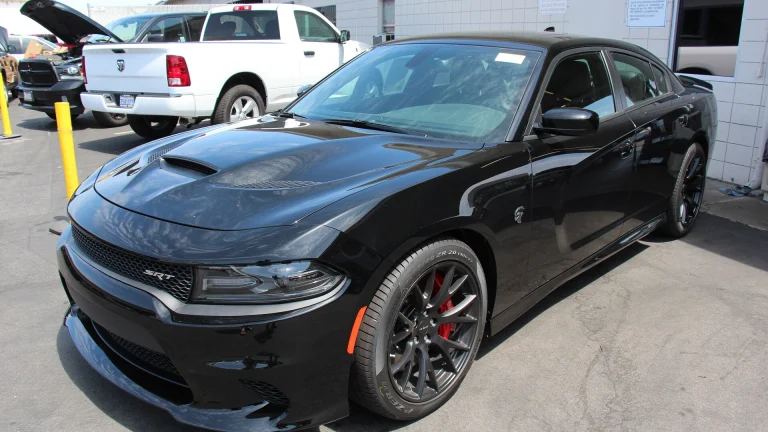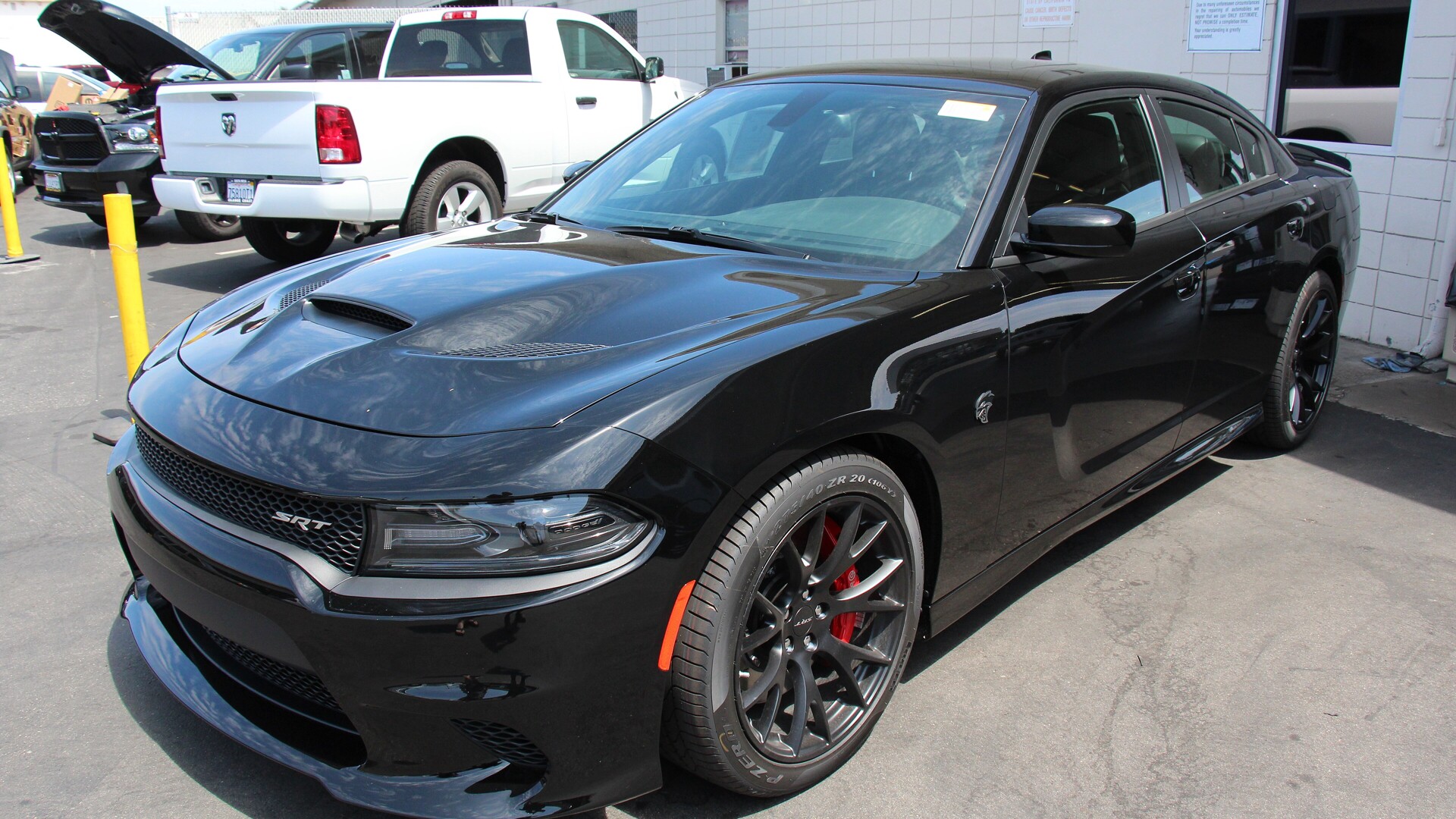
A Dodge Charger SRT Hellcat. Photo: Sicnag via Wikimedia Commons (CC BY 2.0)
Stephon Foster listed his lime green 2023 Dodge Charger Hellcat on Turo to make money. The Gwinnett County, Georgia, host says it came back with a wheel broken off, a bent suspension and more than $27,000 in damage, and Turo has covered less than $5,000. Add him to the list of Turo hosts fighting the platform over who pays for a damaged car.
Foster told WSB-TV Channel 2 in Atlanta that he rented the car out several months ago and later found it abandoned in a parking lot in southwest Atlanta. He said the dealership’s service department estimated the damage at more than $27,000, and that Turo and its insurance are covering less than $5,000 of it. The photos the shop sent him, he said, show the wheel broken off the car, the suspension bent and the lower control arms broken. The Hellcat has been sitting at a repair shop for months while he keeps making payments on what he and the station describe as a $100,000 car.
“They tell me, ‘You know what? This is final. It’s outside of our parameters,’” Foster told the station.
Turo’s statement to Channel 2 describes a claim that is still open. “In April, we reimbursed him for the damages that were approved for this trip, and we’re currently reviewing his additional claims based on our policies and the documentation provided,” the company said, adding that it will continue to work with Foster directly. The station’s report does not identify the renter, say whether a police report was filed, or name the Turo plan that covered the trip.
Turo’s deductibles can’t explain a $22,000 shortfall
I read the earnings plan terms Turo publishes for U.S. hosts, which govern trips booked on the plans it has offered since Jan. 7, 2026. Hosts choose one of three. The More peace of mind plan pays the host 70% of the trip price and makes the host responsible for the first $250 of physical damage per claim. The Balanced plan pays 80% with a $1,500 damage responsibility, and the More earnings plan pays 90% with $2,750. Above that amount, Turo says it reimburses eligible damage up to the lesser of the car’s actual cash value or $200,000. Earlier trips fall under an older set of plans, and Channel 2 did not report the date of Foster’s rental.
On the steepest current plan, the host’s share of a damage claim is $2,750. If Turo had approved the full $27,000-plus estimate, Foster would have been owed at least $24,250. He says he is getting less than $5,000, which leaves more than $22,000 that Turo has not approved. That money turns on what the company counts as eligible damage, and its terms leave that call to Turo. The document states that “Physical damage reimbursement isn’t insurance” and that “Turo retains sole discretion to pay repair costs or ACV,” meaning actual cash value.
The parts Foster lists sit on a line those terms draw. Turo reimburses damage from a collision or comprehensive event during a trip, but it excludes mechanical failure, which it defines to include the breakdown of a car’s suspension, engine, transmission or electrical system and any damage from wear and tear, defects or poor upkeep. The same definition says damage caused by guest negligence, deliberate acts or intentional misuse is not mechanical failure. A wheel torn off and lower control arms snapped can be read as the result of a hard impact or as a suspension that gave out, and the documents Turo used to sort Foster’s claim are not public. Turo also treats dings, dents, cracks and scratches of 3 inches or less, including on rims and wheels, as exterior wear and tear, which no plan covers.
The size of the bill can change under Turo’s rules, too. Foster’s figure came from a dealership service department. Turo pays labor at prevailing local rates set through estimating tools, and the terms say that if a host’s chosen shop charges more, “the difference in cost is the host responsibility.” Whether that rule cut into Foster’s claim has not been reported, but it is one place where a dealer estimate and a Turo check can split apart.
Two more costs never enter a claim. Turo’s U.S. plans do not include loss of hosting income, so the months the Hellcat has spent at the shop instead of on rentals are not reimbursed, and Turo says it does not pay for any drop in a car’s value after a repair. “Now I’m sitting here with a $100,000 car that’s not making any revenue,” Foster said.
One rule that could have hurt an abandoned-car claim has an exception that fits his situation. Hosts normally must take and upload post-trip photos within 24 hours after a trip ends, but Turo’s terms say circumstances such as a car being impounded or out of the host’s possession “will not serve as a disqualification.”
Georgia’s car-sharing law protects third parties, and a fix died in committee

Georgia regulates Turo under the Georgia Peer-to-Peer Car-Sharing Program Act, signed in 2020 and in effect since Jan. 1, 2021. Its central insurance section, O.C.G.A. § 40-1-221, requires a platform to assume the owner’s liability during a rental for bodily injury or property damage to third parties, along with uninsured and underinsured motorist and personal injury protection losses. It does not mention damage to the owner’s own car. Another section, § 40-1-228, requires the platform to tell owners that their own auto liability policy may specifically exclude a car shared through the service.
The state guarantees coverage for a stranger hit by a renter, and it guarantees the host will be warned that his own insurer may not help. What pays for the host’s car is left to the platform’s contract.
Four Georgia House members tried to change that this year. House Bill 1463, sponsored by Reps. Bruce Williamson, Brian Prince, Chas Cannon and Alan Powell, would have added “or damage to the owner’s vehicle” to the list of losses a platform must assume under § 40-1-221. The bill was assigned to the House Regulated Industries Committee, and its last recorded action is a second reading on March 3, 2026. The General Assembly adjourned on April 2, closing the second year of its two-year term, so the bill died there. A lawmaker would have to file it again when the legislature returns in January.
Foster’s case is not the first Turo rental that ended with a wrecked car and a host left sorting out the bill. Backfire News has covered others, including a Ferrari FF listed on the service.
What decides how much Foster gets back
Turo says it is still reviewing Foster’s additional claims, so the amount may change. Under the company’s own terms, the answer turns on two questions: whether Turo classifies each broken part as collision damage or mechanical failure, and whether it prices the repair at the dealer’s rate or at the local prevailing rate. A host in the same spot can ask Turo for the approved and denied items in writing, and should check his own auto policy for a car-sharing exclusion before the next rental, since Georgia law requires platforms to warn about that.
Foster still lists cars on Turo, with seven left from the 11 he started with. “I bought those cars as investments to make a living, and right now, it’s just chipping away,” he said. His advice to anyone thinking of joining: “Don’t think you’re just gonna put your car in there and you’re gonna make a lot of money. It’s not that type of party.”
Should Georgia make platforms like Turo cover the host’s own car, or is a snapped control arm part of the deal when you hand a Hellcat to strangers?
About the Author