Photo: Mecum Auctions
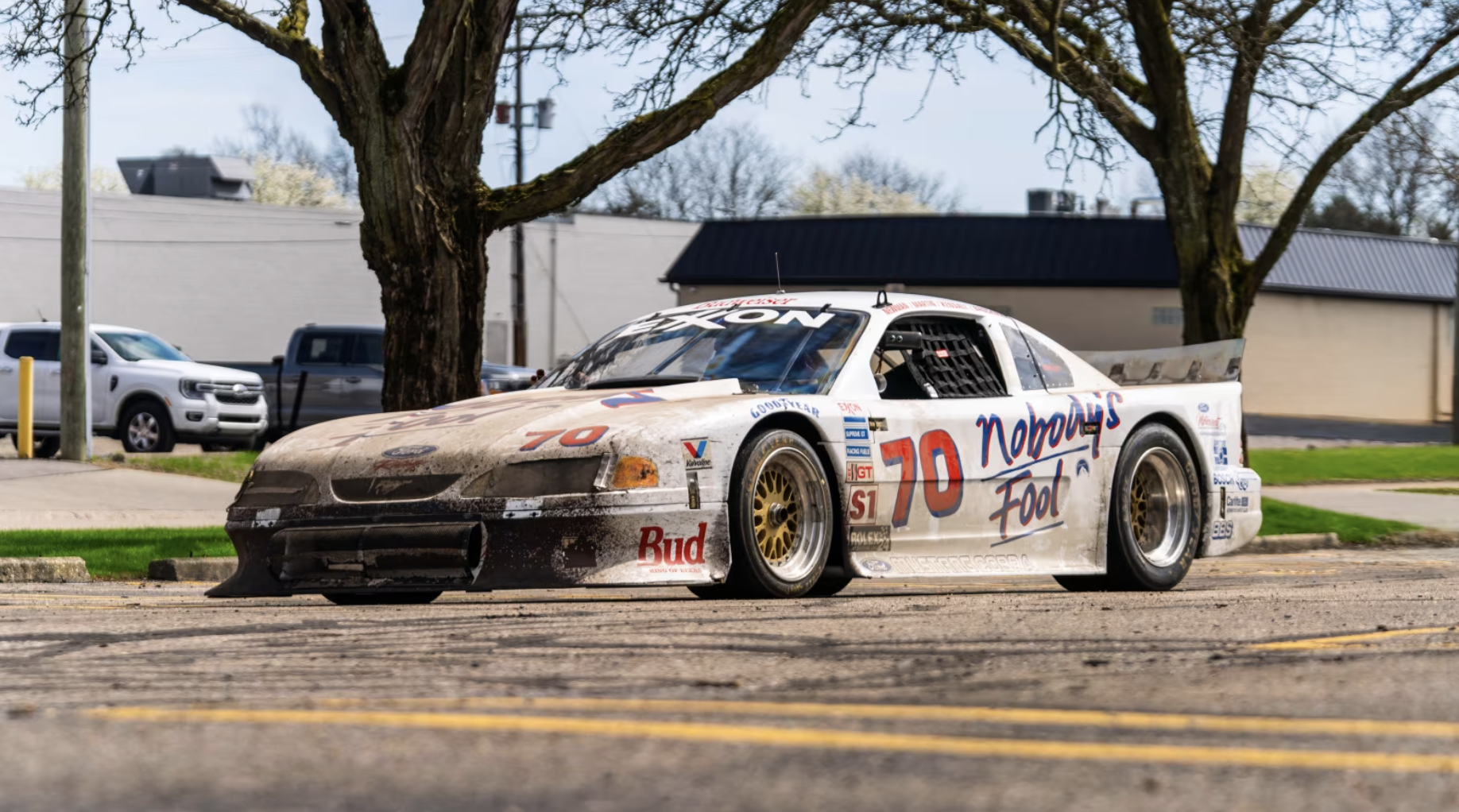
Paul Newman had just picked up a Best Actor Oscar nomination for Nobody’s Fool when, at 70 years old, he climbed into a Ford Mustang Cobra built around a steel tube-frame chassis that had almost nothing in common with anything sold in a Ford showroom. That car, Roush Racing chassis No. 23, went on to win the GTS-1 class and finish third overall at the 1995 Rolex 24 at Daytona. Three decades later, it’s crossing the block as one of the headline lots in the Roush Automotive Collection at Mecum’s Nashville sale on September 26.
We flagged this consignment when Mecum first announced it over the summer, but the sale date is now locked in, and the car has since been reunited with its actual race-worn bodywork.
Newman shared driving duties with Mark Martin, Tommy Kendall, and Michael Brockman, and his spot in that class-winning lineup made him the oldest driver to win a major sanctioned race as part of a team at that level. It wasn’t a novelty seat. Newman had been racing seriously since the late 1970s, after prepping for the film Winning turned into an actual second career, one that included a runner-up finish at Le Mans in 1979. By the time he strapped into this Mustang, he’d been doing this for two decades.
The car earned its Nobody’s Fool nickname and No. 70 livery honestly. Paramount Pictures had marketing money left over from Newman’s newly released film of the same name, and rather than let that budget evaporate into billboards, it went straight into sponsoring a Daytona effort, with the No. 70 chosen to mark Newman’s 70th birthday. It’s the kind of sponsorship arrangement that doesn’t happen anymore, now that studio marketing spends are tracked to the dollar and actors are insured within an inch of their lives before a stunt double even shows up.
Newman wasn’t the last movie star to fall for a race car, either. Decades later, Hollywood is still leaning on real NASCAR names to get racing details right on screen, but Newman skipped the consulting credit and did the actual driving himself. Modern Car Collector covered the same car on its way to the block in Paul Newman’s Daytona-winning Mustang set for Mecum, and Backfire Racing looked at what happens when a manufacturer buys its own history back in Honda selling back its greatest race cars.
A NASCAR Chassis Wearing a Mustang Suit

Strip away the bodywork and Nobody’s Fool looks a lot like the NASCAR machines Roush was building for oval tracks at the same time: a steel tube-frame chassis with a full cage, running gear mounted for quick service, and lightweight composite body panels that bolt on rather than weld in. That’s how IMSA’s GTS-1 class worked in the mid-1990s. Cars like this Mustang, along with the Corvettes and Camaros it raced against, wore silhouettes that resembled showroom coupes while hiding race-only structures underneath. It’s also why Roush’s crew could pull the beat-up panels off after Daytona and bolt on a fresh set for museum duty without touching the chassis at all.
The numbers back up how far removed this car was from anything you could special-order at a Ford dealer. Roush’s shop built the 6.0-liter V8 to a reported 750 horsepower, more than double what Ford’s own 1995 SVT Cobra R could manage from its 5.8-liter V8, and that homologation special was already the wildest Mustang money could buy that year. Everything else followed the same logic: Alcon four-wheel disc brakes, two-piece 17-inch BBS wheels, and a five-speed manual built to survive 24 hours of abuse rather than a Saturday cruise.
Ten Wins, Then a Handoff to NASCAR
This particular win closed out a run of ten consecutive class victories at the Rolex 24 for Roush Racing, a streak that had been building since well before Jack Roush became known primarily as a NASCAR team owner. Roush’s road racing program grew out of Trans-Am and IMSA GT efforts dating back to the 1970s and ’80s, and by 1995 it was running in parallel with Roush’s NASCAR Winston Cup operation, where co-driver Mark Martin was already a full-time driver. Nobody’s Fool sits right at that overlap, built by the road racing side of a shop that was quietly becoming a NASCAR powerhouse.
What Buying It Actually Means
A few practical notes for anyone actually considering a bid. The car is being sold on a Bill of Sale rather than a state title, which is standard for genuine competition cars that were never built for road registration. Expect to store, transport, and insure it as a track car rather than something you can plate for a weekend cruise. Specialty agreed-value policies through collector or motorsport-focused insurers are the normal route for something like this, not a standard auto policy. Mecum also hasn’t published a pre-auction estimate, which tends to happen with lots like this. When the story and provenance are this specific, auction houses often let bidders set the number rather than anchoring expectations with a guess.
What makes Nobody’s Fool worth watching isn’t just the Newman connection. Plenty of celebrity-driven race cars trade on a famous name alone, but this one backs it up with a documented, unbroken chain of custody: built by Roush, raced by Roush, stored at Roush’s Livonia, Michigan headquarters for three decades, and now sold directly out of Roush’s own collection with both sets of body panels included. That kind of paper trail is increasingly rare in a market full of recreations and as-raced claims that don’t hold up to scrutiny. For a sense of how far the Mustang badge has traveled since 1995, Ford’s current performance Mustang lineup is the modern, showroom-legal descendant of that same obsession, just without the Daytona dirt.
Lead image: Mecum Auctions
About the Author