Photo: VanDerBrink Auctions
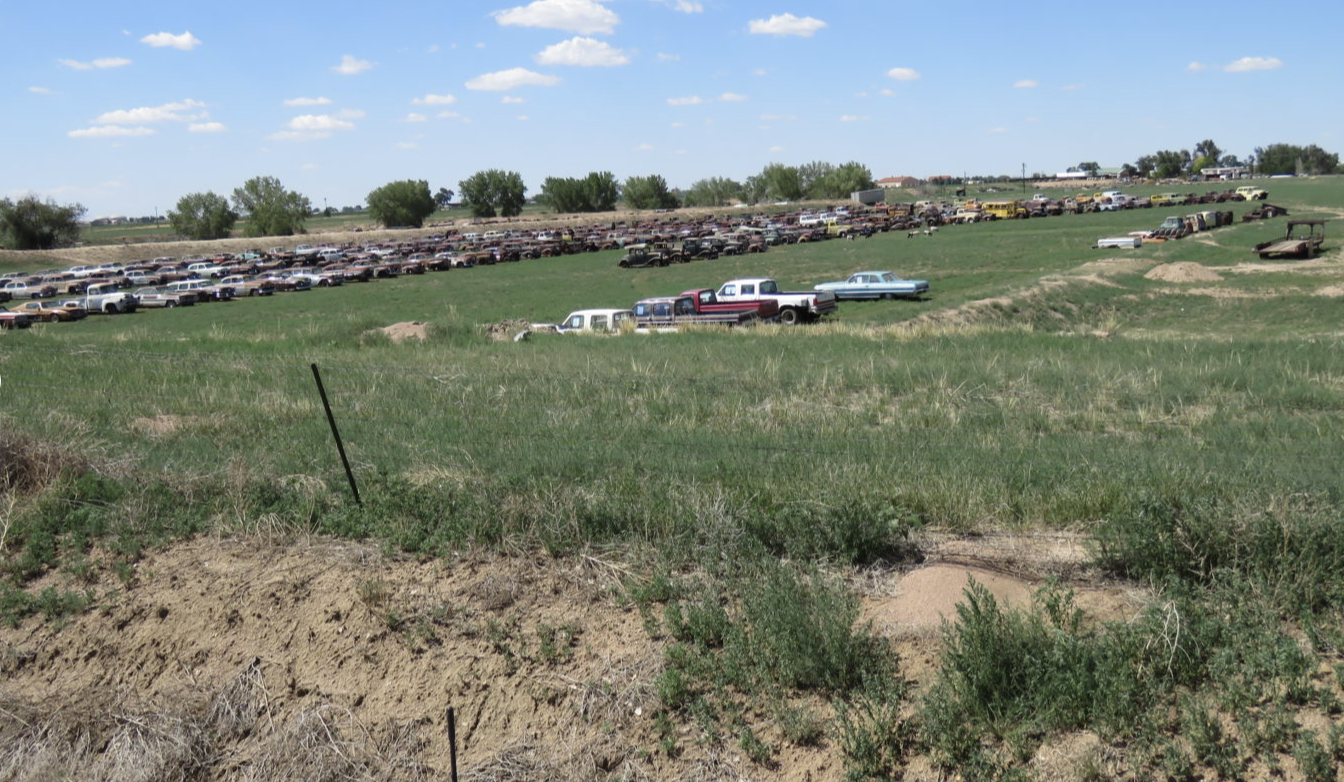
Three generations of car collecting are about to change hands in a field outside Eaton, Colorado. On September 19, VanDerBrink Auctions will work through close to 300 vehicles pulled from the estate of the late Doug Born, along with the vintage gas station signage and spare sheet metal his family collected right alongside them.
A Field Full of Everything From a Model T to a Power Stroke
The catalog reads like a century of American motoring compressed into one pasture. There’s a 1912 Ford Model T Touring Car at one end and a 1995 Ford F-350 with the 7.3-liter Power Stroke diesel at the other, with a small city of Model A Fords, hot rod project shells, and complete-but-tired sedans filling in the decades between them. Highlights include a 1932 Ford Roadster, a 1968 Ford Galaxie 500 convertible, a 1974 Plymouth Ramcharger, a 1961 Oldsmobile 98 hardtop, and a run of International KS-series trucks alongside Chevrolet, GMC, DeSoto, Willys, and Henry J entries. The lineup isn’t only cars, either. Collectors working the sheet metal will also be chasing porcelain advertising signs for Phillips 66, Texaco, and Sinclair, plus an upright visible gas pump — the kind of roadside Americana that now sells for serious money on its own.
Three Generations, One 25-Year Relationship With the Auctioneer
VanDerBrink Auctions has known this family for a quarter century, going back to when Doug Born, his father, and his kids were regulars bidding on early Fords at the company’s sales around the country. Doug Born died before the collection could be fully sorted through, and his children are now selling a portion of what three generations quietly built up. “…too many cars to have, and there’s too many nice ones to part out,” DJ Born, identified in a KDVR interview as being with Rocky Mountain Relics, said of the decision. The family’s stated goal isn’t liquidation for its own sake — it’s finding people who’ll actually use the cars and keep their histories moving instead of letting them sit in a field indefinitely.
That 50-Cent Bid Is Bait, Not a Bargain
Every lot opens at 50 cents with no reserve, which is the detail that turned this into a local news story. It’s also the least useful number for anyone actually planning to bid. A 50-cent opener is a standard auctioneer’s trick for getting a crowd talking, not a preview of what anything will sell for — no reserve simply means the seller can’t quietly pull a lot if bidding disappoints. Backfire News recently watched a genuinely clean, low-mile Buick Gran Sport barn find draw only two bids in a no-reserve sale of its own, proof that soft opening numbers can cut either way once real money is on the table. Add in VanDerBrink’s buyer’s premium — 8% for onsite bidders, 10% for anyone bidding online — plus a payment structure that requires cash, a check with proof of funds, or a credit card with a surcharge, and a wire transfer for any online invoice over $5,000, and none of that shows up in the 50-cent headline. All of it shows up on the invoice.
What Decades in a Colorado Field Actually Do to a Car
VanDerBrink’s terms state plainly that everything sells as-is and all sales are final, no exceptions, which is standard for an estate collection this size but still worth taking seriously before raising a paddle. Vehicles that have sat outdoors on the high plains for years develop problems that don’t always show up in a photo: brake and fuel lines rust from the inside out, tires that still look round on a parked car are frequently too dry-rotted to trust at speed, and rodents love nothing more than a wiring harness that hasn’t moved in a decade. A Ferrari that spent 14 years wrapped in a tarp inside a storage unit made a similar point earlier this year — the gap between how a car looks in a listing photo and what it actually needs mechanically is where the real transaction happens. Anyone serious about a specific lot should plan to attend the September 18th preview, open from 10 a.m. to 5 p.m. the day before the sale, rather than relying on catalog photos and the rural cell service VanDerBrink itself warns can be unreliable on auction day. Sales like this are Modern Car Collector’s home turf: it has covered barn-find cars surfacing after years in long-term storage and a no-reserve estate sale that said more about the builder than the cars.
The Line Item Nobody Budgets For
Winning a bid is only the start of the paperwork. Buyers are responsible for removing whatever they win within 10 days, and VanDerBrink makes clear that hauling costs and logistics are entirely on the purchaser. For a running driver, that might mean a trailer and a free Saturday. For a Model A shell that’s been a parts donor for 40 years, it can mean flatbedding a car that won’t roll off a rural property with no paved access — an expense that regularly doubles the real cost of a ‘cheap’ project car, and one that’s easy to forget in the excitement of a 50-cent opening bid.
Part of a Bigger Pattern in the Hobby
Large single-family estate sales like this one are becoming a fixture of the collector car world as the generation that built these collections in the 1960s, 70s, and 80s ages out of the hobby. It’s a very different kind of auction news than the seven-figure hypercar lots heading to Mecum’s brand-new Nashville sale, but it’s arguably a more accurate picture of where most of the hobby’s inventory actually lives — not in climate-controlled collections, but in fields, sheds, and machine stands behind a family farm, waiting for someone with a truck, a trailer, and realistic expectations. See it
.
Lead image: VanDerBrink Auctions
About the Author