Photo: Barrett-Jackson
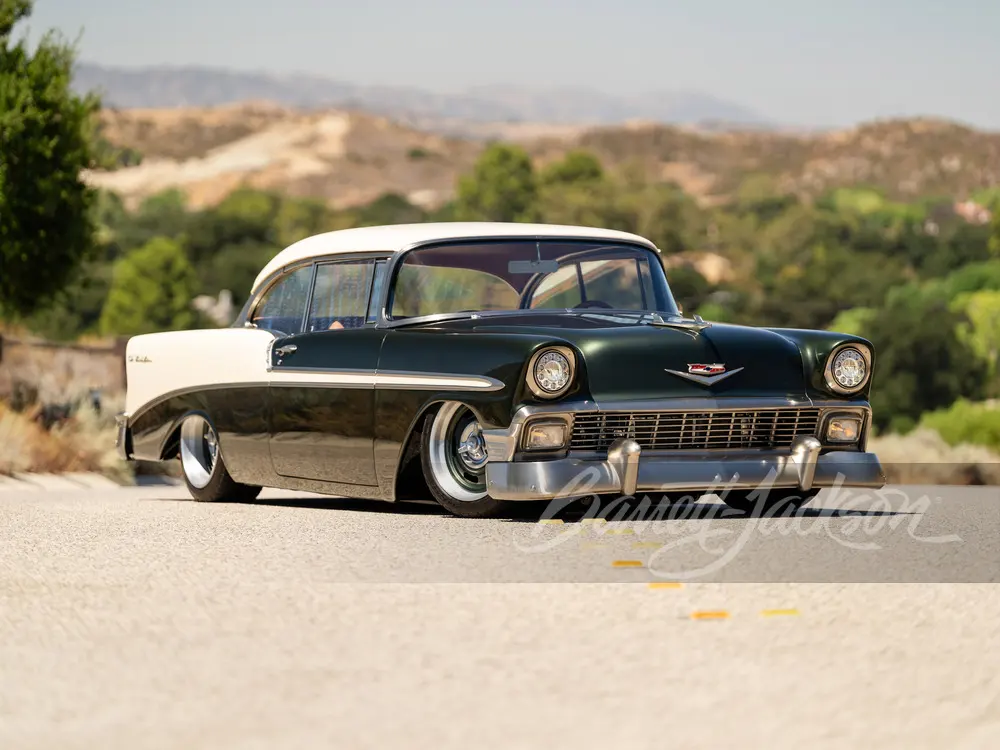
Lot 744 at Barrett-Jackson’s Las Vegas auction is a 1956 Chevrolet Bel Air Custom Coupe, and if you’re picturing a numbers-matching cruiser with a 265 small-block wheezing along at a stoplight, forget it. Someone in this build’s history looked at a seventy-year-old body and decided the only thing worth keeping was the sheet metal.
Under that green-and-cream two-tone skin sits a supercharged Chevrolet Performance 6.2-liter LSA V8, rated at 525 horsepower straight from the factory crate box. The LSA is the same forced-induction small-block GM once dropped into the Cadillac CTS-V and Camaro ZL1, and it has become a favorite among serious builders for a simple reason: the supercharger is already bolted on and calibrated from the factory, so there is no guesswork tuning an aftermarket blower kit onto a naturally aspirated LS. Power runs through a Chevrolet Performance 6L80-E SuperMatic six-speed automatic, another crate-era part chosen because it was engineered from the outset to handle exactly this kind of torque.
None of that power would matter if the chassis underneath still used a mid-1950s perimeter frame with leaf springs out back. This car does not. It rides on a Roadster Shop REVO Stage III chassis with fully independent front and rear suspension, plus an AccuAir E-Level system that lets the owner adjust ride height on the fly using air bags and a compressor instead of coil springs. That combination is why modern restomods can out-corner and out-brake the cars they are based on by an embarrassing margin, since the body is doing sentimental duty while everything holding it up and moving it is contemporary engineering.
Stopping duty falls to Wilwood four-wheel disc brakes with a hydro-boost booster rather than a vacuum booster. That detail matters more than it sounds: a supercharged engine under load does not generate the steady vacuum a traditional brake booster relies on, so hydro-boost setups tap pressure from the power steering pump instead. It is a small engineering choice, but it is the kind of thing that separates a builder who understands why a swap works from one who is just bolting parts together.
The bodywork tells its own story. Per the auction listing, the coupe was pulled off its chassis for metal finishing and paint, and more than $120,000 went into the body and paint alone, a figure that puts this build’s cosmetics ahead of what most buyers spend on an entire finished car. The result is a two-tone paint job with brushed-metal-finish trim, bumpers and grille components, riding on custom-painted Forgeline Rallye wheels measuring 18×8 up front and 18×10 in back.
Inside, the theme continues: a custom Saddle-colored cabin with bucket seats, a machined aluminum switch panel running the power windows and interior lighting, a digital gauge cluster tucked behind an Ididit steering column, and an Alpine touchscreen with Apple CarPlay and Android Auto. It is a period-correct silhouette wrapped around a genuinely modern driving experience, which is exactly the pitch every high-dollar tri-five restomod is built to make.
There is a practical wrinkle worth flagging before anyone gets bidding-fever excited: Barrett-Jackson’s listing carries a VIN notice warning that, depending on the buyer’s state of registration, this car may need a VIN inspection or additional paperwork before it can be titled and plated. That is common on heavily modified vehicles built on aftermarket chassis, since the factory VIN was never assigned to the frame the car is now riding on. It is not a dealbreaker, but it is homework, and a call to your state’s DMV or highway patrol before you wire any money is a lot cheaper than finding out afterward that your new toy cannot get plates. Modern Car Collector has been tracking both halves of that market, from a refreshed 1956 Bel Air Nomad crossing the block at Henderson to Barrett-Jackson’s $38.1 million Columbus debut.
This lot is also crossing the block with no reserve, meaning whatever the gavel says when bidding stops is what it sells for, no minimum and no games. That is a different calculus for buyers than a reserve sale, and it tends to produce more unpredictable final numbers since the seller has already committed to letting the market decide. Given that the drivetrain has racked up roughly 500 miles since the build was finished, this is essentially a brand-new machine wearing a seventy-year-old suit, which is its own kind of value proposition compared to buying a numbers-matching original and doing the work yourself.
Tri-five Bel Airs, Camaros and even performance trucks have all been getting this treatment lately, and Barrett-Jackson’s Las Vegas docket is a good reminder of how mainstream the restomod-and-crate-engine formula has become for financing a car nobody would call practical. That same appetite for spending real money on cars that did not leave the factory this way is the current that turned Monterey Car Week 2026 into a nine-figure weekend. If you want to see how the no-reserve gamble plays out in real dollars, we watched a similarly transformed Ford F-150 restomod cross a Barrett-Jackson stage, and Linda Perry’s 1967 Camaro SS sae is a good look at what a finished, sold example brings once the bidding actually stops.
Lead image: Barrett-Jackson
About the Author