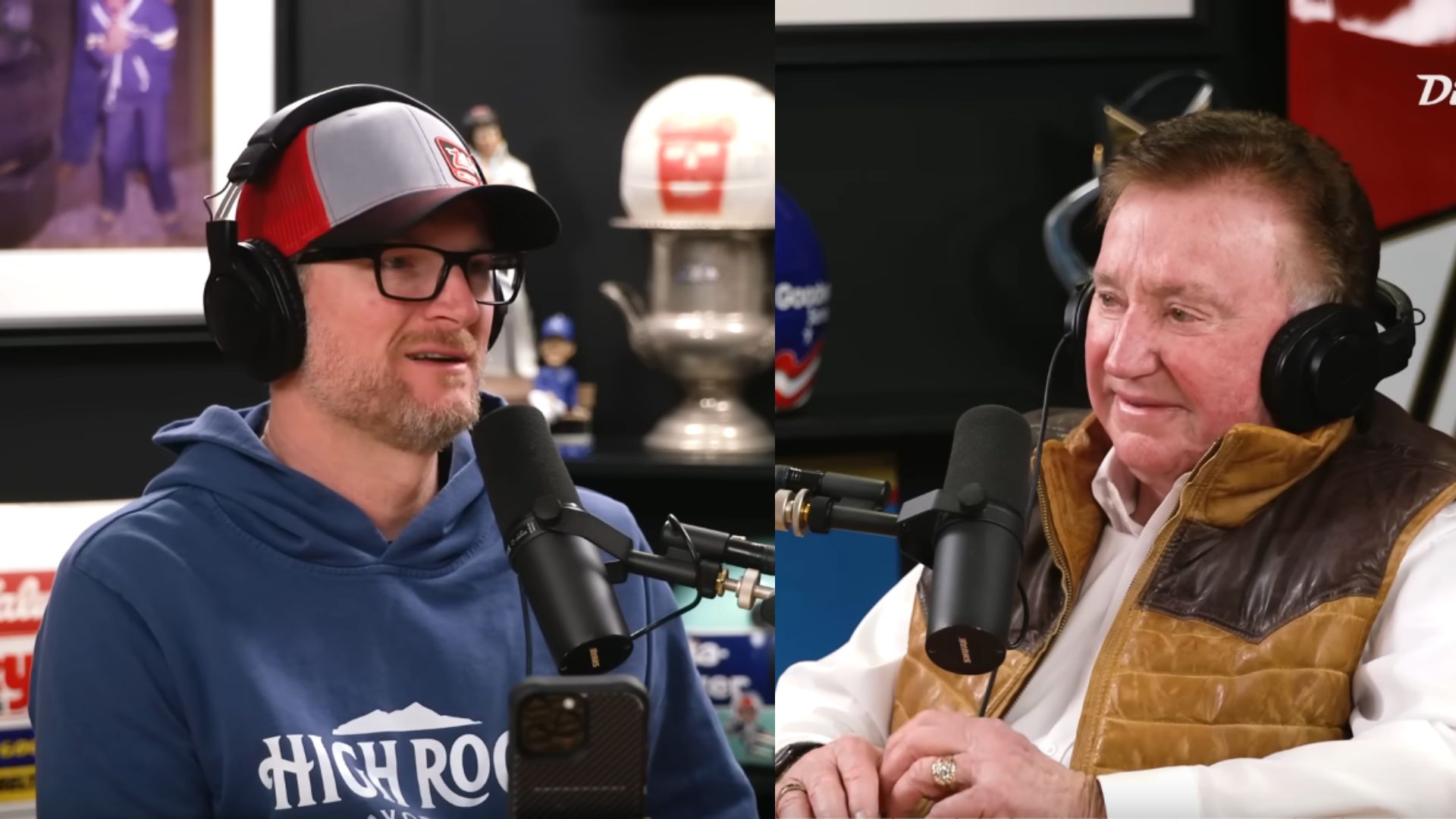
Image via Dale Earnhardt Jr.’s Dirty Mo Media/YouTube
Tom Cruise’s stunt at Daytona made for the moment built for cameras: an actor hopping over a row of potted plants to surprise a room full of drivers with news about “Days of Thunder 2.” The version of this story that actually explains how the movie is getting built happened somewhere much quieter, and it started almost a year earlier, on Dale Earnhardt Jr.’s back porch in North Carolina.
Earnhardt laid out the timeline himself on his own podcast, Dale Jr. Download, and the whole thing began with NASCAR rearranging his weekend. He had planned to leave Daytona once the NASCAR O’Reilly Auto Parts Series race wrapped up, but NASCAR asked him to stick around into Cup race morning because “Tom wants to meet you.”
That meeting turned into its own small production. Cruise flew himself into Daytona and taxied the plane straight up to the NASCAR hangar, where Earnhardt and a small group were waiting around 9:30 that Saturday morning. The two talked for roughly 20 minutes, Earnhardt met Cruise’s family and the people traveling with him, and then everyone went back to preparing for the Coke Zero Sugar 400.
The Real Story Started Almost a Year Earlier
The hangar meeting made for a great photo-op moment between NASCAR and Hollywood, but it wasn’t the beginning of Earnhardt’s involvement, just the most visible part of it. He said he first crossed paths with Will Staples, the screenwriter Paramount brought on to write the sequel, around NASCAR’s 2025 season finale at Phoenix. The two reconnected later at Earnhardt’s home in North Carolina, and that conversation went well past nostalgia about the original film.
Earnhardt’s advice to Staples has apparently stayed consistent since: don’t try to remake 1990, because that version of NASCAR doesn’t exist anymore. Cole Trickle’s era of carbureted, ground-pounding stock cars and a sport still finding its national television audience gave way decades ago to a spec Next Gen chassis, a blended electronic braking system and a sponsorship model built around social media impressions instead of just quarter panel decals. Earnhardt has pushed the writer toward details longtime fans of the original would recognize, small callbacks rather than a scene-for-scene remake.
Why a Retired Driver Ended Up With This Job
None of this makes Earnhardt a credited writer. Nothing publicly disclosed suggests he has a formal consulting deal, a paycheck, or contractual authority over a single line of the script. Studios lean on unofficial subject-matter voices like this constantly on projects built around a real industry, since it costs a production nothing but a phone call and buys a layer of credibility no writers’ room can fake by itself. What makes Earnhardt a particularly useful phone call is that he’s one of the few people alive who has lived in both versions of NASCAR this film needs to satisfy: old enough to have grown up around the culture the original captured, and current enough, through two decades of driving, a broadcasting career, and now his own media company, Dirty Mo Media, to know exactly where a modern Cup Series garage would wince at getting it wrong.
What Authenticity Actually Costs a Production
Realism like this isn’t free. Backfire has already covered how seriously Cruise takes shooting real speed on real pavement instead of faking it with green screens, and that instinct carries a price tag most action movies never pay: cleared track time, dedicated safety and medical crews, and cars engineered to survive repeated takes with camera rigs a factory chassis was never designed to carry. Paramount is also planning to shoot the sequel for IMAX, which raises the stakes on every one of those camera mounts even further. The Next Gen car that Cruise’s production will eventually recreate or modernize around comes with its own crash-structure engineering that has already reshaped how teams plan for the 2027 season, a shift Alex Bowman’s own exit planning laid out in detail.
Don’t Bank on Every Easter Egg Making the Cut
Fans hoping Earnhardt’s fingerprints show up as specific scenes should temper their expectations. Scripts move through drafts, studio notes and reshoots long after an informal advisor’s suggestions get made over dinner, and there’s no guarantee a callback survives that process into a release print. What his involvement really signals is smaller and more durable than a single Easter egg: NASCAR’s inner circle now has a real seat at the table while this film gets built, at a moment when the sport is already counting on nostalgia to do commercial work modern marketing budgets struggle to match. Hollywood and stock car racing have been circling each other for decades. Paul Newman won at Daytona for real decades before Cruise ever strapped into a fictional stock car, and that overlap still shapes what collectors will pay for the right piece of racing history today.
Paramount has “Days of Thunder 2” dated for June 2, 2028, giving Staples, Cruise and, apparently, one very opinionated two-time Daytona 500 winner, close to two more years to get the details right before anyone in a theater gets to judge them.
About the Author