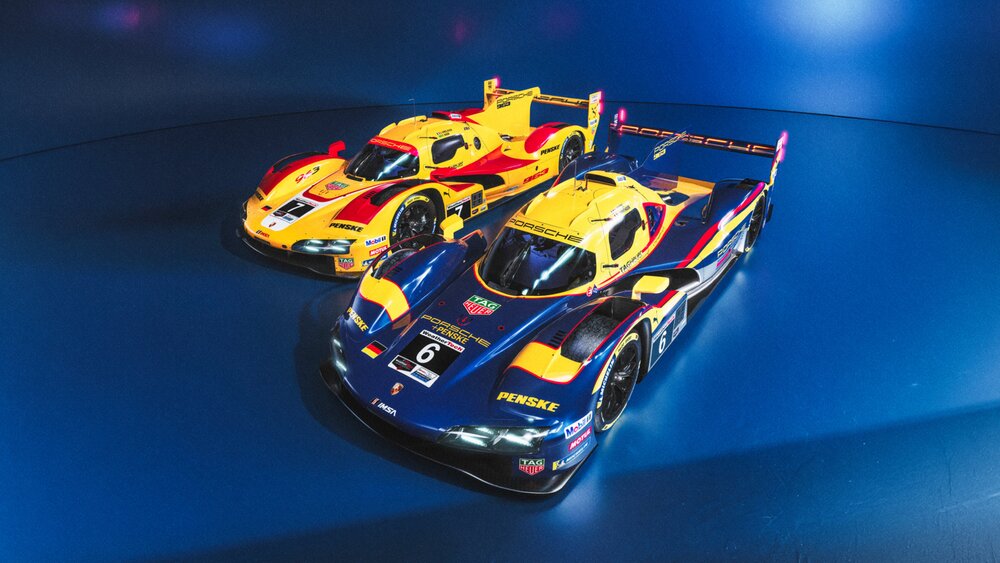
Porsche’s factory prototypes at Road America this weekend aren’t wearing the usual Porsche Penske Motorsport colors. Both Porsche 963 hybrid race cars are running special paint schemes for the eighth round of the IMSA WeatherTech SportsCar Championship season, and the two designs pull from very different eras of winning at this Wisconsin road course: 1973’s brute-force Can-Am racing and 2007’s giant-killing prototype upset.
The timing lines up with a pair of anniversaries. Porsche is marking 75 years of factory motorsport in 2026, and Team Penske is celebrating its 60th year of racing. Road America is actually the fourth stop this season where the factory 963s have worn a heritage design, after similar throwback liveries at Sebring, Long Beach, and Laguna Seca earlier in the year.
Car No. 6, shared by Kevin Estre and Laurens Vanthoor, is finished in the Sunoco blue-and-yellow scheme worn by the Porsche 917/30 during the 1973 Can-Am season. That car was built for a series that barely regulated turbocharging or aerodynamics, and it produced up to 1,200 PS, roughly 882 kW, nearly double what today’s 963 makes. Driver Mark Donohue used that power to win seven of the season’s nine races, reeling off the victories back to back. At Road America specifically, Donohue qualified at 1 minute 57.51 seconds on the track’s old 4.08-mile layout, becoming the first driver there to break the two-minute barrier, and did it more than three seconds clear of the next-quickest car. Estre, who hasn’t raced at Road America in a decade and never in a prototype, is wearing a yellow helmet design for the weekend as a nod to Donohue.
That power figure is worth sitting with for a second. Can-Am rules in the early 1970s left manufacturers free to build essentially unrestricted turbocharged prototypes, and Porsche did exactly that. The current 963 makes roughly 707 PS, about 520 kW, from a hybrid gasoline V8 built to LMDh regulations that cap output and lean on a spec hybrid system shared across every manufacturer in the class, with Balance of Performance adjustments layered on top. The gap between those two numbers explains a lot about why modern prototype racing looks the way it does: the current rulebook trades outright horsepower for tight competition and cost control, rather than seeing who can bolt on the biggest turbo.
The sister car, No. 7, driven by Julien Andlauer and Felipe Nasr, carries the yellow livery of the Porsche RS Spyder, the LMP2 prototype that raced under the Penske banner from late 2005 through 2008. At roughly 1,700 pounds, the RS Spyder built a reputation for punching above its class, and Road America is where it made its biggest statement. On August 11, 2007, Timo Bernhard and Romain Dumas drove it to outright victory over the nominally faster LMP1 prototypes in that weekend’s four-hour American Le Mans Series race, the car’s first overall win in the series after already piling up 14 class victories to that point. By the time the joint Porsche-Penske RS Spyder program wrapped up, it had collected three manufacturers’ championships and three drivers’ and teams’ titles apiece.
Porsche Motorsport vice president Thomas Laudenbach was at Road America for that 2007 win and still brings it up when asked about the track’s place in the partnership’s history. Roger Penske, whose team has fielded Porsche prototypes on and off for more than five decades, called the collaboration “one of the most successful and enduring relationships in racing.”
Retro liveries have become a fairly cheap, high-payoff move for manufacturers with deep motorsport archives, and Porsche leans on it harder than most. The brand’s Sonderwunsch personalization division builds one-off cars themed around everything from historic racing colors to a recent set of Toy Story-inspired 911s built for a charity sale, and vintage racing color schemes still move markets on their own. A Paint-to-Sample Carrera GT finished in Gulf Blue sold for a record price earlier this year largely because that shade carries decades of racing weight behind it. A factory prototype spending one race weekend in Sunoco blue or RS Spyder yellow accomplishes something similar: it reminds everyone paying attention that this is a company with history to spare, not one that just discovered its archives for a marketing meeting.
Road America also carries new significance as a race this year, separate from the paint jobs. The 2026 event runs six hours for the first time, folding it into the Michelin Endurance Cup alongside Daytona, Sebring, Watkins Glen, and the season-closing Petit Le Mans at Road Atlanta, the same Georgia circuit that has hosted a GTD Pro title fight and where Porsche has been trading production-car lap records with the Corvette ZR1. The extra race distance means an added driver stint, tighter tire-strategy windows, and more time for a full-course caution to turn a six-hour race into a three-hour sprint with a long, tense break in the middle.
The stakes are a little higher for Porsche Penske Motorsport this season, too. Porsche walked away from its factory Hypercar program in the World Endurance Championship for 2026, leaving the IMSA GTP effort as the manufacturer’s only remaining factory prototype program running under its own name. That makes Road America less of a nostalgia lap and more of a reminder that the North American side of the operation now carries the full weight of Porsche’s prototype ambitions.
Porsche’s footprint at Road America goes well beyond the two factory cars. JDC-Miller Motorsports enters a customer 963 in the same GTP class, effectively a home race given the team’s Minnesota base is the closest stop on the schedule to its shop. AO Racing brings a 911 GT3 R in GTD Pro from its suburban Chicago base, Manthey Racing splits entries across GTD Pro and GTD, and Wright Motorsports and RS1 fill out the GTD class, five 911 GT3 Rs on track in total. Add three 718 Cayman GT4 RS Clubsports in the Michelin Pilot Challenge and 22 Porsche 911s entered in Carrera Cup North America, and Road America turns into a genuine showcase of Porsche’s racing ladder, from customer club racers up to the factory-backed hybrids at the front.
None of this changes the actual math of the race. The 963s still have to survive six hours inside GTP’s tight Balance of Performance window to matter on Sunday. But there is something worth appreciating about a manufacturer willing to put its current factory hardware in a paint scheme that reminds everyone how much cruder, louder, and more dangerous this sport used to be. The 917/30 and the RS Spyder did not win because of clever hybrid deployment; one won by being nearly uncontrollable and the other by being disrespectfully light. Watching a 2026 hybrid prototype wear either livery is a good reminder of how differently the same manufacturer has solved the same problem, go faster than everyone else at the same track, across five decades.
About the Author