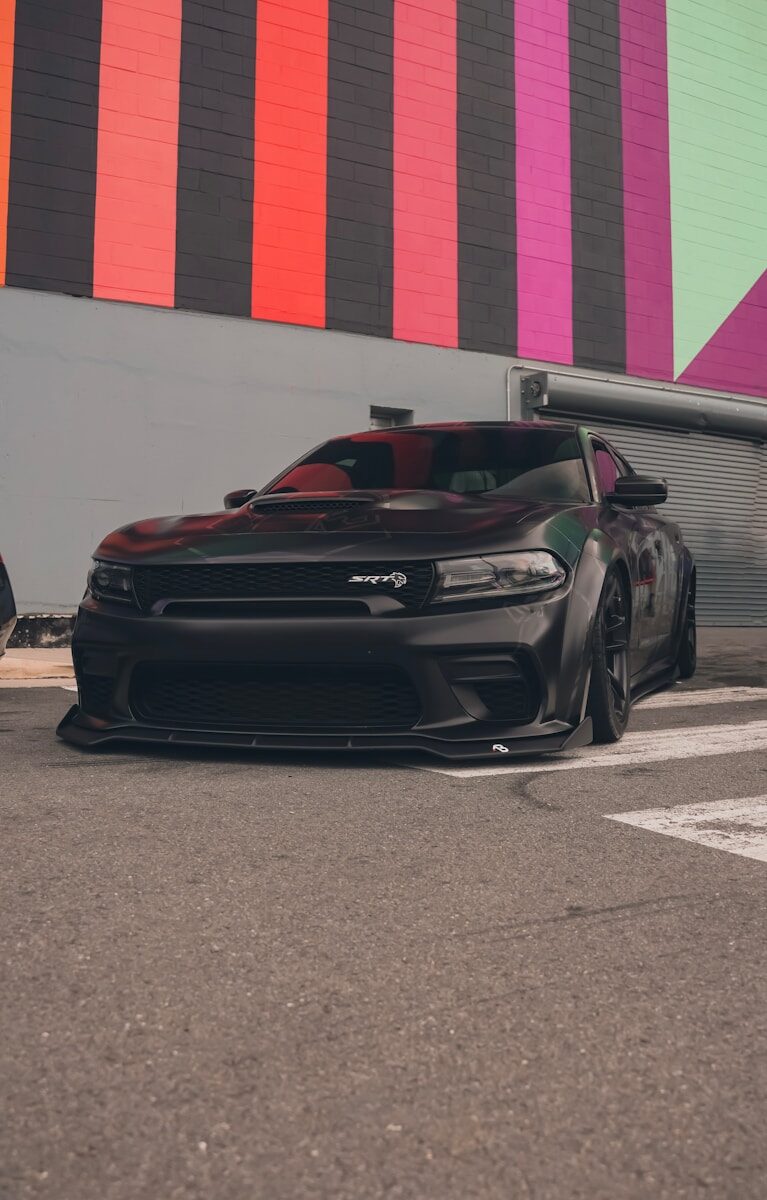
The police report a dealership manager filed describes surveillance video showing three to four people walking into the lot at 5:21 a.m. They went straight for a 2021 Dodge Charger, smashed out the back window, and then did something that should make any Charger owner nervous: they sat there. For roughly 37 minutes, the Charger’s headlights cycled on and off while the group worked, until the car finally rolled off the lot under its own power at 5:58 a.m.
That flickering isn’t nerves or a bad alternator. It’s the visible symptom of a car being tricked rather than hot-wired. Modern Chargers, like most vehicles built in the last decade, run their locks, ignition, and immobilizer through a CAN bus network instead of a simple wired circuit. Thieves have adapted by building small relay boxes, some disguised inside speaker housings or wired straight into a headlight harness, that inject counterfeit unlock and start signals directly onto that network. Every failed handshake between a fake signal and the car’s actual security module can cycle the exterior lighting, which is exactly the kind of stutter a dealership’s cameras just caught on tape. Thirty-seven minutes is a long time to stand in a lit-up parking lot, which suggests this wasn’t a clean, rehearsed job so much as trial and error against a system that was putting up a fight.
The same crew, or an associate, wasn’t as patient with a second Charger sitting nearby. That one never left the lot. Instead, whoever popped its rear window went after the steering column the old-fashioned way, and the manager’s report described it as “peeled” once officers arrived. It’s the same brute-force approach that recently failed spectacularly for a man who tried to steal a Porsche off a driveway in North Hollywood and ended up towing it down the street, ignition and all. Peeling a column can still work on older vehicles, but on anything built in the last fifteen years with a functioning steering lock and immobilizer, it tends to produce exactly what it produced in Boardman: a wrecked dash and a car that still doesn’t start.
Local police didn’t have to rely on the dealership’s cameras alone. Flock Safety’s network of automated license plate readers, now standard equipment for a lot of Ohio municipalities, picked up the stolen Charger’s plate again later that same morning and gave investigators a location to chase. It’s the same technology that’s been drawing scrutiny elsewhere for how easily it can be misused, including a Milwaukee officer who resigned this year after he was caught running a woman’s plate through the system 179 times. The tool helping close this case is the same one civil liberties groups keep warning about, and Boardman just handed a real-world example of the upside.
There’s a reason a 2021 Charger specifically is worth this kind of effort. Stellantis built the last gas-powered, Hemi-eligible Charger in December 2023 before handing the nameplate to an electric Daytona for 2024. Every V8 Charger on the road now is a finite, non-renewable asset, and that scarcity is already pushing up parts and resale values on the used market. A theft ring doesn’t need to sell a stolen Charger as a whole car to profit from it; a Hemi block, a set of Brembo brakes, or a wide-body fascia can move fast through the same chop-shop channels that fed an earlier armed Charger theft that carried a stolen car across state lines within minutes of the break-in. Insurance data has flagged Chargers and Challengers as disproportionately targeted for years, and taking the factory V8 out of production only raised the stakes.
For the dealership, this is a floorplan and garage-liability insurance claim rather than the comprehensive claim a private owner would file, and insurers tend to price that risk into the cost of doing business along a high-theft corridor. For the thieves, if caught, Ohio treats auto theft as a fourth-degree felony under state law regardless of the vehicle’s value, and a case built on a Flock hit, dealership video, and a genuine crime-scene workup on the second Charger gives prosecutors more to work with than a lot of stolen-car cases start with.
For anyone who owns one of these cars and isn’t selling new vehicles for a living, the practical lesson is that factory security alone increasingly isn’t enough. A visible steering wheel lock still adds friction that relay attacks and column-peeling both hate, and a locking OBD-II port cover makes it harder to plug in the diagnostic tools some theft crews use to program a blank key on the spot. Automakers are also starting to build in their own kill switches; Ford’s new start-inhibit feature can shut down an F-150’s engine remotely through an app, and it’s a preview of where anti-theft technology across the industry is headed as manufacturers respond to exactly the kind of overnight lot raid Boardman just experienced.
As of this report, the first Charger remains missing and the investigation tied to the Flock hit is ongoing. The second one is still on the lot, minus a window and a steering column, waiting on an insurance adjuster instead of a buyer.
About the Author