Flip one toggle in the Ford app, and a two-and-a-half-ton F-150 will roll to a stop and simply refuse to start again — even with a valid key sitting right in the ignition. That’s the blunt, practical reality of Start Inhibit, the remote engine kill switch built into Ford’s Security Package, and Ford has spent the past few weeks pushing it toward more of its lineup.
The Security Package itself isn’t new hardware bolted onto the truck. It’s a connected-services bundle sold through the Ford app and tied to your Ford Account, built from three pieces: Theft Alerts, Start Inhibit, and Stolen Vehicle Services. Equipped trucks get it free for a year starting from the vehicle’s warranty date, no credit card required to activate. After that, Ford charges $7.99 a month, and owners can cancel anytime from the Connected Services tile in their account.
What Start Inhibit Actually Does
Inside the Ford app’s Location & Security menu sits a simple on-off slider. Switch it on, and the truck cannot be started again, not with the key fob, not with a remote start command, until someone switches it back off. If the truck happens to already be running when you flip the switch, Ford doesn’t cut the engine mid-drive; it lets the truck keep running until the driver shuts it off normally, then locks out the next start. Even Accessory Mode gets accounted for: if you inhibit the truck while it’s sitting in accessory power, the command queues up silently and takes effect the moment the truck is powered down, with a “Slide to Cancel” option available in the app during that window.
The Backup Code Wired Into the Dash
Ford built in an offline fallback, which is the more interesting engineering detail buried in the support documentation. Every time Start Inhibit is switched on, the app automatically generates a one-time, six-digit de-inhibit passcode and drops it into the message center, visible to every authorized user tied to that vehicle, not just whoever flipped the switch. That code can be typed directly into the truck’s center touchscreen to cancel the lockout without a phone, a network connection, or an app at all. Lose the phone entirely, and Ford’s call center can verify your identity and remotely de-inhibit the truck over the phone at 1-866-861-0419.
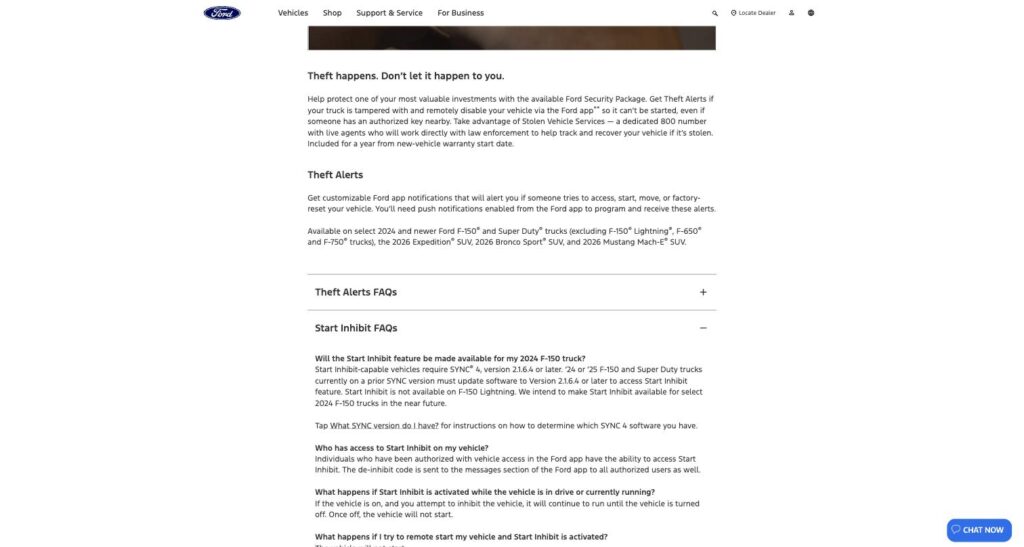
None of this works automatically on every 2024-and-newer F-150, either. Start Inhibit requires SYNC 4 software version 2.1.6.4 or later, so trucks running an older build need a software update before the feature does anything at all, worth checking before you assume a used or dealer-stock truck already has it live. It’s also not available on the F-150 Lightning.
Where the Rollout Actually Stands
Ford’s own fine print draws a sharper line than the marketing page does. The broader Security Package, meaning Theft Alerts and Stolen Vehicle Services, now covers select 2024-and-newer F-150 and Super Duty trucks (excluding Lightning, F-650, and F-750) alongside the 2026 Expedition, Bronco Sport, and Mustang Mach-E. Start Inhibit itself, the actual kill-switch function, is currently limited to select 2024-2025 F-150 and Super Duty trucks. In other words, buyers of the new Expedition, Bronco Sport, or Mach-E get the alerts and the tracking, but not yet the ability to remotely disable the vehicle’s starter. Ford says it intends to extend Start Inhibit to more of the 2024 F-150 range soon, contingent on that software update rolling out fleet-wide.
The Fine Print That Actually Matters to Owners
Start Inhibit isn’t limited to the primary account holder. Anyone granted authorized access to a vehicle inside the Ford app can trigger it, and everyone with access receives the de-inhibit passcode the moment it’s activated. That’s a reasonable design for a family truck, but it’s worth a second thought for co-signed loans, a shared work vehicle, or a relationship that’s ended less amicably than the paperwork suggests: remote access to a truck’s ignition is now a feature of the account, not just the key.
The system also leans entirely on cellular and GPS connectivity. Ford’s own FAQ acknowledges that both tracking and remote commands stop working the moment the truck loses signal, whether from rural coverage gaps, terrain, or deliberate tampering. Given how many F-150 and Super Duty buyers use these trucks specifically for ranch work, towing into the backcountry, or job sites outside cell coverage, that’s a real limitation rather than a footnote.
There’s also a shrinking eligibility window buried in the Deductible Reimbursement portion of the package, the part that reimburses your insurance deductible if the truck is stolen. It isn’t offered at all in California, Florida, Kentucky, Louisiana, Missouri, Tennessee, Canada, or U.S. territories, and Ford cut off eligibility entirely for trucks purchased on or after June 11, 2026. Those buyers still get Theft Alerts, Start Inhibit, and Stolen Vehicle Services, just not the deductible payback if the worst happens.
One more mechanical wrinkle: once Stolen Vehicle Services flags a truck as stolen, Ford automatically disables the factory reset function so a thief can’t wipe the truck’s connectivity and vanish off the grid. Owners can manually re-enable that reset for a one-hour window through the app if they genuinely need it, though Ford’s own guidance is to leave it alone until the truck is recovered.
What This Means If You’re Buying, Selling, or Insuring One
If you’re shopping a 2024 F-150 or Super Duty off a dealer lot, ask specifically whether it’s running SYNC 4 version 2.1.6.4 or newer. That’s the difference between Start Inhibit working on day one and needing a service visit first. Buyers of a used truck should also check where that vehicle sits relative to its original warranty start date, since the complimentary year is tied to the truck, not the current owner; a three-year-old F-150 changing hands today rolls straight into the $7.99-a-month tier to get the same protection a first owner got for free.
It’s also worth a call to your insurance agent. Carriers frequently offer modest discounts for vehicles with verified tracking and remote-immobilization technology, and a documented Stolen Vehicle Services plan is exactly the kind of thing an underwriter wants to see in writing.
The Bigger Picture
Full-size pickups remain a prime target for thieves chasing resale value and parts, and the recent bust of a truck-theft ring that quietly rented out stolen semis to unsuspecting businesses is a reminder that moving stolen trucks is an organized business, not a joyride. Connected security tech isn’t foolproof against determined thieves, either; the Kia Boys proved that beating a supposedly fixed anti-theft system can take minutes, not months. Treat Start Inhibit as a strong deterrent and a useful recovery tool, not an invincibility shield.
Ford’s answer also sits alongside a broader industry pattern of building recurring subscriptions into what used to be simple included hardware, a shift already playing out in how GM is leaning on monthly connected-service revenue long after the sale is final. A remote kill switch is genuinely useful against opportunistic theft, but it also means the difference between your truck starting and not starting now runs through Ford’s servers and an app account, not just a metal key. That trade-off deserves real thought before you tap activate, not after.
About the Author