DeKalb County, Georgia didn’t ease into automated license plate surveillance. Commissioners approved a ten-year, sole-source contract worth nearly $19 million in one sitting, branded the rollout “Digital Shield,” and promised residents a system built on transparency and ethical data use. It took less than a year for a sergeant with nearly two decades on the job to become the first real test of what those promises were worth.
The Paperwork Behind Digital Shield
On September 23, 2025, DeKalb’s Board of Commissioners unanimously approved Change Order No. 1 to Contract No. 2000081, a multiyear, sole-source master services agreement with Flock Group Inc. County records list the deal as not to exceed $18,969,939 and describe it as funding ten years of additional license plate reader cameras, AI-enabled drone first responders, mobile security trailers, more surveillance cameras, and a service called Flock 911, all feeding into the county’s new Real-Time Crime Center. CEO Lorraine Cochran Johnson formally unveiled the initiative on October 1 as a defining moment for how we reimagine public safety in our county, and the county’s own announcement promised safeguards to ensure transparency, accountability, and ethical data use. Worth noting: DeKalb didn’t run this through a competitive bidding process. Sole-source procurement is standard practice for expanding an existing proprietary platform, but it also means no other vendor ever got a chance to underbid a contract approaching $19 million.
What These Cameras Actually Capture
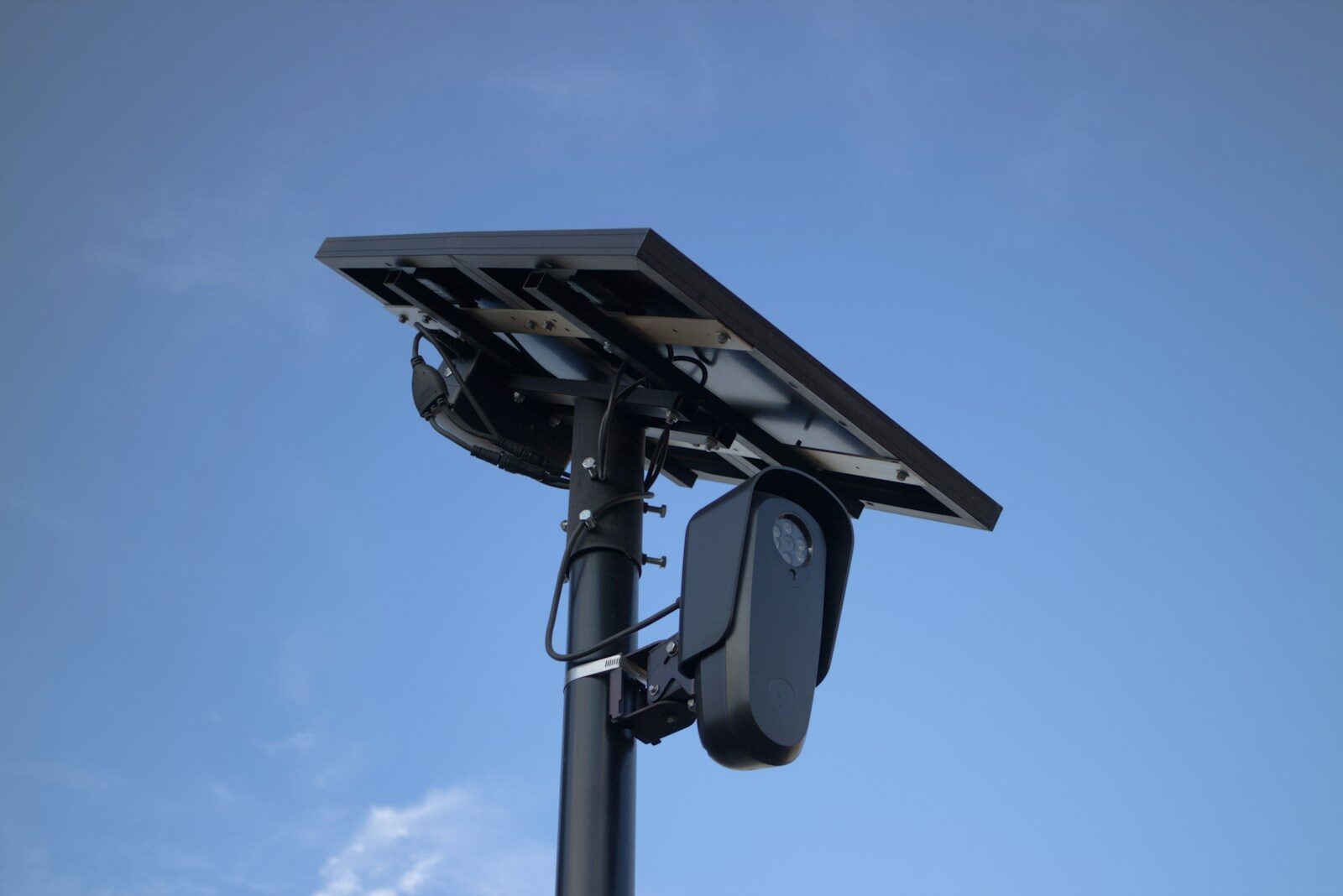
Flock’s pitch to law enforcement has never really been about plates alone. Each camera also logs a vehicle fingerprint: make, color, body damage, roof racks, bumper stickers, even temporary tags, all timestamped and geotagged, then shared across a network the company says spans more than 6,000 communities and roughly 5,000 law enforcement agencies. The cameras themselves are solar-powered and wireless, which is why a county can bolt on hundreds of them without tearing up a single sidewalk. That same networked design is what makes the system useful for chasing stolen cars across county lines, but it also means every search against that database is logged: who ran it, when, and supposedly why. Flock itself describes this as a tamper-proof trail of accountability. DeKalb’s case is what happens when somebody tests that claim from the inside.
The Search That Ended A 17-Year Career
On July 17, that audit trail is what ended Sgt. Kabiru Salawu’s career. A DeKalb County Sheriff’s Office veteran since August 2009, Salawu was fired and arrested after an internal review found he had run queries through the county’s Flock system for reasons that had nothing to do with police work. He is charged with a felony count of violating his oath of office and a misdemeanor count of misusing license plate data, and he is being held without bond at the DeKalb County Jail. “The public expects and deserves integrity from every member of this agency,” Sheriff Melody Maddox said in a statement. “The misuse of law enforcement technology or confidential information for any unauthorized purpose is a serious breach of the public’s trust and will not be tolerated.” The sheriff’s office has not said what Salawu allegedly searched for or how investigators caught it, and the case remains open.
Why Flock Keeps Pointing To Its Own Audit Logs
That silence on how the misuse surfaced matters, because DeKalb’s case lands in the middle of a much bigger reckoning over exactly how these searches get flagged in the first place. Flock told investigative reporters this year that it had rolled out a new audit assistance feature: an AI layer that flags queries falling outside a department’s stated policy and routes them to supervisors instead of leaving someone to comb through months of logs by hand. Company spokesperson Paris Lewbel has pointed to the resulting wave of firings as proof the system is working as intended, noting that “in many of the rare documented cases of misuse of our platform, it was our own audit logs that surfaced the issue.” Georgia alone has produced at least 20 documented cases of alleged personal searches over the past year, several tied to stalking accusations.
The Same Company Is Also Making Its Logs Less Transparent
Here’s the part worth knowing if you’re the one driving past these cameras every day. While that AI tool has been surfacing more misuse, Flock has simultaneously scaled back what the public can see in its own audit records. Officer names tied to cross-agency searches now show up as anonymized ID numbers instead, and license plate numbers no longer appear in logs released through open records requests. Lewbel says the change followed complaints from roughly 200 law enforcement leaders that activists were using published audit data to identify undercover officers, and maintains that “all omitted information is preserved in full… and remains available to authorized oversight bodies.” That is a reasonable security concern for undercover work, but it also means a resident trying to check their own history on a public audit-log tool may not see which officer ran a search or which plate triggered it, only that one happened.
DeKalb Isn’t An Isolated Case
Salawu’s arrest is one entry in a longer list. In the same stretch of weeks, Cherokee County fired three sheriff’s employees, including a lieutenant and a sergeant, over improper database searches. Albany saw five former police officers arrested following a Georgia Bureau of Investigation probe. Greene County fired a deputy after an audit flagged personal use of the system. Fayetteville dismissed three officers accused of running plates on themselves, family members, and acquaintances. Add Salawu and Georgia has fired or arrested more than a dozen officers over Flock misuse in about six weeks, which says less about any single department and more about how many agencies bought into the same trust-the-safeguards pitch DeKalb just tested. It isn’t unlike the case out of Milwaukee earlier this year, where an officer resigned after allegedly running a woman he was dating’s plate 179 times before she found out through a public audit-log search tool. Some jurisdictions have responded by dropping Flock entirely, as Denver and Douglas County, Colorado did earlier this year, though both ended up hiring a different vendor to run a similar network days later.
What A Felony Oath Violation Actually Carries
Violation of oath by a public officer is a felony under Georgia law, punishable by one to five years in prison on conviction, separate from whatever penalty the misdemeanor plate-data charge adds. It’s a statute prosecutors don’t reach for often, generally reserved for officials accused of using their position for something entirely outside the job they were sworn to do. A conviction would almost certainly end any future in Georgia law enforcement, on top of whatever time Salawu ends up serving.
What It Means If You Drive Through DeKalb County
For everyday drivers, the practical takeaway is simple: if you’ve driven through most of metro Atlanta recently, your plate has probably been photographed and logged by one of these networks already, and DeKalb’s own footprint is set to keep growing for another decade under this contract. Public transparency portals and third-party tools built on that public data can tell you whether a specific agency’s cameras have scanned your plate, though Flock’s recent redactions mean you won’t always see which officer ran a search or what triggered it. If you want your own record, DeKalb County Sheriff’s Office fields open records requests through its public information office; filing one is currently the most reliable way to find out if your plate turned up in a search that had nothing to do with an actual crime. It’s also worth remembering that this fight over vehicle data isn’t confined to county contracts. Congress has its own version of this argument brewing over how much automotive data collection should be allowed at all, foreign or domestic.
DeKalb’s press release promised residents an ethical surveillance network with safeguards built in. Nine months later, the safeguards did their job, just not in the way anyone likes to put on a press release: they didn’t stop the misuse, they documented it after the fact and handed the county a felony case built on its own technology. An audit trail that actually produces an arrest beats one that doesn’t. But it’s also a preview of what a ten-year, $18.9 million commitment really buys a county: not a guarantee against abuse, just a much better paper trail for when it happens anyway.
About the Author