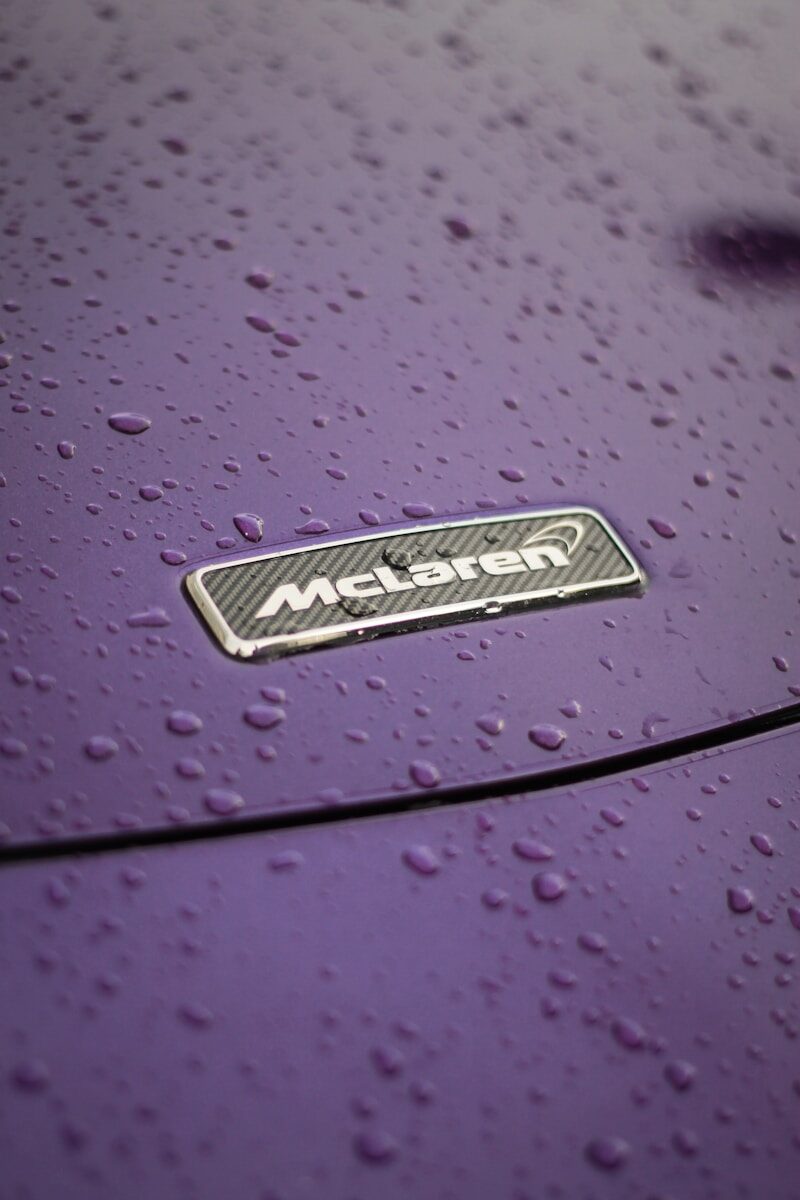
The Manual McLaren Rumor Deserves Better Questions Than “Is It Real?”
Somebody at Woking is having a good month. Two weeks after McLaren pulled the sheet off the 788HS at Goodwood, the internet decided the company is also building a three-pedal hypercar called the P50, and that it lands at Monterey in three weeks. McLaren has said precisely nothing about it.
Here is what actually exists. The Quail runs Friday, August 14 at Quail Lodge in Carmel, its 23rd edition, and the organizers have promised more than a dozen debuts from manufacturers and designers. That part is on the record. The P50 itself traces back to an anonymous forum post from February that described an MSO-built limited series with a manual gearbox and a possible naturally aspirated engine — and which explicitly told readers to take it with a pinch of salt. Everything since has been elaboration on that.
So instead of relitigating whether the rumor is true, let’s ask the more useful question: if McLaren really is doing this, what would it have to be?
The number is the interesting part
Nobody seems to have noticed that McLaren spent early July telling a story about fifty cars.
The M6GT that MSO unveiled at Goodwood is Bruce McLaren’s own road car, rebuilt from period tooling over roughly 3,000 hours, and by McLaren’s own account Bruce “set his sights on creating 50 road-going M6GTs.” The project died with him in June 1970. MSO explicitly framed the restoration as the launch of a heritage program, not a one-and-done.
Related Articles
- Ukraine Just Codified an AWD Electric Military Motorcycle That Recharges Itself With a Gas Can
- This 1970 Chevelle LS6 Hid Its Own Proof Under the Front Seat for 55 Years — Now It’s Headlining Mecum Harrisburg
A limited-run McLaren carrying a “50” in its project name, revealed weeks after the company reintroduced the fifty-car road program its founder never got to build, with a manual gearbox like the one bolted behind the M6GT’s small-block Chevy? That’s either a coincidence or a marketing department that knows exactly what it’s doing. I’d bet on the second.
Mechanical manual or the Ferrari trick?
This is the fork in the road, and it determines everything about what the car is worth in twenty years.
A genuine H-pattern manual behind hypercar power is hard but not impossible — Hennessey just shipped one. The Venom F5-M pairs a billet gate and a physically connected shifter with 2,031 bhp, in a run of twelve roadsters at $2.65 million. It required a bespoke gearbox, a new carbon chassis and a total rethink of the car around the driver’s left foot. That’s the cost of doing it for real.
The alternative is what Ferrari and Koenigsegg have done, and it’s cleverer than the purists want to admit. Ferrari’s 12Cilindri Manuale leaves the eight-speed dual-clutch in place and hangs a shift-by-wire lever and a clutch-by-wire pedal on top of it, with sensors translating pedal travel into hydraulic commands. Koenigsegg got there first with the CC850’s Engage Shift System, which serves up a gated six-speed manual and a nine-speed automatic from one gearbox.
Here’s the wrinkle nobody’s flagged: McLaren’s newest transmission would make the by-wire route genuinely awkward. The W1’s eight-speed gearbox uses E-reverse — there is no mechanical reverse gear at all, because the electric motor simply spins the other way. Ferrari can wire reverse into its gate because reverse is a physical ratio sitting in the box. Design a gated shifter over a W1-derived transmission and the reverse slot is a button pretending to be a gear. Solvable, but it tells you the hardware wasn’t conceived with a stick in mind.
Don’t expect the Solus V10
The most persistent forum theory is that McLaren recycles the naturally aspirated 5.2-litre V10 from the Solus GT. Mechanically, this is a much bigger ask than it sounds.
That engine, built by Judd, isn’t installed in the Solus so much as it is part of the Solus — bolted directly to the tub as a stressed member, with the rear suspension hung off the gearbox casing, LMP-style. It revs past 10,000 rpm through a multi-plate carbon clutch that’s software-managed, not driver-managed. Turning that into a road car means new mounting architecture, NVH isolation, crash structure, emissions hardware, cold-start behavior and a clutch a human can actually modulate in traffic. At that point you haven’t adapted an engine, you’ve designed a car around a block casting.
Related Articles
- Patrick ‘Paddy’ McNally, the Journalist Who Helped Engineer F1’s Commercial Empire, Has Died
- Dreyer and Reinbold Buys Into IndyCar’s New Charter Economy, Returns Full-Time for 2027
Meanwhile McLaren just closed the book on its other option. The 788HS — 788PS, 200 cars split between coupes and Spiders, every one through MSO — was presented as the definitive and final evolution of the 720S/765LT/750S line. If the M840T is retired, the only fresh engine in the building is the W1’s MHP-8, which revs to 9,200 rpm and is barely two years old. That’s where I’d look.
The regulatory math is friendlier than you’d think
Two things that surprise people about low-volume hypercars in the United States.
First, CAFE isn’t the obstacle you assume. NHTSA has repeatedly granted low-volume manufacturers exemptions from generally applicable fuel economy standards, and a 2024 final rule lists McLaren Automotive as exempt for model years 2012 through 2023, alongside Ferrari, Koenigsegg, Pagani and Aston Martin. A thirsty manual halo car doesn’t drag down a fleet average that isn’t calculated the normal way.
Second, the gas guzzler tax is real but trivial here. It tops out at $7,700 for cars rated under 12.5 mpg combined. On a car priced north of the W1’s $2.1 million, that’s a rounding error — and worth remembering that a manual almost always tests worse on the EPA cycle than a modern eight-speed dual-clutch, because the software can’t upshift early to game the drive trace.
Who’s paying for this
McLaren’s finances changed shape in 2025, when CYVN Holdings completed its acquisition of McLaren Automotive and folded it together with Forseven under McLaren Group Holdings, promising expansion into new product categories. Low-volume, ultra-high-margin specials are exactly how a company funds that kind of pivot while the volume cars are being re-engineered.
One correction worth making, since it keeps getting garbled: CYVN’s 2023 purchase was a controlling stake in Gordon Murray Technologies, the iStream engineering arm, per Gordon Murray Group’s own announcement. Gordon Murray Automotive — the outfit that builds manual V12s — stayed with Gordon Murray Group. Nobody bought Murray’s manual expertise and pointed it at Woking.
What a buyer should actually think about
If it’s a mechanical manual, the clutch is a wear item, it isn’t a warranty item, and replacing one in a mid-engined carbon-tub car means dropping the powertrain. Budget accordingly, and expect your insurer’s agreed-value appraiser to ask about it. If it’s by-wire, the pedal is a sensor — cheap, and effectively idiot-proof, because the software will refuse to let you cook anything. That difference matters for long-term values: a car that can be destroyed by a clumsy owner gets rarer over time, and the market prices that in.
Related Articles
- Three Hurt as Vintage Model T Collides With Pickup in Goldsboro
- Nissan Just Recalled 168,149 Full-Size SUVs Because a Sticker Has the Wrong Number on It
The market context is sitting right there in Monterey the same week. RM Sotheby’s is offering McLaren F1 GTR chassis 10R with a published value in excess of $35 million, and the house’s previous marque benchmark came from a 1994 F1 LM-spec that made $19,805,000 in 2019. Three pedals are a meaningful part of why those cars trade where they do.
What to watch on August 14
If something appears at The Quail, the tells are simple. Look at the gate for a reverse slot. Look at whether McLaren says “manual” or “manual shift-by-wire” in the first paragraph of the release — Ferrari was upfront about it, and Maranello’s willingness to be honest is why that car reads as clever rather than fraudulent. And look at whether the number 50 shows up anywhere.
Until then, this is a forum post with good instincts and a lot of company. McLaren’s most recent unannounced-until-Goodwood reveal turned out to be a 200-unit send-off for an eight-year-old platform, not a reinvention. That’s worth keeping in mind before anyone spends three weeks writing a deposit check in their head.
About the Author