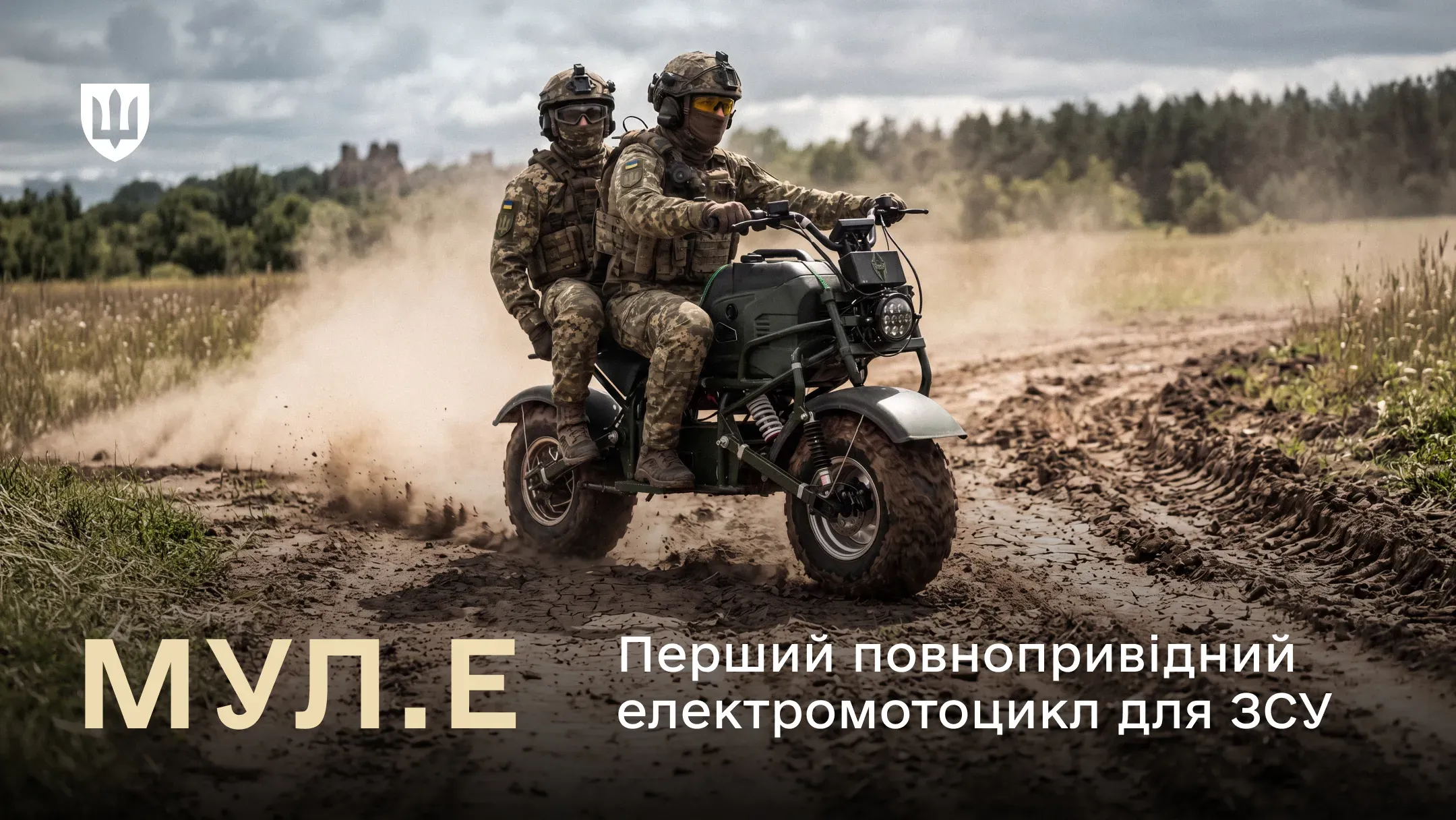
Ukraine's MUL.E all-wheel-drive electric military motorcycle, codified for service in July 2026. Photo: Ukraine Ministry of Defence
Every consumer EV company on the planet is still arguing over how to cure range anxiety, bigger battery packs, faster chargers, swappable cells, take your pick. Ukraine’s Ministry of Defence looked at the same problem from a foxhole and picked an answer no civilian brand would touch: bolt a small gasoline generator onto an electric motorcycle and let it recharge itself in the field. That machine is called MUL.E, and on July 23 the ministry officially codified it and cleared it for service with the Armed Forces of Ukraine, making it the country’s first domestically built, all-wheel-drive electric military motorcycle.
“Codified” isn’t just paperwork jargon here. It’s the formal process that turns a prototype into an approved piece of military equipment eligible for procurement, spare-parts support, and official doctrine, the same bureaucratic hurdle dozens of Ukrainian-made drones, vehicles, and weapons have had to clear before reaching units at the front. A codification stamp means the design has already survived military testing and is judged ready to build in volume, not just a slick concept photo.
What The MUL.E Actually Is
Strip away the camouflage paint and the MUL.E is a two-wheeled cargo mule built for infantry logistics, moving armed troops, small loads, and wounded soldiers across off-road terrain that would swallow a pickup truck whole. The defining feature is its 2×2 all-wheel-drive layout, powered by two independent electric motors rather than one motor driving a single wheel through a belt or chain. That’s a meaningful engineering choice beyond traction: if one motor or its wiring takes damage crossing a shell crater, the bike can likely still limp along on the other. Redundancy like that almost never shows up on the big-block cruisers most riders dream about owning one day, because nobody’s shooting at your daily commute.
A full charge is good for close to 100 km, respectable for a purpose-built off-roader hauling two people and gear, but the backup plan is what makes this bike genuinely interesting. Instead of leaning purely on grid charging or a swappable battery pack, the MUL.E carries a small removable gasoline generator mounted to the frame. When the battery runs flat, the generator tops it back up, so the bike doesn’t simply die in the field the way most battery-powered gear eventually does. Pull the generator off entirely and it doubles as a portable power source for charging radios, phones, or FPV drone batteries, or running other equipment where there’s no grid power at all. It’s nothing like the complex hybrid powertrains automakers have experimented with over the years, just a genset doing exactly what a genset does, mounted somewhere a rider can access it mid-mission.
Why Ground Pressure Beats Armor Here
The ministry’s other headline claim is mine resistance, and the mechanism behind it has nothing to do with armor plating. Wide off-road tires and all-wheel drive spread the MUL.E’s weight over a large enough contact patch that its ground pressure is compared to an infantry soldier’s footstep. Most anti-vehicle mines use pressure fuses calibrated to trigger under the weight of a car, truck, or armored vehicle, not a person walking over them. A motorcycle light enough to mimic that footstep-level pressure can cross ground a loaded pickup can’t, without the belly armor that adds hundreds of pounds to MRAP-style vehicles. It’s a low-tech workaround to an extremely expensive problem, and it only works because the vehicle stays light, proof that not every survivability answer on a modern battlefield involves more steel.
A Second Bike Built For A Different Job
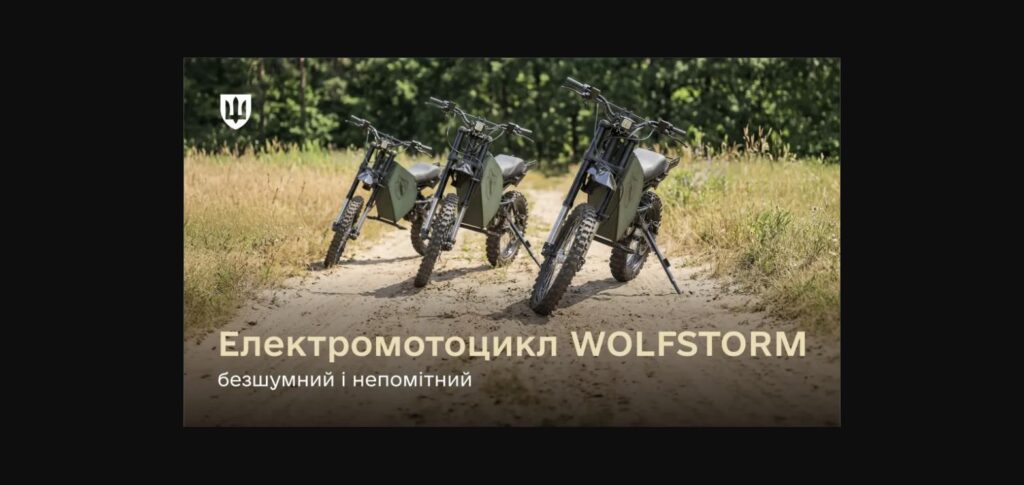
MUL.E isn’t the only electric motorcycle Ukraine’s military has approved this year. Back in June, the ministry codified WOLFSTORM, a single-track, mid-drive electric bike built more like a conventional dirt bike than a cargo hauler. WOLFSTORM weighs 105 kg, tops out around 80 km/h, uses an 8-kW motor mounted low and central in the chassis, and drives its rear wheel through a chain rather than a pair of hub motors, a layout chosen specifically because it handles like a familiar motorcycle on hills and rough ground. It even has a reverse gear, which is unusual on two wheels of any kind. Rather than a generator, WOLFSTORM relies on a fully swappable battery pack and a four-hour recharge time, and its 200-kg payload rating is built around carrying two soldiers with gear rather than cargo or casualties.
Fielding two different designs instead of settling on one says something about how deliberately Ukraine’s military is approaching this technology: MUL.E is a load-hauling, mine-avoiding mule for logistics and evacuation, while WOLFSTORM is closer to a stealthy scout bike for reconnaissance and small-unit mobility. We’ve looked before at how militaries around the world have experimented with electric two-wheelers for exactly this kind of stealth mobility, and the throughline is always the same: an electric drivetrain makes almost no noise and throws off almost no heat signature, which matters enormously when the alternative is a two-stroke dirt bike announcing your position from half a mile out.
The Procurement Numbers Behind The Hardware
Neither bike exists in a vacuum. Ukraine’s Defense Procurement Agency signed contracts this year for 1,500 motorcycles for the armed forces, triple the volume ordered the previous year, with six manufacturers competing for the work. That competition trimmed close to 12 million hryvnia off the final contract value, a modest line item in a wartime defense budget, but a sign Ukraine now has enough domestic motorcycle manufacturing capacity to run a genuinely competitive tender instead of sole-sourcing whatever’s available. Motorcycles and pickups remain the two vehicle classes that keep showing up in every account of frontline logistics, precisely because neither one needs an intact road or bridge to be useful.
What happens to this kind of engineering after the war is the more interesting question for anyone who isn’t in uniform. Battlefield necessity has a track record of pushing vehicle design in directions the civilian market takes years to catch up to, and a generator-backed electric drivetrain that solves range anxiety without a full hybrid powertrain is exactly the kind of idea that could show up in adventure-touring and overlanding circles long after it stops being classified as military hardware. Between Honda’s frameless approach to electric motorcycle charging and GM’s struggles to greenlight its own EV off-roader, the rest of the industry is still figuring out the fundamentals that a wartime workshop in Ukraine just solved with a generator and some spare wiring.
About the Author