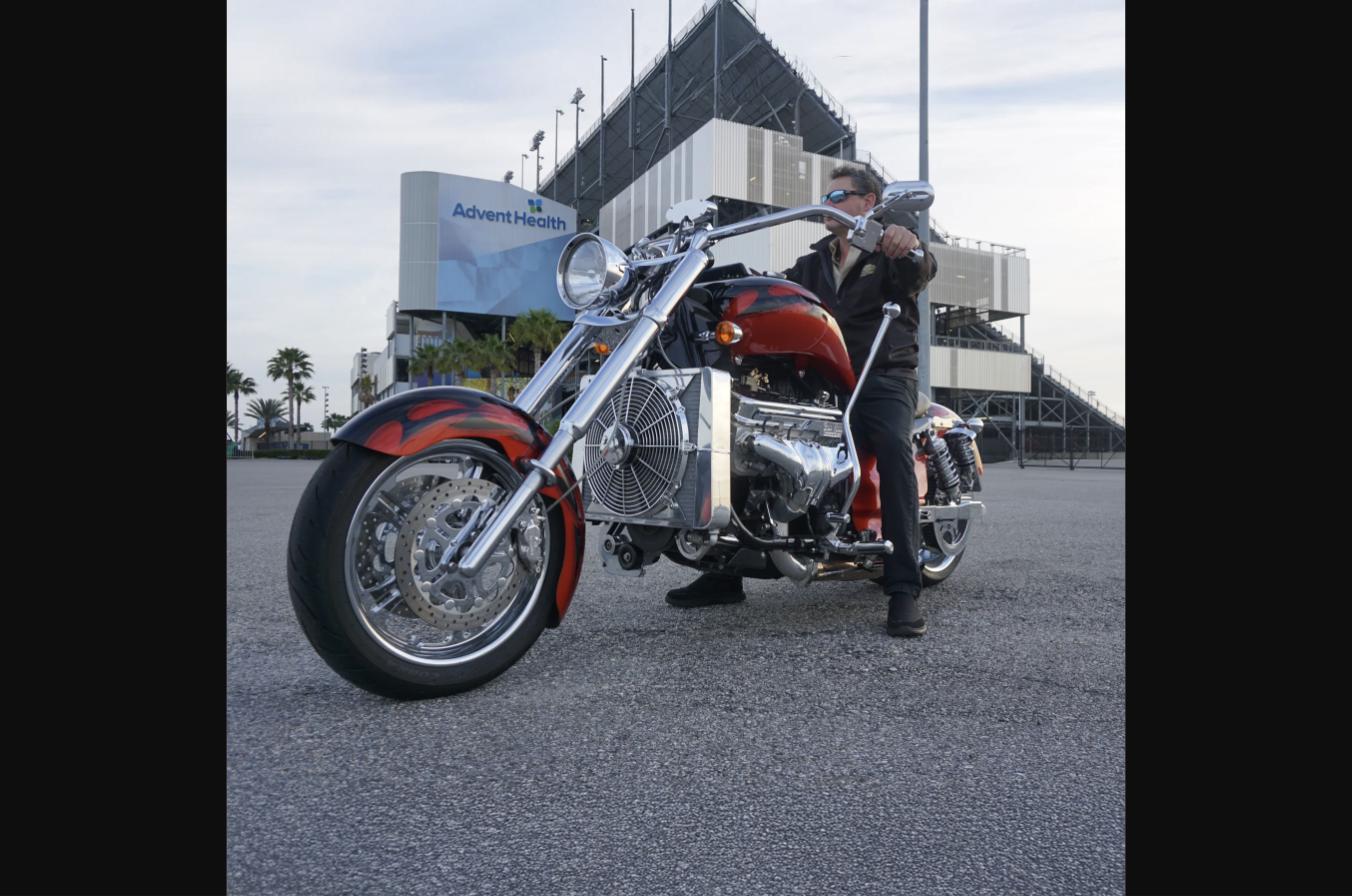
Boss Hoss has spent 35 years selling a premise that sounds like a bar bet: take a full-size Chevrolet V8, skip the car entirely, and bolt it straight into a motorcycle frame. The Cruiser Bike, the company’s current standard model, is where that premise gets distilled to its simplest form. No trike stability crutch, no bodywork theatrics, just a V8 between your knees and 21 inches of front wheel out ahead of you.
The Engine Menu Reads Like a Parts Catalog
Pricing starts at $70,995, and that base figure buys a choice of four different Chevrolet-derived V8s rather than one fixed spec sheet. The entry engine is a 383 cubic inch small-block stroker rated at 430 horsepower and 450 lb-ft of torque at 3,800 rpm. Above that sits a 376 cubic inch LS3, the same third-generation small-block family GM has shipped in Corvettes and Camaros for roughly two decades, rated here at 445 horsepower. Boss Hoss will also sell a 454 cubic inch small block making 563 horsepower, and at the top of the sheet is a 496 cubic inch big block rated at 600 horsepower and 568 lb-ft. That last engine puts the Cruiser Bike in the same conversation as the biggest domestic V8s ever built.
How the Powertrain Actually Works
None of that power runs through a clutch. Every engine option pairs with Boss Hoss’s own two-speed semi-automatic transmission, built with Winters Performance and equipped with a reverse gear, a feature that exists because a motorcycle weighing 1,100 lbs dry and 1,226 lbs wet is not something most riders want to muscle backward out of a parking spot by hand. Two speeds also solves a quieter engineering problem: automotive V8s don’t rev like sportbike engines and don’t need six or seven gears to stay in their power band, so a wide torque curve and two ratios get the job done instead. Fuel delivery depends on which engine a buyer orders, split between a Holley 750 CFM carburetor and Holley’s Terminator EFI system, a detail that lines up with Boss Hoss’s recently announced status as an official Holley dealer. Boss Hoss quotes 18 to 25 mpg depending on engine and throttle discipline, and with an 8.5-gallon tank, riders aren’t stopping dramatically more often than they would on a full-dress Harley bagger.
Built By Hand in Dyersburg, Tennessee
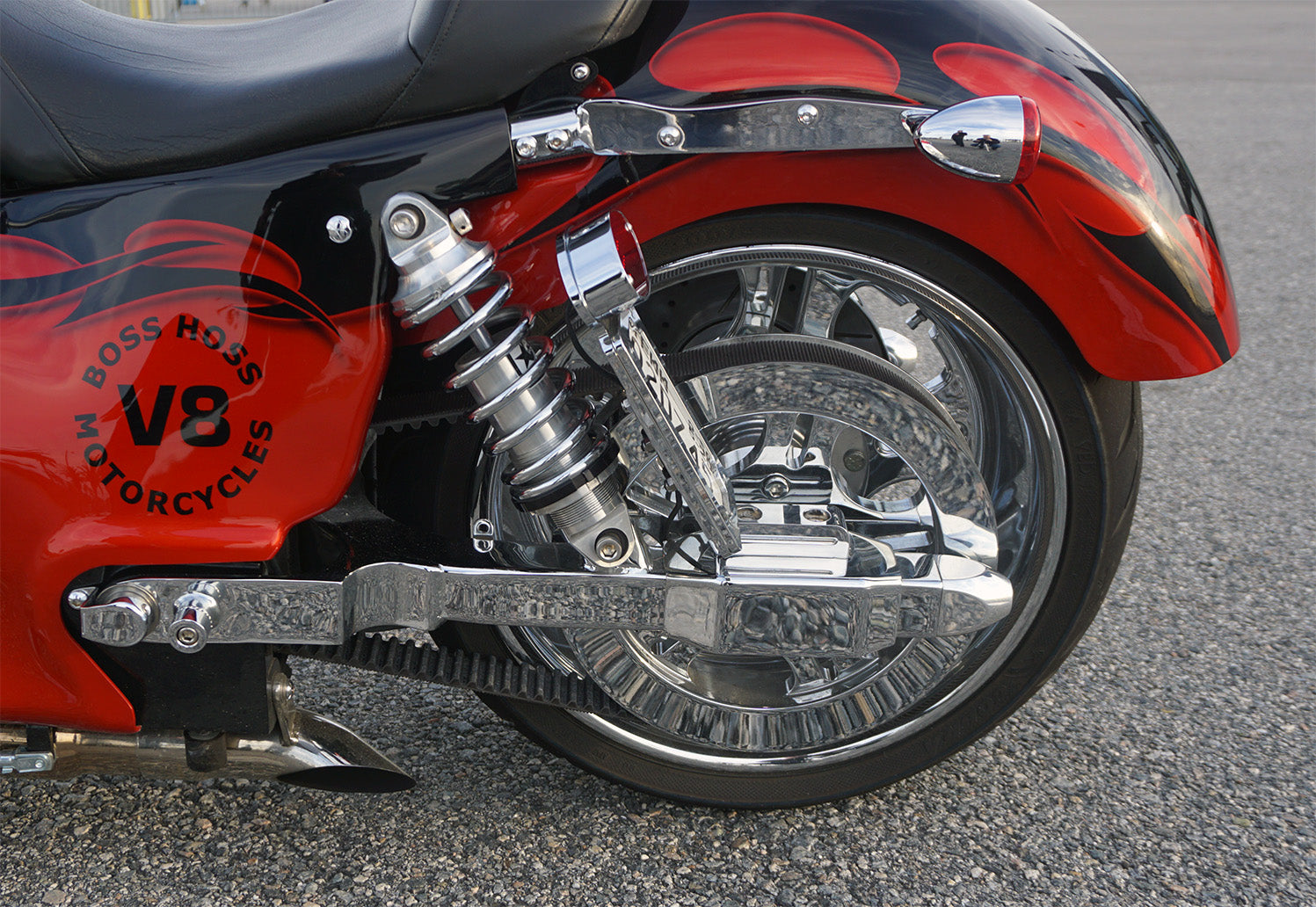
Every Cruiser Bike is welded up by hand at Boss Hoss’s factory in Dyersburg, Tennessee, using chrome-moly steel frames and cast steering necks, construction details that matter more than usual here since the frame is absorbing torque figures a normal motorcycle chassis was never designed around. The finished bike stretches 110 inches long on an 80-inch wheelbase, carries a 26-inch seat height, and wears a 300-series rear tire that looks like it wandered off a muscle car rather than a cruiser. Boss Hoss has been building V8 motorcycles since 1990, when the company started as a kit-bike operation before moving into complete, factory-built machines, making it, by its own account, the first production manufacturer to put a V8 in a motorcycle at all.
What Ownership Actually Costs
The ownership math is worth working through before signing anything. Because the Cruiser Bike is titled and registered as a motorcycle, most states only require a standard motorcycle endorsement to ride it legally, and the semi-automatic transmission doesn’t change that even though it removes the clutch hand riders are normally trained around. Insurance is the bigger variable. Carriers tend to price V8 motorcycles as a specialty category, with premiums reflecting actual displacement and horsepower rather than a generic motorcycle rate, so a quote is worth getting before budgeting the full out-the-door price. Maintenance is where owners actually come out ahead of typical exotic-bike ownership: small-block and big-block Chevy parts are about as commoditized as automotive parts get, so a Cruiser Bike owner isn’t waiting on a single proprietary supplier for engine parts the way owners of other high-dollar factory customs often are.
Where the Cruiser Bike Sits in the Market
At roughly $71,000 to start, the Cruiser Bike sits well above premium Harley-Davidson and Indian baggers, and the gap only widens once a buyer starts climbing the engine list toward the 496 cubic inch big block. That price reflects what’s actually happening on the build floor. This isn’t a motorcycle with a big engine dropped in for a marketing angle, it’s closer to a hand-built street rod that happens to balance on two wheels, priced like the low-volume, labor-intensive build it is. Enthusiasts often work the same idea from the other side of the garage, building an unusual-engine Corvette replica or reviving a reworked Bel Air wagon around a modern V8, because the pairing ends up more interesting than either component was on its own.
Garage-worthy EDC gear, on sale this week.
Boss Hoss doesn’t need to win an argument about whether a V8 belongs in a motorcycle. It settled that argument for itself in 1990 and has spent every year since building the same case louder, one big-block at a time.
About the Author