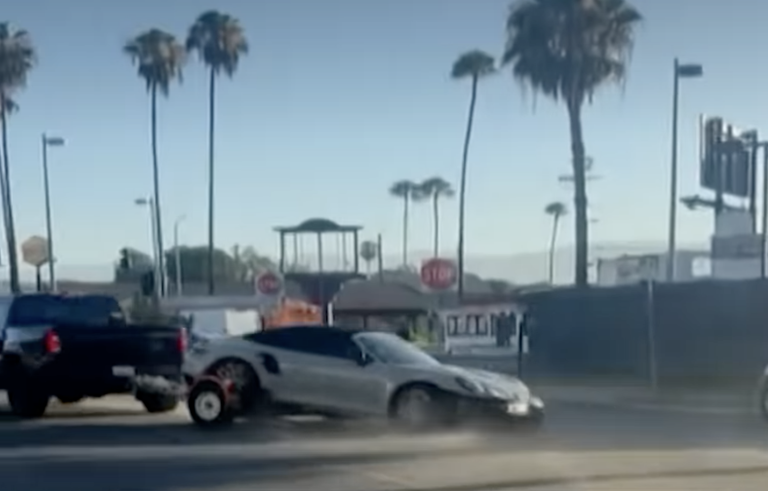
North Hollywood, early Thursday morning, July 16: someone calls the Los Angeles Police Department to report a man trying to steal a Porsche. Officers roll up a little after 6:27 a.m. and find something stranger than a standard smash-and-grab: a gray Porsche hooked to the back of a black pickup truck, engine off, nobody in the driver’s seat. Whoever wanted this car never got past the ignition. So he tried skipping that step entirely and just dragging the thing away.
It did not go well.
Why Steal It When You Can Just Drag It
Late-model Porsches are lousy candidates for a classic hot-wire. The ignition talks to an immobilizer chip embedded in the key, the body control module checks that signature before it will even think about spinning the starter, and the steering column locks itself the instant the car senses it has not been properly authenticated. Rip the column cover off with your hands the way thieves do on cheaper, older cars with exposed ignition barrels, and you are still staring at a wheel that will not turn and an engine that will not catch. There is no USB-cable trick for this one.
Towing sidesteps the whole problem. Chain the car to a truck and you do not need the engine, the key, or the computer’s blessing. You just need the wheels to roll enough to get the vehicle out of sight before someone notices. It is a crude solution, but it is also why organized theft crews increasingly show up with tow straps and pickup trucks instead of laptops and relay boxes.
The Chase Down Tujunga Avenue
That method has a built-in flaw: a car that never authenticated its key typically locks its steering column, not just the ignition, which means the front wheels are frozen at whatever angle they were left. When officers arrived and gave the truck driver orders to stop, he refused and pulled out onto Tujunga Avenue with the Porsche still chained on behind him, dead weight riding on wheels that could not turn to follow the truck’s path.
That is exactly the setup for the next several blocks: the Porsche’s nose scraped along the curb as the truck hauled it through North Hollywood. The tow connection eventually gave out, and the Porsche skidded to a stop in front of a car wash with its hood and front bumper caved in. The truck did not slow down. It kept going for another ten minutes before officers finally caught up with it near Sherman Way and Canal Loop.
A Steering Lock Turns a Tow Into a Wrecking Ball
Here is the part that does not show up in a 30-second clip: dragging a car with its steering locked is not like towing a trailer. A trailer’s wheels are free to swivel and roll straight because nothing is fighting them. A car with a seized steering rack behaves more like a plow blade bolted to a subframe that was never engineered to take that kind of sideways load at towing speed.
Every time that front end got yanked sideways against the curb, the load traveled straight into the tie rods, the control arm bushings, and potentially the subframe mounts themselves. Bodywork is the cheap part of a repair bill like this one. The expensive question an insurance adjuster has to answer is whether the unibody or front subframe got bent enough to throw off the car’s alignment permanently, which is the kind of structural damage that can push a repairable claim into total-loss territory even when the visible sheet-metal damage alone would not.
Felony Evading, Not (Yet) Grand Theft
LAPD booked the driver on felony evading, which in California does not require prosecutors to prove the underlying theft, only that he willfully fled and drove with a disregard for safety while doing it. That is a far easier case to build from officers’ own account of the pursuit than a grand theft auto charge would be, since grand theft requires establishing ownership, lack of consent, and tying a specific suspect to the actual taking of the vehicle. Police have not released the identity of the suspect or the owner, and it is common in cases like this one for the pursuit charge to stick fast while the theft charge either follows later or never quite catches up.
Tow Straps Are the New Workaround for Immobilizers
This is not an isolated method. As factory anti-theft software closes the door on hot-wiring, crews are adapting by removing the need to start the car at all. It is the same arms race that has been playing out with Kia and Hyundai models targeted by a viral steering-column theft method, where automakers eventually patched the ignition vulnerability and thieves simply moved on to the next weak point. Dragging a whole car away is about as low-tech a workaround as it gets.
Los Angeles in particular has become a hotspot for crews targeting Porsches specifically. A 911 that was recovered stripped down to a bare shell earlier this year is a good reminder of how organized the higher end of this market has gotten, and how differently a theft can end depending on whether the crew wants the whole car intact or just the parts underneath it.
What Actually Stops This
If there is a takeaway for owners here, it is that a modern immobilizer stops a casual hot-wire, but it does not stop someone willing to show up with a truck and a chain. A visible steering wheel lock or a set of locking lug nuts will not stop a determined crew either, but both add friction and time, which is exactly what opportunistic thieves are trying to avoid. A GPS tracker tucked somewhere other than the factory infotainment system, which can be disabled once a crew has physical access to the cabin, is often the difference between recovering a car within the hour and not recovering it at all.
If a car is ever recovered wrecked the way this one was, comprehensive coverage typically treats it as a theft-and-recovery claim rather than a standard collision, and documentation matters. Photos, the police report number, and a clear timeline of when the vehicle went missing versus when it turned up all factor into how quickly a claim gets processed. Adjusters want to know whether the damage happened during the theft itself, and a case with an official pursuit record behind it, like this one, is about as clean a paper trail as an owner could hope for.
Source: Los Angeles Police Department; NBC Los Angeles
About the Author