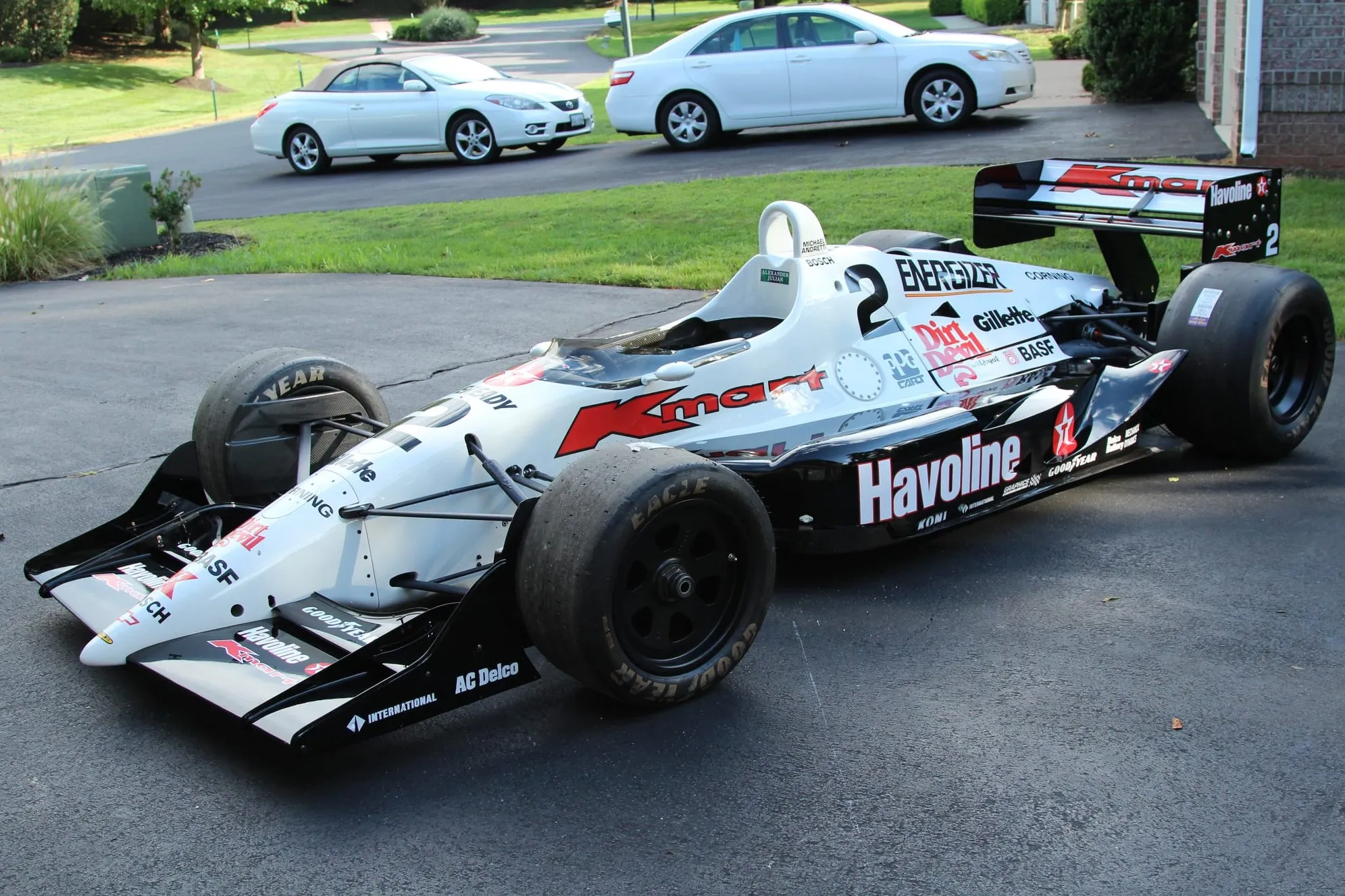
Chassis HU04 spent 1991 doing something modern IndyCar chassis rarely get to do anymore: winning constantly, with two Andrettis sharing the cockpit. Right now it’s listed on Bring a Trailer with a $50,000 bid, dressed in fresh Kmart and Havoline livery, and the engine won’t turn over.
This is one of 38 Lola T91/00 chassis built for the 1991 CART PPG Indy Car World Series, and it went new to Newman/Haas Racing, the team fielding Mario Andretti and his son Michael that year. Teams didn’t bolt one driver to one tub back then, so HU04 did double duty. Mario used it as a practice car for the 75th Indianapolis 500 and raced it at Phoenix, Milwaukee, and Portland, while Michael took it to outright wins at Road America and the non-championship Marlboro Challenge at Laguna Seca, the same weekend he clinched that year’s driver’s championship over Bobby Rahal.
The math on that season is absurd by any era’s standards: Newman/Haas’s T91/00s won 15 of 17 rounds, including that non-points Laguna Seca exhibition race. You’d struggle to find a single-season sweep like it anywhere in modern IndyCar competition, and it’s a big reason the T91/00 gets mentioned alongside other short lists of dominant open-wheel chassis, the kind of cars that show up in garages full of championship-winning machinery at events like Monterey.
HU04’s post-racing life is fairly typical for a car this significant. It landed with Newman/Haas crew member Bud Hoffpauir before the current seller, a partner at Andretti Global, bought it in 2022. The refurbishment that followed, completed this year, covered the parts you can see: bodywork repairs, a new windscreen, a repaint in the correct Texaco, Havoline, and Kmart scheme sourced from Newman/Haas and applied by Andretti Global’s own graphics shop, refinished center-lock wheels, and an overhauled double-wishbone suspension. What it didn’t cover is the part that actually makes an Indy car an Indy car.
The turbocharged Ilmor-Chevrolet 2.65-liter V8 doesn’t run, and the seller says the ECU and turbo blow-off valve are missing outright. The Lola-Hewland six-speed sequential gearbox was pulled apart this year for inspection, and the listing includes photos from that teardown rather than a finished, buttoned-up transmission. None of that is a deal-breaker for a display piece, but anyone hoping to actually fire this thing up needs to budget well beyond the winning bid. Period Ilmor-Chevrolet Indy V8s aren’t a parts-counter rebuild. There’s no aftermarket supporting a 35-year-old CART turbo motor, so sourcing a working ECU and correct internals means tracking down specialists who still service this exact engine family, and that kind of bespoke labor adds up fast on top of the purchase price.
There’s no title changing hands here, and there never will be. Indy cars aren’t registered for the road, so ownership transfers on a bill of sale, along with the log sheets and refurbishment photos this listing includes. That paperwork trail matters more than usual with a car like this: Lola built three dozen-plus examples of the T91/00, several teams ran them, and provenance claims on 30-plus-year-old race cars are easy to overstate. The chassis tag stamped HU04 and the seller’s race-by-race log sheets are what actually tie this tub to Mario and Michael’s 1991 season, not just the livery on the bodywork. Buyers shopping this corner of the market should take the same lesson learned from a certain celebrity-owned Land Rover pickup that crossed the same auction site earlier this year: the documentation is the provenance, not the story attached to it.
Fifty grand sounds like a rounding error next to what contemporary Formula 1 chassis fetch, and that gap is really a story about audience size rather than mechanical significance. Vintage IndyCars pull from a smaller, more American-focused buyer pool, parts support is thinner, and there’s no road-going halo model keeping the brand in the public eye the way there is for European race teams tied to Ferrari or McLaren. It’s the same dynamic that shows up across the broader collector market. Plenty of six- and seven-figure sales get the headlines during a week like Monterey Car Week, while genuinely historic, ex-championship hardware like this Lola trades for the price of a nicely optioned pickup truck.
With six days left on the clock, more than 9,000 views, and over 1,300 watchers, there’s clearly an audience paying attention. Whether that translates into real money is a different question. A non-running chassis missing its brain and its blow-off valve is a tougher sell than a turnkey vintage racer, even with two Andretti names in the history file. For the right buyer, though, this is less a car to drive this weekend and more a rolling piece of one of CART’s most one-sided seasons, sold with the receipts to prove it.
About the Author