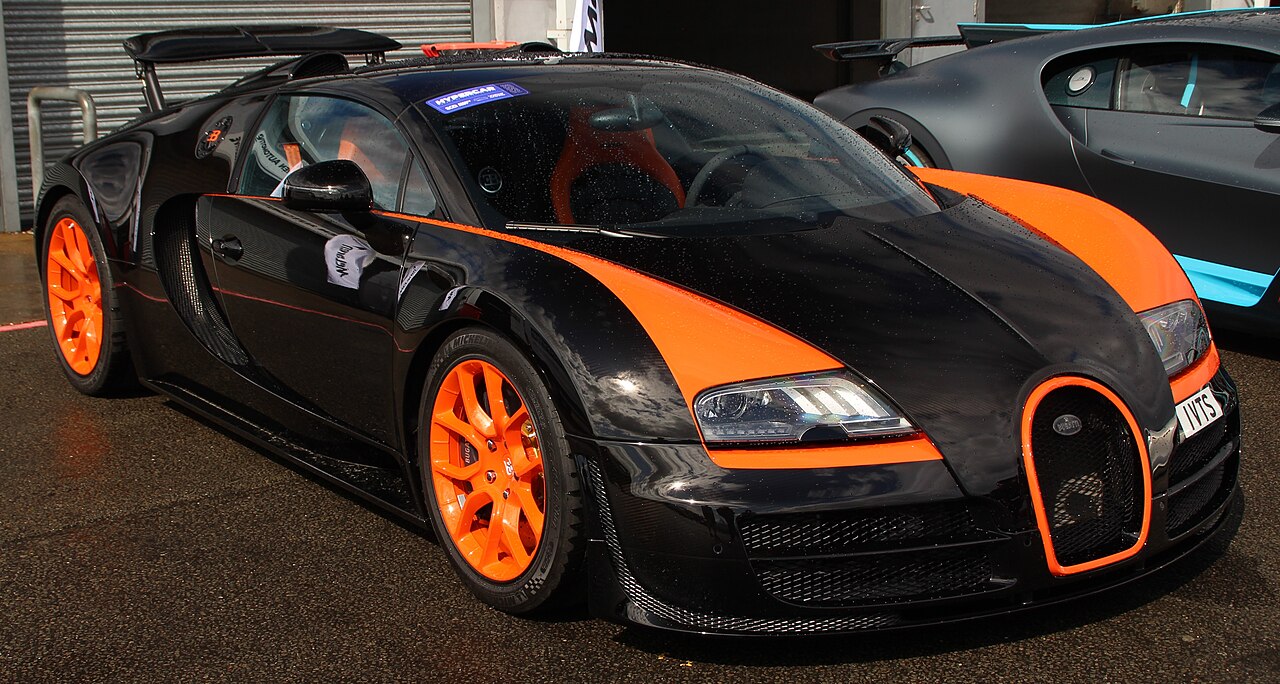
Photo: MrWalkr via Wikimedia Commons (CC BY-SA 4.0)
Most Bugatti Veyrons get their shine from paint over carbon fiber. The one Fernando Alonso was photographed driving along the Monaco harborfront on September 16 gets it from the metal itself. Barcelona-based automotive photographer Gerard Milà posted a set of images showing a mirror-finished Veyron 16.4 Grand Sport Vitesse rolling past the yachts with Alonso behind the wheel, and he tagged it as the newest piece of the two-time Formula 1 champion’s collection.
That silver isn’t a wrap, and it isn’t chrome paint. It’s the car German Bugatti specialist Mechatronik had been marketing as a Grand Sport Vitesse with a polished aluminum body and a Carmine red leather cabin, which the dealer billed as the most elaborate and expensive Veyron ever built, and the only one made using machined, polished aluminum. The sill plates read “Vitesse 1 of 1.” The price was never public; the car was listed as price on request.
The car under the mirror
Strip away the finish and this is still the most extreme version of the Veyron roadster. Bugatti unveiled the Grand Sport Vitesse at the 2012 Geneva Motor Show with the 8.0-liter quad-turbo W16 turned up to 1,200 PS (1,184 hp) and 1,500 Nm (1,106 lb-ft), fed by four larger turbochargers and new intercoolers. Bugatti quoted 0-100 km/h in 2.6 seconds and a 410 km/h (255 mph) top speed with the roof on, electronically capped at 375 km/h with it off.
Then Bugatti proved the number. On April 11, 2013, at Volkswagen Group’s Ehra-Lessien proving ground, racer Anthony Liu took a Grand Sport Vitesse to 408.84 km/h (254.04 mph), verified by TÜV, making it the fastest open-top production car in the world at the time. Bugatti followed with an eight-car World Record Car Edition in the record car’s black and orange.
Mechatronik’s listing puts Alonso’s car at model year 2015, the tail end of Veyron production, with just 750 km (about 466 miles) on the clock. That works out to roughly 70 km a year over a decade. You’d put more miles on a lawn tractor.
Why aluminum is the weird part
Here’s the thing most people glancing at those photos miss: a standard Grand Sport Vitesse is a carbon-fiber car. Bugatti’s own engineering history of the roadster describes a carbon body, carbon doors, and a carbon monocoque reinforced around the sills and transmission tunnel, with carbon supports stiffening the B-pillars, to recover a torsional rigidity of 22,000 Nm per degree after the roof came off.
That matters because it tells you what the aluminum is and isn’t doing. The strength of a Vitesse lives in that tub and its reinforcements. The body panels are skins. Swapping carbon skins for aluminum doesn’t make the car stiffer or faster; it’s an aesthetic decision executed with aerospace-grade stubbornness. Mechatronik lists a curb weight of 1,838 kg for this car, and aluminum is denser than carbon composite, so nobody specced this for lap times.
Machining is also the hard way to make a body panel. Stamped or hand-formed aluminum starts as a sheet and gets bent into shape. Machining starts with a solid block and cuts away everything that isn’t the panel, which means most of the metal you pay for ends up as chips on the shop floor, and every compound curve on a Veyron becomes hours of spindle time. Then someone has to polish it to a mirror without leaving tool marks, waves, or swirls, on a shape that’s famous for having almost no flat surfaces.
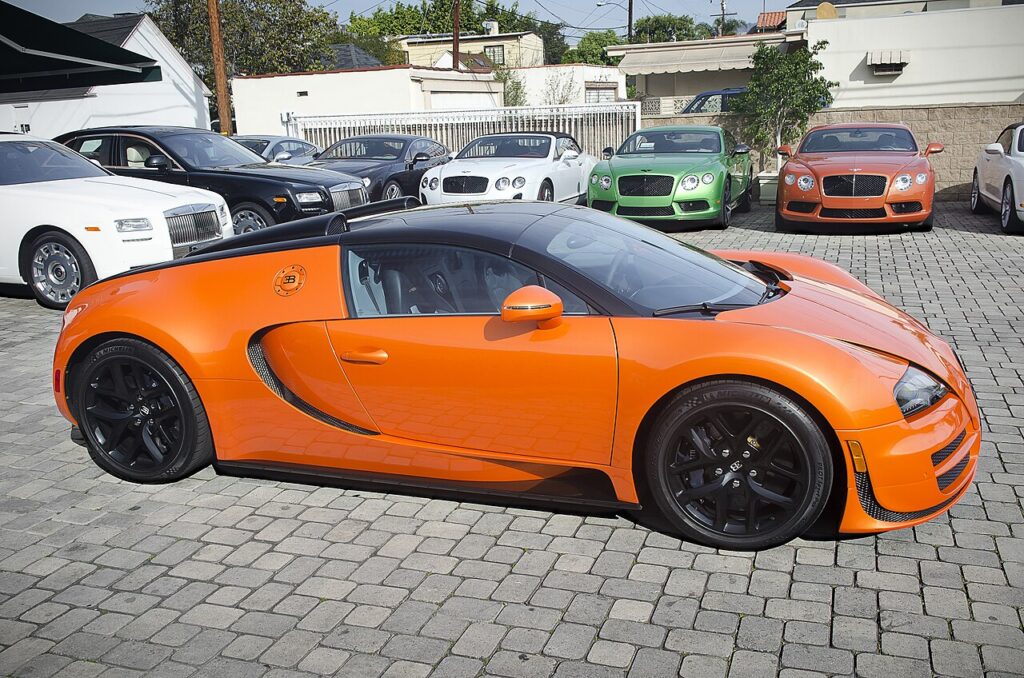
The ownership math nobody posts on Instagram
Veyrons were already notorious for eye-watering running costs, and a one-off body adds a layer the service menu can’t price.
- There’s no parts-counter replacement. Scuff a carbon Vitesse fender and there’s at least a known path to a replacement panel. Crease a machined aluminum one and the choices are skilled metal repair that has to disappear under a mirror finish, or machining a new panel from scratch.
- A mirror shows everything. Paint hides small dings with color and gloss. Bare polished metal turns every ripple and swirl into a funhouse reflection, so a repair that would pass on a painted car can be obvious here.
- Insurance is a paperwork game. A car like this goes on an agreed-value policy with a specialist underwriter, not a standard auto policy. For a one-off, the documentation (build records, dealer history, photos) is what establishes that value if something happens. With no comparable sales, an appraisal carries more weight than usual.
- Monaco is a tough place to be precious. Tight streets, steep ramps, curb-hugging parking and tourists leaning in for selfies. The photos show Alonso driving it anyway, which is the correct answer to owning a 1,200-PS roadster.
What it says about the one-off market
One-offs are the least liquid cars in the collector world. Regular Veyrons trade often enough to have a market; a single polished-aluminum Vitesse has no comparable sales, a tiny pool of buyers who want to live with it, and a look that divides even people who can afford it. That’s the reason a dealer lists a car like this as price on request, and why a buyer with a very specific taste can end up in a strong position.
It’s also a preview of where Molsheim is heading. Bugatti has now turned bespoke builds into a formal business, and its new one-off program is built on the same idea this Veyron proves: the richest customers will pay extra for a car nobody else can match. The difference is that this one was done the hard way, a decade early. (For Bugatti’s last big reinvention before the Veyron, revisit the EB110’s 1991 debut.)
F1 drivers and their road cars
Grand Prix drivers spend their workdays in cars they don’t own and can’t keep, so it makes sense that their personal cars lean toward the personal. Lewis Hamilton’s restored Ferrari F40 and Lando Norris’s Porsche 911 GT3 RS in Monaco both say something about their owners. Alonso’s choice says he wanted the fastest Veyron roadster there is, in a finish no one else has, and he’s not afraid to drive it past a harbor full of cameras.
The takeaway for everyone else: if you ever get the urge to go bare-metal on a car you love, remember that the magic is in the polishing, and so is the bill. Every scratch becomes a restoration project.
Monaco sighting of Alonso’s car: Gerard Milà (@gme.photo). Vehicle details: Mechatronik GmbH listing; performance data: Bugatti. Article images: Wikimedia Commons, credited in captions.
About the Author