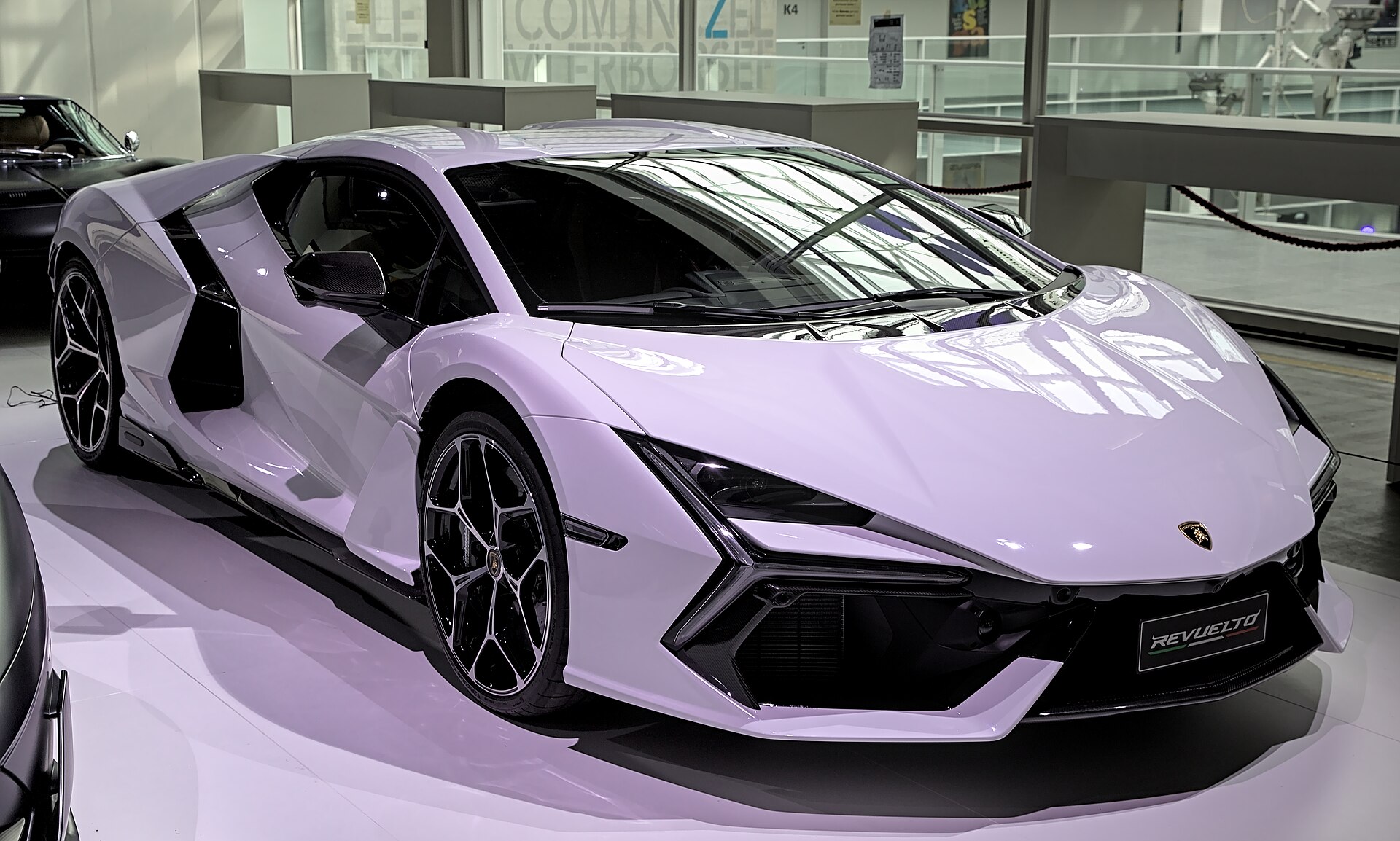
A stock Revuelto, before anyone got creative with it. Photo: Alexander-93 via Wikimedia Commons (CC BY-SA 4.0)
Lamborghini spent years building a Revuelto rear wing that stays out of sight until the car needs it. Venuum Black took one look at that idea and bolted a big, fixed wing on top.
That is the most interesting decision on the Voltoro V1, the body kit the Spanish-founded, Dubai-based design house has just rolled out for Lamborghini’s hybrid V12 flagship. The first real-world photos went up on Venuum’s own Instagram this week, with the car parked outside EmiratiOne Motors in Dubai, doors up. A video reveal followed. The caption promises a Revuelto made “even more extreme, without losing its original DNA.” The photos show a car that has kept most of its DNA and sharpened the rest.
What Venuum changed, panel by panel
Going through the tuner’s own photo set, the car is finished in matte black from nose to tail, with the Lamborghini shield picked out in gold. The changes stack up like this:
- Nose: A deep new front bumper with a pair of blade-like canards that drop almost to the pavement on each side, framing a large splitter.
- Hood: A reshaped bonnet carrying two stacked, stepped vent openings along its centerline.
- Flanks: Fender extensions and bodywork that push the rear shoulders out wider than stock.
- Wheels: Bronze, directional multi-spoke wheels with Venuum center caps.
- Tail: New surrounds for the Revuelto’s high-mounted twin exhaust outlets, a finned diffuser with mesh inserts and a Venuum-badged centerpiece, and a large fixed wing on pylons, braced by visible support struts.
- Cabin: A light, cream-and-white interior that contrasts hard with the blacked-out body.
Venuum’s posts say nothing about the powertrain, the chassis, pricing, or how many kits it will build. It tagged the reveal “#limitedition” but hasn’t put a number on it. For context, the company’s silver Ferrari 812 “Titan” posted days earlier was billed as one of 25.
Underneath, still 1,001 horsepower of factory hardware
With no mechanical changes announced, the Voltoro V1 should carry the stock Revuelto running gear, which is the most complicated drivetrain Sant’Agata has ever put in a production car. Lamborghini’s engineering documents describe a new 6.5-liter naturally aspirated V12 (6,498.5 cc) producing 825 CV (814 hp) at 9,250 rpm and 725 Nm of torque, with a 9,500-rpm ceiling. Two axial-flux electric motors drive the front axle, and a third motor sits above the gearbox. Total system output is 1,015 CV, or 1,001 hp.
The packaging is what makes the Revuelto clever. Lamborghini turned the new eight-speed dual-clutch transmission sideways, mounting it transversely behind the longitudinal V12. That freed the central tunnel, where a 3.8-kWh lithium-ion pack now lives, the spot that would normally hold a driveshaft. It keeps the heaviest new component low and central, which is exactly where a chassis engineer wants it.

The wing is the part worth arguing about
A standard Revuelto uses an active rear wing that raises and lowers depending on what the car is doing. It trims drag at speed and adds downforce and stability when you brake or turn. A fixed wing can’t adapt. It gives the same downforce, and the same drag, at 40 mph on a boulevard and at 180 mph on a runway.
Here’s the awkward timing for Venuum: Lamborghini just did the same thing itself, and it brought wind-tunnel numbers. The Revuelto SV, which debuted at The Quail during Monterey Car Week on August 15, gets a fixed, functional rear wing. The factory claims 80 percent more total downforce than the regular Revuelto, 10 percent more than the old Aventador SVJ, and a 60 percent better downforce-to-drag ratio. The SV also gets 1,065 CV (1,050 hp), a 7.3-kWh battery, and a production run of 1,963 cars.
That tells you two things. First, a fixed wing on a Revuelto isn’t a crazy idea, since Lamborghini’s own engineers landed on one. Second, the factory’s version was developed as a complete aero package, with brake cooling Lamborghini says is 12 percent better, and it came with published numbers. A wing that adds a lot of rear downforce without matching front grip can leave a car planted at the back and light at the nose, which shows up as high-speed understeer. Venuum’s deep splitter and canards may be meant to balance that out. Without published data, owners are taking the aero balance on faith. For a car that parks outside a Dubai showroom, that’s fine. For one that runs at a track day, it’s worth a question before the check clears.
The practical stuff nobody puts in the reveal video
Ground clearance. Those front canards reach nearly to the ground. Speed bumps, steep driveway lips, and parking-garage ramps will take a toll on a splitter like that, and on a car this expensive, a scraped nose means a body-shop visit, not a touch-up pen.
Wheels and tires. From the factory, the Revuelto rides on Bridgestone Potenza Sport run-flats in staggered 20/21-inch or 21/22-inch setups. Any aftermarket wheel has to clear the big carbon-ceramic brakes, keep the offset and load ratings right, and work with the car’s tire-pressure sensors. Owners should also confirm whether the new setup still uses run-flat tires, because that changes what happens after a puncture on the highway.
Warranty. In the U.S., the federal Magnuson-Moss Warranty Act generally stops a manufacturer from voiding your whole warranty just because you installed aftermarket parts. However, a dealer can still deny a claim if it can show the modification caused the failure. Keep every factory panel, the original wheels, and the original wing assembly, and write down who installed what.
Insurance and repairs. Tell your insurer about the kit in writing, ideally on an agreed-value policy that lists the modifications. If you don’t, a claim can be settled at the value of a stock car, and the insurer won’t pay for bespoke panels it didn’t know about. Repairing factory Revuelto parts is already expensive and slow, as the saga of one YouTuber’s wrecked Revuelto rebuild showed. Low-volume tuner panels add another supplier, another lead time, and another paint-matching problem. Even factory-fresh Revuelto paint hasn’t been immune to complaints.
Resale. Coachbuilt or tuner-kitted flagships sell to a narrow group of buyers. The ones that hold value best are almost always the ones that can go back to stock. If you want this look but care about what the car is worth later, treat that box of original parts like part of the title.
Why Dubai, and why Venuum
Venuum was founded in Spain in 2018 and opened a facility in Dubai in 2022. The Voltoro reveal location makes sense, since Dubai is where showy supercar builds tend to get their photo shoots. It’s a city where even the police fleet includes a Mansory-bodied Ferrari 812. The company’s portfolio already includes an Urus program it calls Furioso, plus work on the Rolls-Royce Dawn, Ferrari 12Cilindri, and Purosangue. Its whole look is heavy on matte finishes, sharp angles, and contrasting wheels, and it doesn’t try to be subtle.
Whether the Voltoro V1 is a styling kit or a real aero upgrade depends on data Venuum hasn’t released. As a piece of rolling sculpture, it works: the Revuelto’s Y-shaped lighting and angular surfaces already looked like the car was built for a matte-black finish. (If you want your black cars with a Gotham backstory and a bigger budget, the Batman Returns hero Batmobile is heading to auction.) If you want to know what a fixed wing actually does to a Revuelto, Lamborghini has already put a number on it: 80 percent. Now it’s Venuum’s turn to publish one.
Image credits: Voltoro V1 photos embedded from Venuum Black’s official Instagram account. Featured and inline stock Revuelto photos by Alexander-93 (CC BY-SA 4.0) and JustAnotherCarDesigner (CC0) via Wikimedia Commons.
About the Author