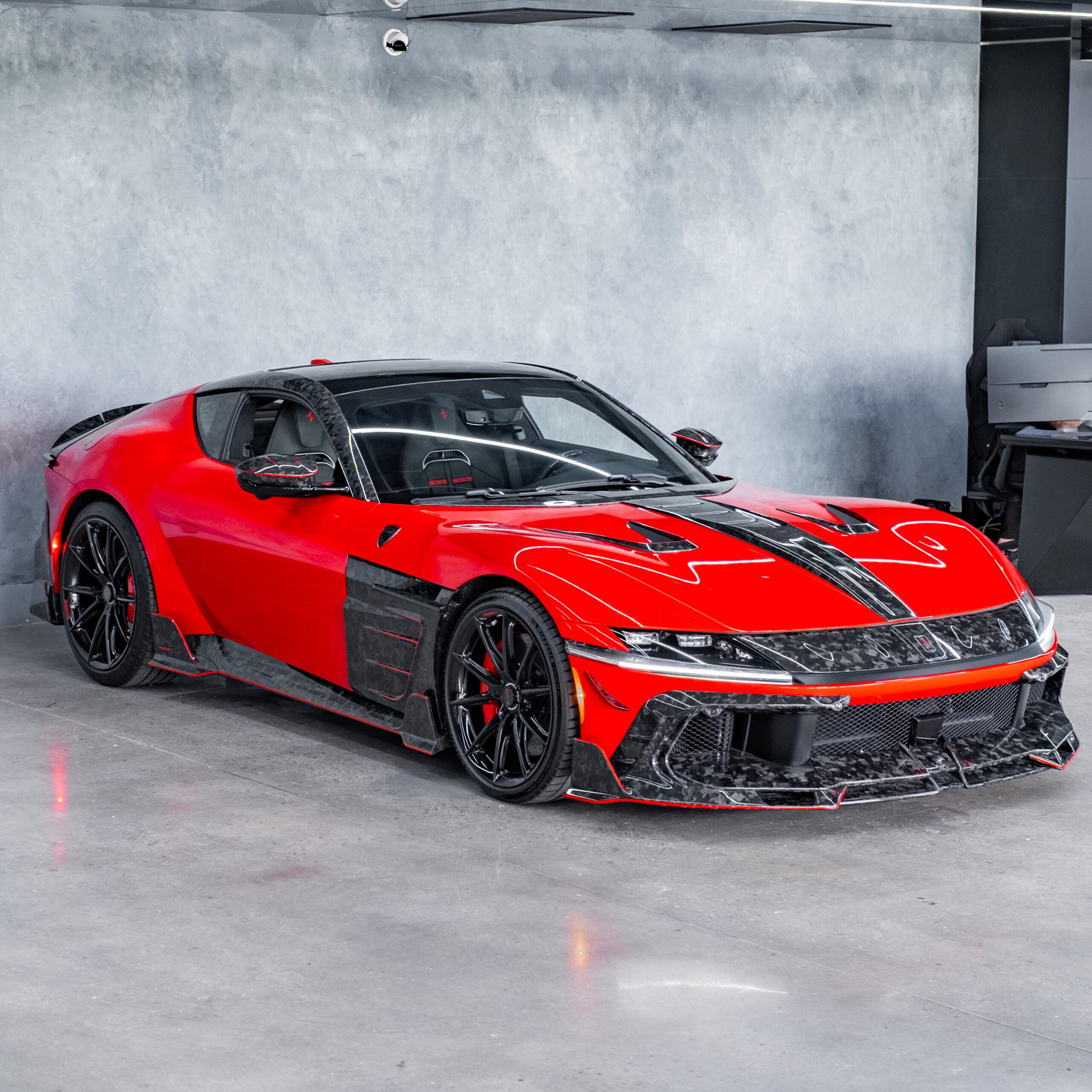
The Mansory USA 12Cilindri, with forged carbon covering the nose, fender panels and sills. Photo: Mansory USA via Instagram
Mansory doesn’t usually do understated. This is the company that gave Dubai Police a carbon-clad Ferrari 812 and pushed a Lamborghini Urus SE past 1,000 horsepower. So the Ferrari 12Cilindri its U.S. division posted to Instagram last week stands out for how much it leaves alone. The paint is still red over most of the body. The post makes no power claim, and it never mentions the cabin.
The caption covers two things. The first is an aero package “executed entirely in exposed MANSORY carbon fibre” that the company says respects Ferrari’s lines while adding downforce. The second is a set of Mansory’s newest fully forged wheels. That’s the whole announcement. Nothing about the V12, and nothing about price.
What the Photos Show
The six images Mansory USA shared show a car where the forged carbon starts low and works its way up. The whole lower front bumper is new, with a deeper splitter and canards at the outer corners. A carbon stripe runs down the center of the hood, and carbon trim frames the bonnet vents. Big slatted carbon panels cover the front fenders behind the wheels. Carbon sills connect those panels to the rear wheels.
At the back there’s a fixed ducktail spoiler on the tail, a larger diffuser and four exhaust tips framed in carbon. The mirror caps are carbon too, and the fenders wear shield badges with the Mansory name set into forged carbon. The wheels are gloss-black multi-spoke forged pieces with red calipers behind them. Ride height looks close to stock.
Compare that with the Mansory Equestre, the company’s first full 12Cilindri conversion, which debuted at the 2025 Monaco Yacht Show. Mansory said at the time that the Equestre came in coupe and Spider form with VF.5 forged aluminum wheels, new body parts in dyed-through forged carbon, a new interior and a tune to 855 hp and 730 Nm. The U.S. car appears to take the bodywork idea and stop there. For a tuner that usually leads with horsepower, this one is mostly about looks.
Ferrari Designed Those Panels to Do Jobs
This is where it gets interesting for an owner, because the parts Mansory replaced aren’t decorative on the stock car. Ferrari’s launch documentation says the 12Cilindri’s front bumper has seven openings, and each one has a specific job. The central intake feeds the engine coolant radiator and the A/C condenser. The oil cooler is split into two units that sit ahead of the front wheels. Each side intake is divided so its outer half cools engine oil and its inner half cools the brakes. Another brake-cooling duct takes air from an opening low in the splitter.
Replace that bumper and the new one has to feed all of those systems at least as well as the original. Mansory hasn’t published cooling or airflow data for this kit. That matters less on a sunny cruise and much more on a track day or in summer traffic. With 830 cv (818 hp) and a 9,500-rpm redline, the F140HD V12 makes a lot of heat.
The same goes for the sides. Ferrari put a vent on the front wing, behind the wheel, to release pressure from the wheel arch. The front underbody also carries three pairs of vortex generators, a layout Ferrari says follows the 812 Competizione. Mansory’s large fender panels sit right over that area. They may well keep the vent working, but the photos can’t tell us.
A Fixed Spoiler on a Car Designed Without One
The rear is where the design thinking really differs. Ferrari decided against a conventional spoiler for the 12Cilindri. It used a 25-mm nolder (a small lip) on the trunk lid plus two active flaps built into the rear screen, which form the car’s signature black “delta” shape. According to Ferrari, the flaps stay flush with the body below about 37 mph (60 km/h) and above roughly 186 mph (300 km/h), where drag matters more than downforce. In between, they move based on the car’s longitudinal and lateral acceleration.
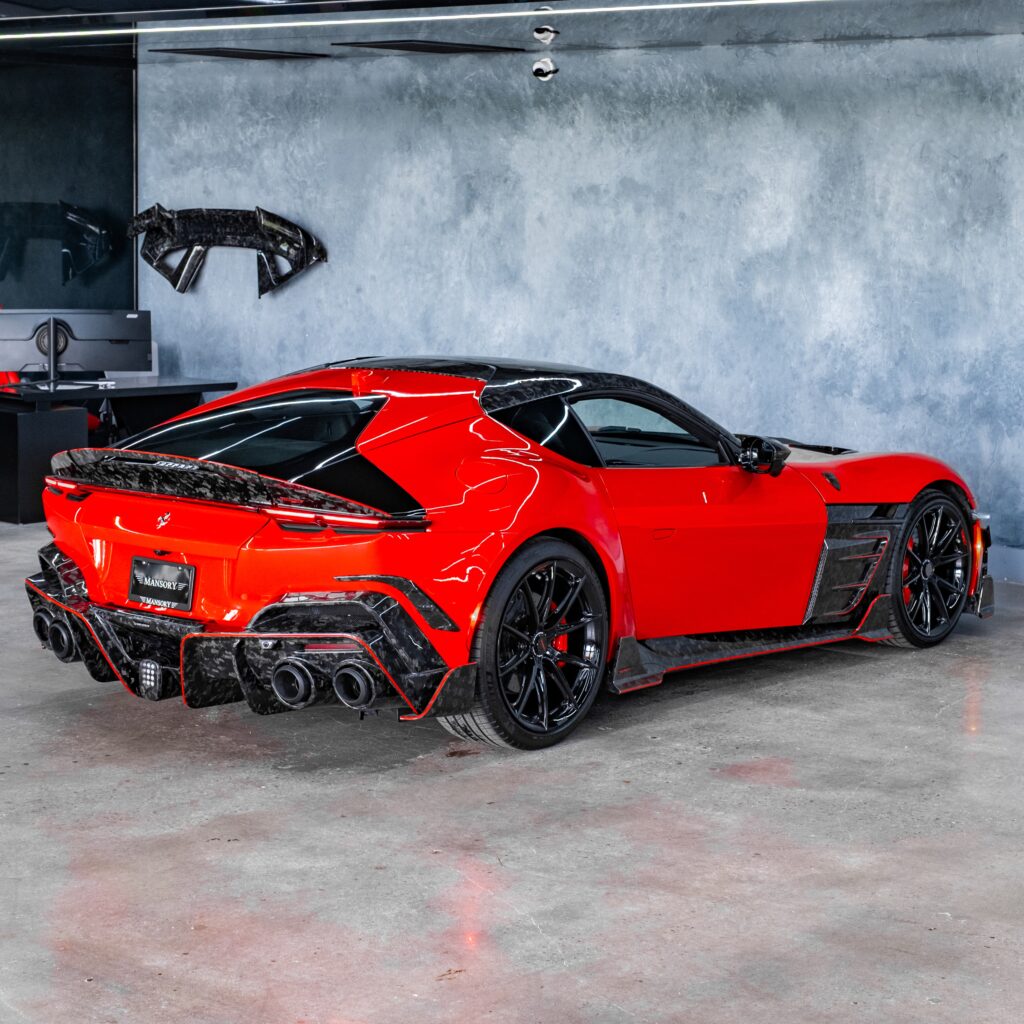
A fixed ducktail doesn’t adapt. It adds downforce all the time, and drag along with it. Mansory promises “distinct, aggressive downforce” but gives no numbers, no speed and no front-to-rear balance. That’s a real gap on a car Ferrari balanced around a 48.4/51.6 front/rear weight split, active rear flaps and a stability-control system (SSC 8.0) that works alongside four-wheel steering. Because the kit changes the front splitter and the rear lip together, it probably shifts both ends at once. Whether the balance stays where Ferrari set it is anyone’s guess until Mansory shares data.
There’s also a smaller practical issue. Ferrari says the lower rear section of the 12Cilindri holds the car’s sensors along with its two pairs of tailpipes. After swapping the diffuser, a good shop will check that the parking sensors and any driver-assistance hardware back there still read correctly.
The Wheels Are Not a Free Choice
The Michelin Pilot Sport S5 and Goodyear Eagle F1 Supersport tires Ferrari approves for the 12Cilindri were developed in sizes made for this car: 275/35 R21 in front and 315/35 R21 in back, on 10- and 11.5-inch-wide rims. Behind them are 398-mm front brake rotors, and the rear axle steers. So any aftermarket wheel has to clear big brakes and suit a steering rear axle, and the tire you fit may no longer be one Ferrari tested for the car.
Mansory hasn’t listed sizes or offsets for this car’s wheels. Before buying, ask whether they keep factory-approved tire sizes. If they don’t, ask what’s been tested in their place. Forged wheels do cut unsprung weight, which is a real benefit. Getting the fitment right is what lets you keep that benefit.
Warranty, Insurance and the Resale Question
A 12Cilindri this new is almost certainly still under factory coverage, and its owner probably cares about that. Under U.S. federal law, a manufacturer generally can’t make warranty coverage depend on using its own branded parts. The Federal Trade Commission has warned automakers about exactly that. What a manufacturer can do is refuse to cover damage the aftermarket part actually caused. So if an oil cooler starts struggling behind a new bumper, expect a hard conversation at the dealer. Ferrari’s seven-year maintenance program covers scheduled servicing, and it won’t pay for a scuffed forged-carbon splitter.
Insurance deserves just as much attention. Forged-carbon Mansory panels don’t come from Ferrari’s parts catalog, so an adjuster pricing a front-end hit off factory parts can come in far short. Owners should tell their insurer about the kit in writing, keep the invoices, and look for an agreed-value policy that lists the modifications. Otherwise, the first parking-garage scrape can turn into a fight over the claim.
Then there’s resale. Ferrari designed this car as a direct descendant of its front-engine V12 grand tourers, and many buyers of used V12 Ferraris want factory originality. Keep every stock part you remove, crated and labeled, and ask before install whether the kit bolts on or needs cutting and drilling. Parts that bolt on can be reversed. Holes in the car can’t.
What the Base Car Already Brings
For context, here’s what the kit starts with. Ferrari unveiled the 12Cilindri in Miami Beach on May 3, 2024. It uses a 6,496-cc, 65-degree dry-sump V12 with titanium connecting rods, a lighter crankshaft and finger-follower valve gear developed from Ferrari’s F1 experience. It makes 830 cv at 9,250 rpm and 678 Nm (500 lb-ft) at 7,250 rpm, and it revs to 9,500. Power goes through an eight-speed dual-clutch transmission. Ferrari quotes 0-100 km/h in 2.9 seconds, 0-200 km/h in under 7.9 seconds and a top speed above 340 km/h (211 mph). Dry weight is 1,560 kg when fitted with the optional lightweight parts.
That’s more car than almost anyone will ever use, which may explain why Mansory USA left the engine alone. The Equestre’s 855 hp claim was only about 25 more than stock. That’s hardly the kind of gain that sold Mansory’s turbocharged builds. With a naturally aspirated V12 there’s no boost to turn up, and the gains are small.
The Takeaway
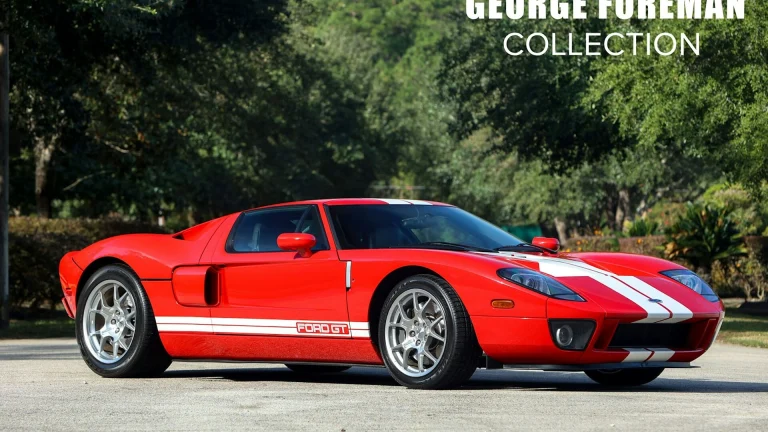
Mansory’s work usually divides people, from a zero-mile “Le Mansory” Ford GT to rival German tuners’ 1,000-hp Brabus Bodo. This 12Cilindri is milder than that, and the carbon is at least shaped around Ferrari’s own design. Still, a kit that touches the cooling intakes, the underbody-adjacent bodywork and a carefully calibrated active-aero rear is doing more than styling. Mansory’s caption says the car gets downforce and forged wheels. What a buyer needs are the numbers behind those claims, and Mansory hasn’t published any yet.
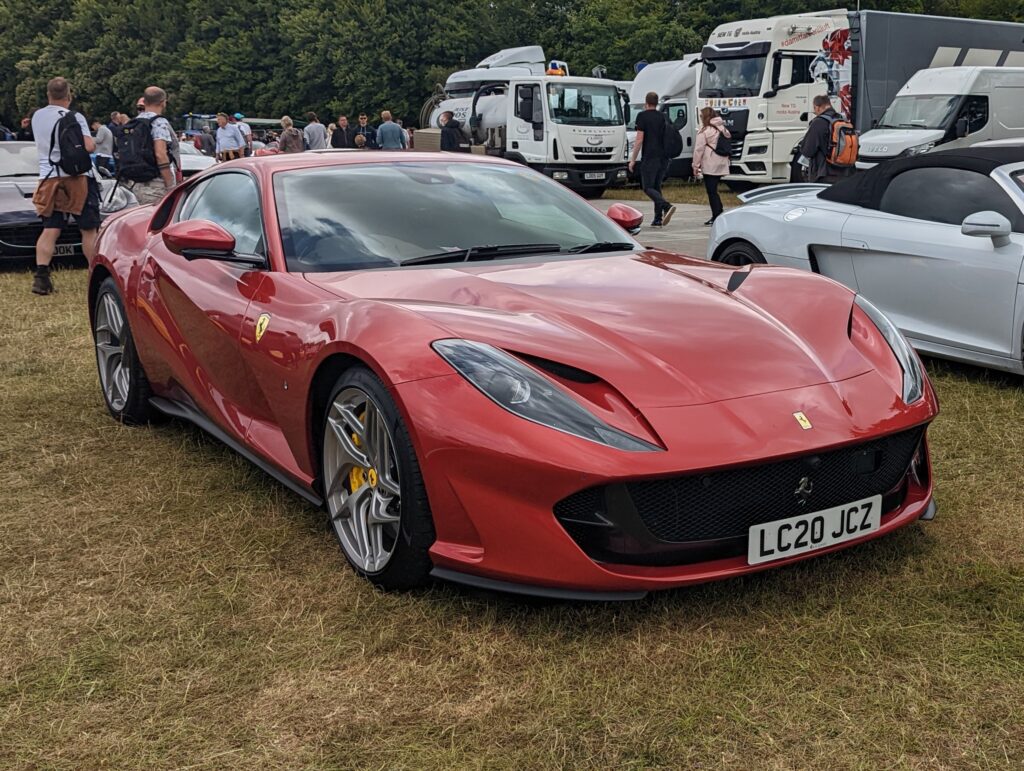
Photos: Mansory USA via Instagram; Calreyn88 via Wikimedia Commons (CC BY-SA 4.0).
About the Author