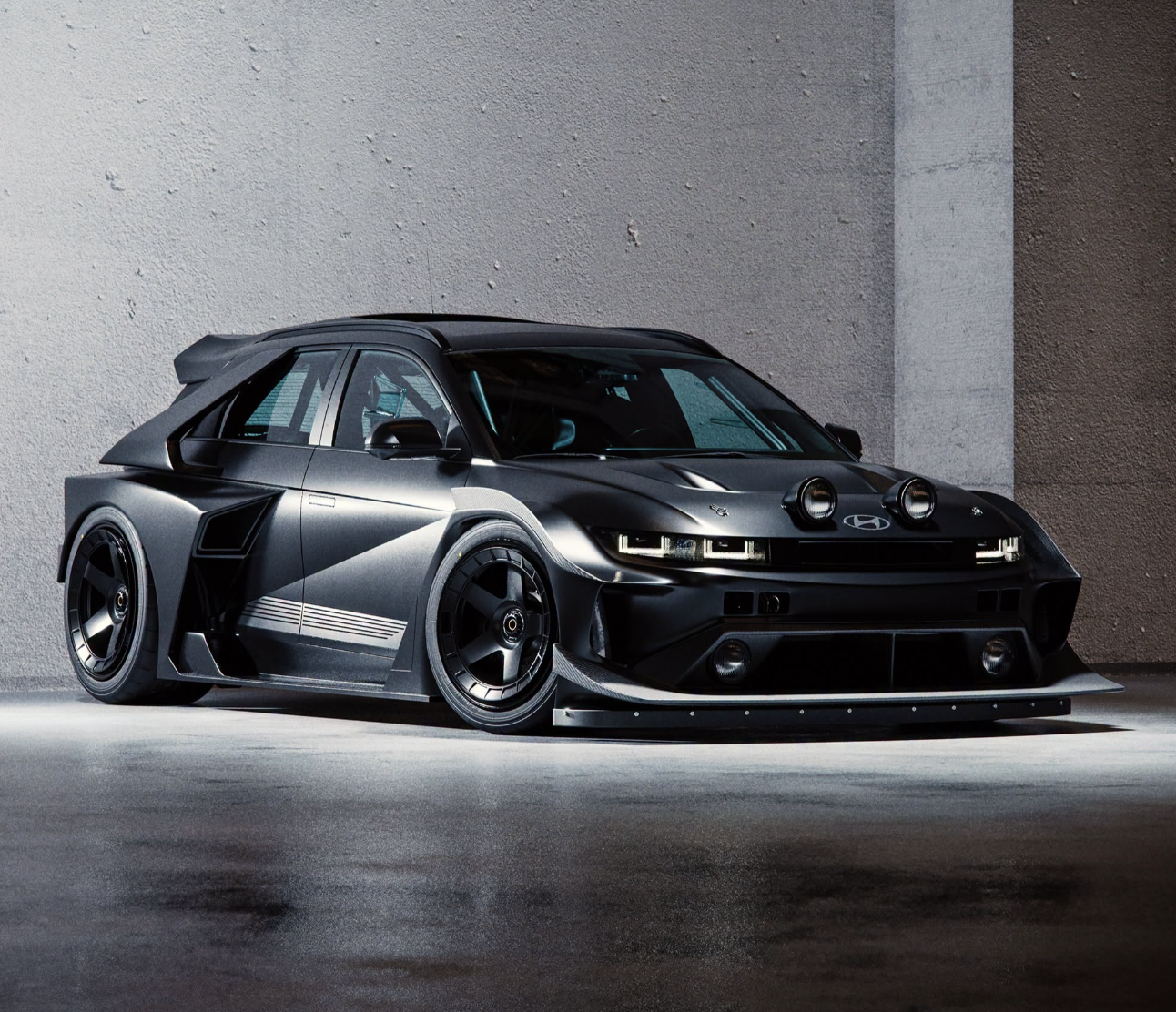
Take the Ioniq 5 N’s pixel-block styling, add arches that look cut from sheet steel, bolt a wing to the tailgate, and something odd happens: the design starts to look like it was meant for this. British digital artist Khyzyl Saleem, who works as The Kyza, has done exactly that with a rally-kitted rendering of Hyundai’s performance EV, and the result looks less like a fan fantasy and more like a homologation special someone forgot to build in 1985.
It’s a rendering. Nobody is building it, and there’s no order book. But it raises a better question than most digital builds do: how far is the real Ioniq 5 N from being a real rally weapon? The honest answer is further than it looks, and closer than you’d think.
Why the Ioniq 5 N Fits the Look
Group B worked visually because the cars were upright, boxy road cars pumped up to absurd proportions. Hyundai designed the Ioniq 5 with hard creases and square lighting, so it already has that shape. Wide arches suit it in a way they’d never suit a soft modern crossover.
Related Articles
- JOP Brought Two Ferrari Enzos Back to His Childhood Home in San Bernardino, and the Real Story Is Under the Hood
- The 2026 Tesla Model 3 Just Swept NHTSA’s Five Stars — Here’s Every Test That Rating Skips
The numbers support the attitude, too. Hyundai’s official spec sheet lists 601 hp and 545 lb-ft normally, rising to 641 hp and 568 lb-ft with N Grin Boost, plus a 3.25-second 0-60 time. Hyundai says the motors spin to 21,000 rpm, and Grin Boost delivers its extra power in 10-second windows. That’s roughly push-to-pass for a family-sized hatch.
The Problem Is the Scale
The same spec sheet explains why a real Group B Ioniq would need more than a body kit. The curb weight is 4,861 pounds, and the 84 kWh battery accounts for 1,071 of them.
Compare that to current top-tier rallying. For 2025 the FIA cut minimum weight for Rally1 cars from 1,260 kg to 1,180 kg, about 2,601 pounds, after dropping the plug-in hybrid units. The Ioniq 5 N’s battery alone equals about 41 percent of a complete Rally1 car’s minimum weight. The whole road car weighs about 1.9 times as much.
That’s why Saleem’s rendering ditches the electric drivetrain for a combustion engine. The swap would be a much bigger job than it sounds. On Hyundai’s E-GMP architecture, the battery sits in the floor and is part of the car’s basic structure. Remove it, fit a mid-mounted engine behind the seats, and you’re no longer modifying an Ioniq 5 N. You’re building a tube-frame race car and dressing it as one, which, to be fair, is how the wildest Group B cars were built anyway.
Group B’s Real Rules Were Stranger Than the Myth
According to the FIA’s own historic homologation database, Group B was introduced in 1983 after being announced in 1978. It gave manufacturers almost total freedom. The catch was homologation. Ford’s RS200 was named for the 200 road cars theoretically needed for FIA approval. The FIA then banned Group B from rallies in 1986 for safety reasons, although the cars kept racing in European Rallycross until 1992.
That homologation catch is the interesting part here. Group B’s road-going specials existed because the rulebook required them. Hyundai already sells a car with rally-sounding software, such as drift optimization, simulated gearshifts and adjustable torque split. What it has never had to do is build a street car in order to race.
Hyundai Has Already Built the Sensible Version
The most practical takeaway is that Hyundai has already explored this idea, just without the combustion engine or the hair metal. Its RN24 rolling lab, revealed at N Day 2024, put the Ioniq 5 N’s 650 PS dual-motor system into a WRC-inspired chassis. A redesigned 84 kWh pack allowed a wheelbase 340 mm shorter than the production car’s. Hyundai said that brings RN24 down to B-segment size, comparable to the i20 N Rally1, and fitted it with rally-spec dampers and high-rigidity subframes.
In other words, Hyundai’s engineers have already tried to shrink the Ioniq 5 N toward rally-car proportions. The rendering goes the other way: it keeps the road car’s shape and makes it huge. Put side by side, the two tell you what a real rally-bred Ioniq would be fighting: mass and length, not a lack of power.
Hyundai’s Rally Credibility Is Real
This isn’t a brand wearing someone else’s heritage. Hyundai won WRC manufacturers’ titles in 2019 and 2020, and Thierry Neuville gave the team its first drivers’ title in 2024 in the i20 N Rally1 Hybrid.
The timing matters, too. Hyundai Motor Group describes 2026 as the current Rally1 generation’s last full season before cost-focused WRC27 rules that lean heavily on Rally2 architecture. The FIA’s hybrid removal (announced in 2024) also shrank the restrictor from 36 mm to 35 mm to keep power-to-weight roughly equal. Top-level rallying is heading toward cheaper, simpler cars, while Hyundai’s road-going halo moves toward heavier, faster, software-driven performance. A Group B Ioniq sits exactly where those two directions split, which is probably why it’s so appealing.
What Owners Should Know Before Chasing the Look
Some Ioniq 5 N owners will see this and start pricing fender flares. A few practical points first.
Sensors. Front and rear fascia changes on a modern Hyundai can affect radar and camera-based driver aids. Any bumper replacement should include checking whether those systems need recalibration, which is often expensive at a dealer.
Tires and range. Wider tires and bigger wheels change rolling resistance and aerodynamics. On a car with an 84 kWh pack, that affects real-world range. Wider rubber for a 4,861-pound EV also isn’t cheap to replace.
Insurance. Declare the modifications. A widebody kit, aftermarket aero or lighting changes can affect both premiums and claim payouts. Undisclosed modifications are an easy way to have a claim disputed.
Legality. Race-style polycarbonate windows and roll cages belong on track cars. Federal glazing rules under FMVSS No. 205 exist to protect visibility and reduce occupant ejection. Check local rules on auxiliary lighting before mounting a light pod on the hood.
Related Articles
- BRM’s One-of-One Le Mans Prototype Just Got Its Roof and V12 Back After 30 Years
- The Freeway Revolts of the 1960s Still Dictate How America Builds Roads Today
Cost. Hyundai cut the 2026 Ioniq 5 N’s starting price to $59,900 before destination, $6,300 less than the previous model year. A cheaper starting point may encourage more owners to modify, and depreciation on EVs means modified examples may hit the used market sooner than you’d expect. Buyers should ask for records of who did the work and whether the car’s electronics were recalibrated.
The Verdict
As a render, it works because the car underneath already looks the part. As an engineering idea, it runs into the fact that the Ioniq 5 N weighs almost twice what a modern top-tier rally car is allowed to. Hyundai’s RN24 shows the company knows that, and has already shown what a serious answer would look like: smaller, shorter and still electric.
The Group B Ioniq will stay a digital car. But if Hyundai ever builds a compact, rally-bred N EV with arches this outrageous, it’ll be easy to guess where the idea came from.
Images Via: Khyzyl Saleem
About the Author