Photo: Ethan Llamas / Wikimedia Commons (CC BY-SA 4.0)
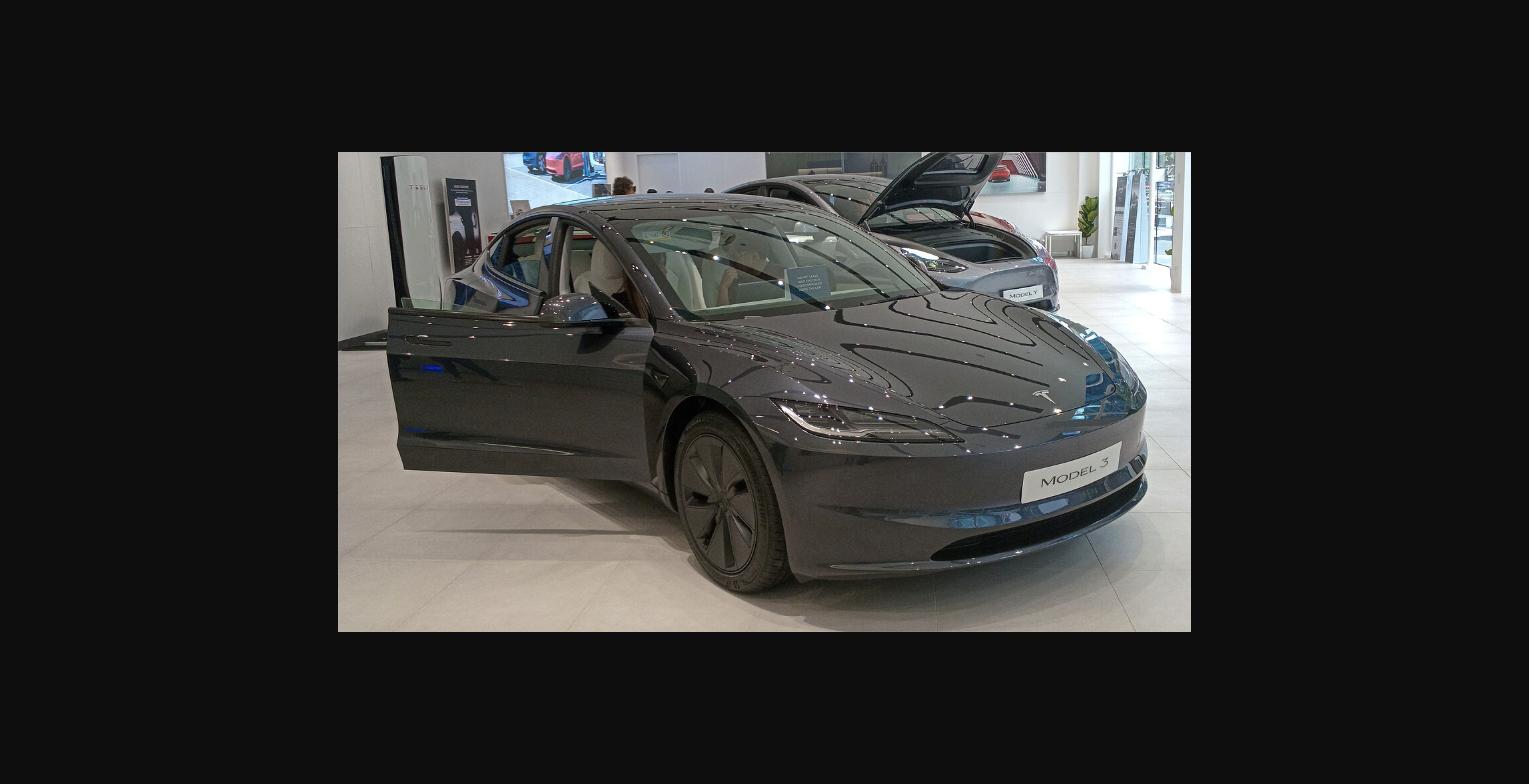
The 2026 Tesla Model 3 carries a five-star overall rating from NHTSA, and it did not squeak in. Pull the agency’s own safety-ratings data and every single subscore comes back at five stars: frontal crash driver side, frontal crash passenger side, side barrier front and rear, side pole, and rollover. Four configurations sit in the database, rear-wheel drive and all-wheel drive plus two listed as Early Release, and they all post identical numbers. There is no separate Performance entry.
That is a clean sheet. It is also a much narrower statement than most people think it is, and the gap between what the stars measure and what actually happens in a crash is where the useful information lives.
What five stars actually covers
NHTSA’s New Car Assessment Program runs four tests. A full-width frontal impact into a fixed barrier at 35 mph, with an average-male dummy driving and a smaller-female dummy in the passenger seat. A side impact from a 3,015-pound moving barrier at 38.5 mph. A side pole test, where the car is pulled sideways at 20 mph into a 25-centimeter pole. And a rollover rating built from the static stability factor plus a dynamic fishhook maneuver. The Model 3 posted a 6.8 percent rollover risk and a “No Tip” result, which is exactly what you would expect from a car with a floor-mounted battery pack.
Two limitations come straight from NHTSA’s own documentation, and neither gets printed on a window sticker. Frontal star ratings are only comparable between vehicles within roughly 250 pounds of each other, because the barrier test simulates a collision between two similar cars. A five-star subcompact and a five-star three-row SUV are not making the same promise. And the federal program contains no small-overlap frontal test at all. That test, the one that catches what happens when the corner of a car hits a pole or another vehicle outside the frame rails, only exists in the insurance industry’s program.
Where the Model 3 stops being perfect
IIHS runs the harder curriculum, and the 2026 Model 3 does not sweep it.
Small overlap front, driver and passenger: Good. Side crash under the updated, more severe protocol: Good. Front crash prevention, both vehicle-to-vehicle and pedestrian: Good, with collisions avoided in every scenario tested. That is genuinely strong.
Then the updated moderate overlap front test comes back Acceptable, not Good. Every driver-side measure is Good; the score drops because the rear-seat passenger’s chest injury measure rates Marginal. That test was added specifically because back-seat occupant protection had fallen behind front-seat protection across the industry, and the Model 3 is one of a long list of cars it caught.
Headlights: Acceptable. Child seat anchors: Acceptable, with two full LATCH positions and one tether-only. Seat belt reminders: Marginal, flagged because the front-row alert duration is too short. And no Top Safety Pick badge appears on the car’s IIHS page, which follows directly from those Acceptable and Marginal scores.
The rating is a carryover, and Tesla ran some of the tests
This is the part worth understanding before anyone treats a 2026 rating as a 2026 result. The Model 3 was redesigned for the 2024 model year, and the physical crash tests underlying the current IIHS ratings were run on a 2025 car. The driver-side small overlap test was performed by Tesla itself and submitted, and the passenger-side small overlap was tested both by IIHS and by Tesla.
Manufacturer-run testing is a normal, disclosed part of the IIHS program and the institute verifies results, but it is a different thing from an independent lab crashing a car it bought off a lot. When a rating gets described as brand new for a model year, it is often a structure that was validated two years ago and has not changed since.
NHTSA was supposed to make this harder in 2026
The federal program was scheduled to add real content this model year: pedestrian crashworthiness scoring, plus new checkmarks for blind-spot warning and intervention, lane-keeping assist and pedestrian automatic emergency braking. Those updates got pushed from model year 2026 to model year 2027 after the Alliance for Automotive Innovation asked for a delay. NHTSA’s notice states plainly that no pedestrian-protection credits will be awarded for model year 2026 vehicles and that the five-star crash rating program remains unchanged.
So a 2026 five-star rating is measured against the same yardstick as a 2020 five-star rating. Nearly every new car sold in America clears it. That is not a knock on the Model 3; it is a knock on treating the stars as a differentiator. The agency’s attention has been elsewhere lately anyway, including a Tesla door handle complaint that turned into a federal rulemaking and a suspension investigation opened this year.
No, this will not lower your insurance bill
The most persistent myth attached to safety ratings is that stars translate into premium discounts. Insurers do not price policies off NHTSA stars. They price off claims data, and the organization that publishes that data is the Highway Loss Data Institute, the IIHS affiliate that tracks actual insurance losses by vehicle.
HLDI’s most recent bulletin comparing electric vehicles to gasoline counterparts excludes Tesla outright, for a specific reason it states directly: Tesla has no conventionally powered equivalent to compare against. The same bulletin notes that earlier HLDI work found Tesla vehicles running higher losses than comparable luxury gasoline cars, and that the gap widens once you adjust for how many miles the cars actually cover.
The broader EV findings in that research are worth knowing if you are shopping the segment. Adjusted for mileage, EVs showed roughly 20 percent lower collision claim frequency and 17 percent lower property damage liability frequency than gas equivalents, with bodily injury, personal injury protection and medical payment claims down 22, 40 and 41 percent. A large chunk of that comes down to exposure: the EVs in the sample were driven about 39 percent fewer miles per day.
The practical read
If you are cross-shopping the Model 3, the five stars tell you the car does not have a structural problem. They do not tell you it is safer than the five-star sedan parked next to it. The information that separates cars is in the IIHS scores, and there the Model 3 is very good in front and side impacts, very good at avoiding the crash in the first place, and merely acceptable at protecting whoever is sitting in back. If you routinely carry rear-seat passengers, that moderate overlap result is the number that should matter to you, and it is the one that did not make the headline.
Your Turn: Do crash-test ratings actually change which car you buy? Let us know in the comments.
About the Author