A Tesla Model 3 owner named Kevin Clouse spent the last several months trying to convince NHTSA that his car’s door handles helped set the stage for a genuine nightmare. In a petition filed November 7, 2025, and logged in federal docket NHTSA-2026-1553, Clouse said his 2022 Model 3 suffered a head-on collision that knocked out the car’s electrical system and started a fire. With the electric door handles dead, he said he couldn’t locate the mechanical backup release, forcing him to climb into the back seat and escape through a rear window. On July 24, 2026, the agency published its answer: no investigation. Case closed. Except it isn’t, not really, because buried in the same notice is an admission that the current rulebook has a hole in it big enough to climb through.
NHTSA’s Office of Defects Investigation checked Clouse’s complaint against every other consumer complaint in its databases tied to the roughly 179,031 Model 3s built for the 2022 model year. It found exactly one matching complaint: his. One entrapment allegation out of a six-figure fleet isn’t the kind of pattern that typically justifies opening a formal defect investigation, and the agency said as much, concluding it was “unlikely that additional investigation would result in finding” a safety defect.
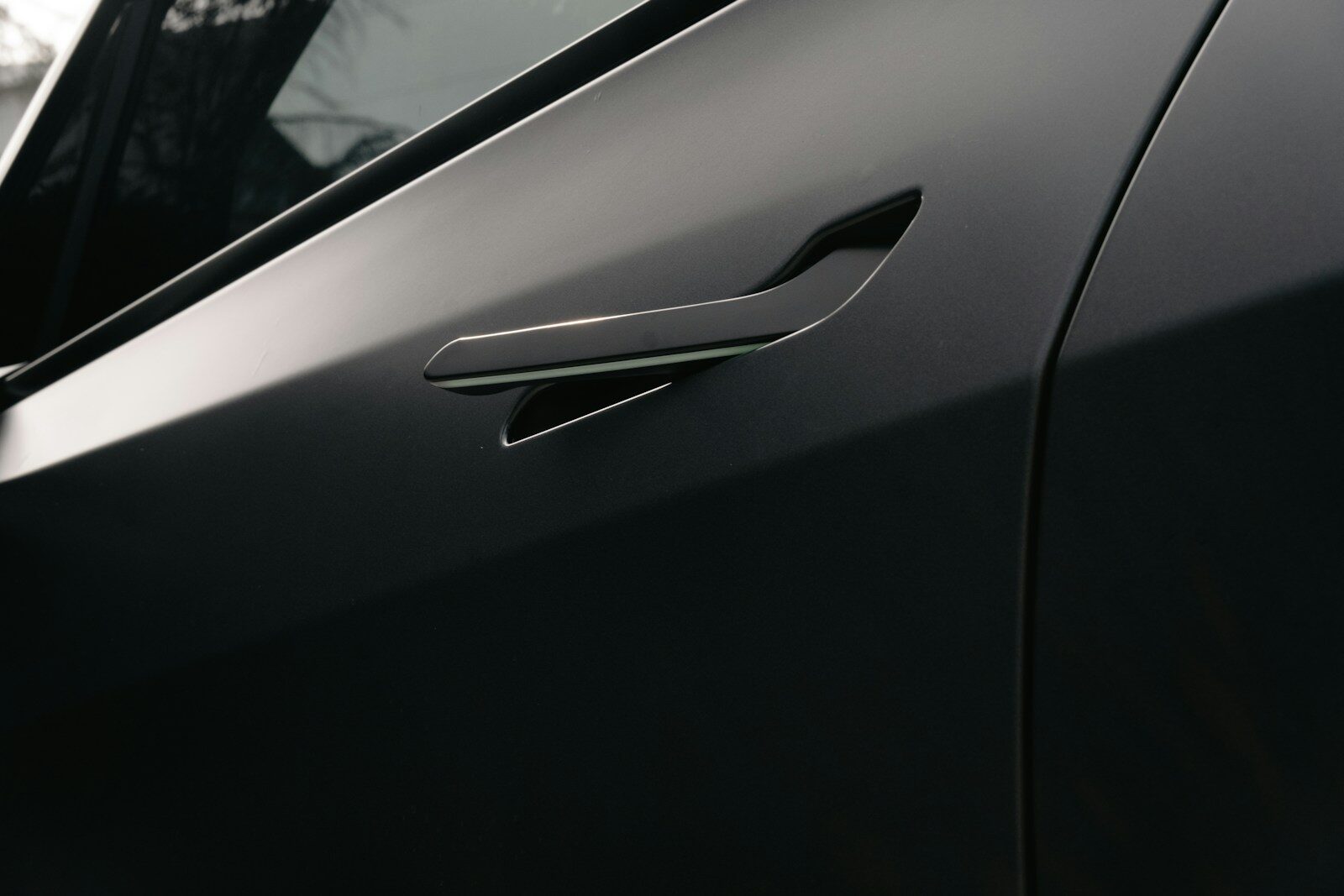
Here’s the part that actually matters if you’re shopping a modern EV. The 2022 Model 3’s front doors do have a mechanical backup latch, a small lever tucked in front of the window switch that you pull upward when the powered release quits working. The rear doors on that model year don’t have one at all. Tesla’s owner’s manual walks through the procedure under a section titled “In Case of Emergency,” complete with an illustration and an arrow showing which way to pull. But inside the actual car, that lever carries no label and no icon, nothing to tell a panicked occupant in a smoke-filled cabin that it’s the thing standing between them and the outside world. NHTSA’s own read of the applicable standard, FMVSS 206, is that none of this violates anything, because FMVSS 206 was written to keep doors from popping open and ejecting occupants during a crash, not to dictate how a manual release should be labeled or located. It’s a latch-integrity standard from an era when every door handle was a physical piece of metal linked directly to the latch. Nobody drafting it decades ago planned for a car whose exterior handle is a capacitive-touch pad that goes dark the instant the 12-volt battery dies.
That gap is exactly why the agency’s decision reads like a contradiction until you notice the timing. Three days before Clouse filed his petition, NHTSA’s Office of Rulemaking had already received a separate request asking the agency to create a brand-new safety standard mandating a robust, obvious door egress system across all motor vehicles, not just Teslas. NHTSA granted that request in the very same notice that denied Clouse’s. Translated out of bureaucrat: no, the agency won’t investigate this car specifically, because there’s no existing rule it actually broke, but yes, the agency agrees the rule needs to exist, so it’s going to go write one.
That distinction is worth understanding if you want to know what happens next, because a defect petition and a rulemaking petition run on completely different tracks. A defect investigation requires evidence that a specific vehicle violates an existing standard or contains a safety-related flaw with a discoverable pattern; with one complaint out of 179,031 cars, Clouse’s petition was never clearing that bar. A rulemaking petition asks a different question entirely, whether a new rule should exist, and it doesn’t require proof that a defect has already caused widespread harm. NHTSA can act on the second track while rejecting the first, which is precisely what happened here. The catch is timing. Rulemaking proceedings typically run for years: a proposal, a public comment period, agency review, and a final rule that then phases in over subsequent model years. Nothing changes for the Model 3 sitting in a driveway today, and realistically nothing changes industry-wide for a good while yet.
This isn’t Tesla’s only appointment with federal regulators this year. The company is simultaneously trying to head off a proposed defect investigation covering roughly 3.2 million vehicles tied to Autopilot performance, working through a recall on its cheapest Cybertruck trim after wheels were found capable of separating from the truck, and answering federal investigators now examining a Tesla that plowed into a Texas home and killed a woman. None of those cases involve door handles, but they fit the same pattern: a company moving fast on new technology, and regulators playing catch-up after the fact.
The United States is taking the slow road on a problem some regulators decided couldn’t wait. Backfire News covered China’s decision to ban hidden and retractable door handles outright, forcing every automaker selling there to revert to traditional mechanical designs. NHTSA’s approach is the opposite instinct: study it, petition it, propose it, take public comment, then maybe mandate it years down the line. Both responses target the same underlying design trend, flush, electronically actuated handles adopted for aerodynamics and styling, popularized in the U.S. by Tesla and copied widely across the EV segment. The tradeoff was baked in from the start. Slick handles shave a fraction off a drag coefficient; handles that go dead the moment power is lost can turn a car into a box nobody can get out of.
None of that helps anyone already driving one of these cars, so treat this as homework. Every Tesla model has some form of mechanical backup release, but the location and operation differ by model and by door, front versus rear, sedan versus SUV, and Tesla isn’t alone; several other EV makers have adopted similarly power-dependent handle designs. Find yours in daylight, manual in hand, before you ever need it in the dark with smoke in the cabin. If you’re buying a used EV with flush or electronic handles, ask the seller to physically show you every mechanical release in the car, front and rear, as part of the walkthrough; it takes thirty seconds and it’s more useful than the infotainment demo. Insurers and fleet managers should be flagging this in driver training now rather than waiting on a final rule that’s still years away.
Filing a defect petition and getting denied isn’t the same as losing. Clouse’s complaint didn’t get Tesla in trouble, but it landed at the exact moment NHTSA had already decided the underlying rule needed rewriting, and that timing is the real story here. A federal agency just told the public, in writing, that door handle rules haven’t kept pace with the cars now being built. It just didn’t feel like admitting it, so it buried the concession inside a denial.
About the Author