Image via Porsche
Porsche just told its own workforce that keeping the 911 in production for another decade is going to cost more than money. It’s going to cost jobs, bonuses, and a chunk of everyone’s Christmas check. On July 27, 2026, the automaker’s Executive Board and General Works Council signed off on what the company is calling its “Future Package,” a deal hammered out with IG Metall and the Südwestmetall employers’ association that eliminates another 5,000 positions by 2035 while simultaneously locking in employment and site protection at Zuffenhausen and Weissach through the same year. Nobody is getting a pink slip on Monday morning. Instead, Porsche is engineering a slow bleed built from retirements, demographic attrition, an expanded partial-retirement program, and voluntary severance, spread across nine years.
If a U.S. automaker announced this, the headlines would simply say “layoffs.” Germany’s labor system doesn’t work that way. Porsche’s workforce operates under codetermination, or Mitbestimmung, where a General Works Council holds real influence over restructuring decisions and IG Metall, the country’s largest industrial union, negotiates alongside the regional employer association Südwestmetall. That’s why the same document that erases 5,000 jobs also contains a binding promise of zero compulsory redundancies through the end of 2035. Attrition does the trimming, not termination notices, and that distinction matters both legally and financially, since voluntary severance and early retirement packages carry very different costs and obligations than a mass layoff would.
The workforce is essentially paying for its own job security. A collectively agreed 3.5 percent pay increase gets deferred all the way out to 2035, along with future increases. Senior and top managers give up an equivalent slice of base-pay growth in 2027 and 2028. The company-funded share of the annual Christmas bonus shrinks from 45 percent down to just five percent by 2035, which cuts the maximum payout from a full month’s salary down to 60 percent of one. Mobile work gets capped at eight days a month instead of twelve, and break schedules and production cycle times are being renegotiated on the shop floor. In exchange, Porsche is paying a one-time transformation bonus of 1,500 euros in August 2026, worth 1,911 euros for IG Metall members, who also receive an extra paid day off and a 200-euro annual voucher.
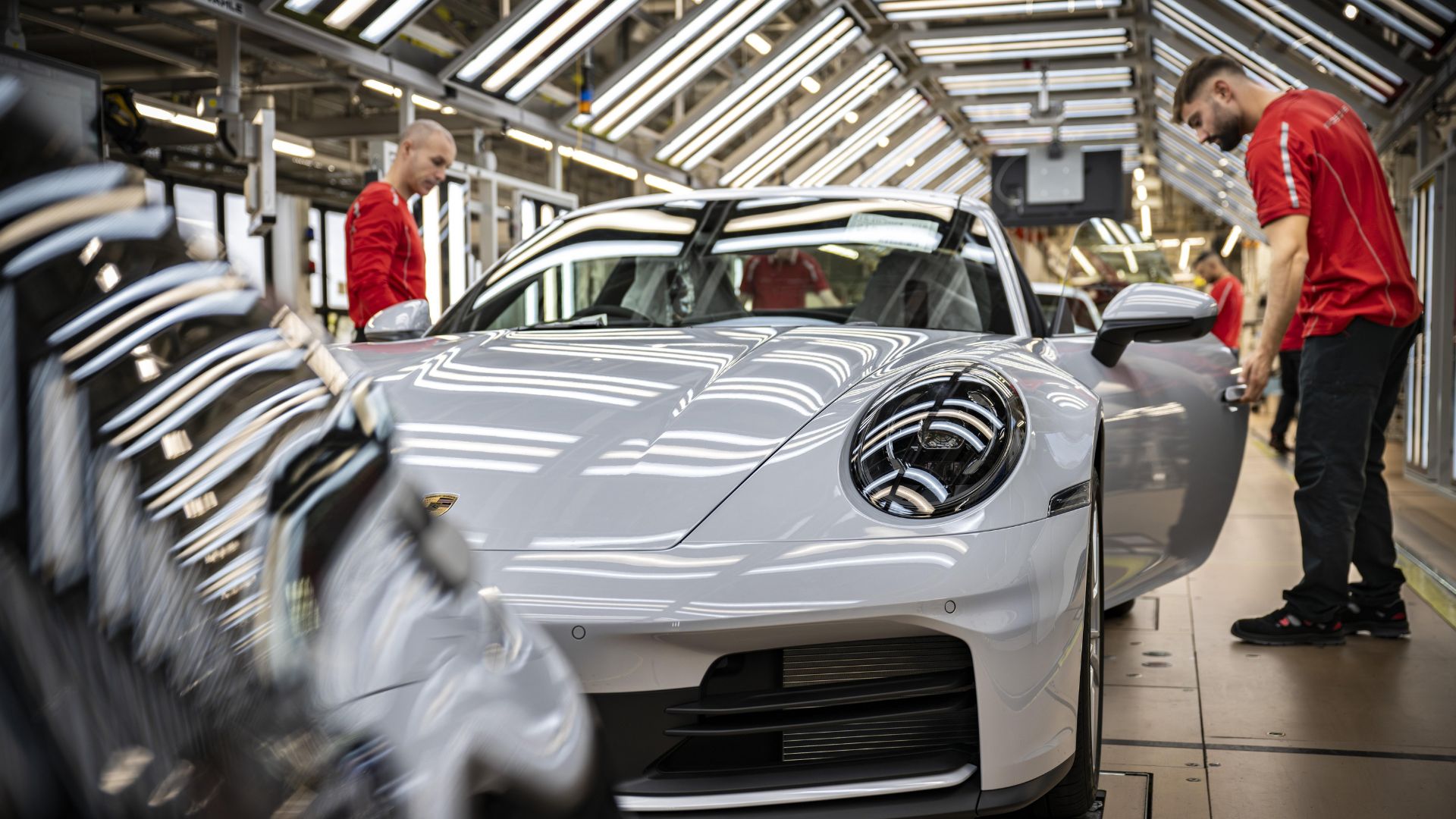
On the other side of the ledger, Porsche is committing a cumulative 2.1 billion euros into Zuffenhausen and Weissach through 2035. That money is earmarked to keep two-door sports cars physically rolling off the Zuffenhausen line, to grow capacity for the Sonderwunsch personalization program, and to keep development work for every model line centered in Weissach. CEO Dr. Michael Leiters frames the whole exercise, internally dubbed “Sportwagenschmiede 35,” as the financial foundation underneath the broader Strategy 2035 plan Porsche will detail at a Capital Markets Day on October 7.
None of this is happening in a vacuum. At Porsche’s Annual General Meeting on June 23, Leiters confirmed 2026 guidance of just 5.5 to 7.5 percent operating return on sales, a figure that already bakes in 800 to 900 million euros of one-off restructuring costs and roughly 700 million euros in tariff exposure. Sales revenue guidance sits around 35 to 36 billion euros, well off the margins Porsche built its reputation on. The dividend proposed for 2025 dropped to 1.00 euro per ordinary share and 1.01 euros per preferred share, down from the prior year. Leiters has also been blunt about trimming Porsche’s model complexity, pointing to the U.S. market specifically, where Porsche already discontinued two Taycan body styles because demand didn’t support the variant count.
The detail most enthusiasts will actually care about is buried further down the AGM transcript: Leiters reconfirmed that the 911 is not going fully electric. The performance hybrid powertrain already fitted to the current lineup is being treated as a permanent piece of the car’s identity, not a stopgap on the way to a battery-only future. Porsche’s real BEV ambitions are aimed instead at cars like the upcoming Cayenne Electric, which Leiters wants to establish as the brand’s electric halo model rather than forcing that job onto the 911. That’s a meaningful shift in tone from Porsche’s earlier electrification messaging, and it lines up with the company’s own admission that it over-expanded its lineup chasing sales volume instead of protecting the exclusivity and pricing power that actually make Porsche profitable.
Some of the pressure forcing this reset is coming from outside Germany entirely. Chinese manufacturers have been closing the technology and perception gap in exactly the price brackets Porsche used to own uncontested, and a softer Chinese market for European luxury brands has hit Porsche’s volume assumptions hard. Add tariff costs eating into margin on both sides of the Atlantic, and the picture looks less like Porsche losing its engineering edge and more like a company that built too much production capacity and headcount for a sales environment that no longer exists.
For current owners, the practical upshot is reassuring, if unglamorous. Extending site protection at Zuffenhausen and Weissach through 2035 is effectively a decade-long guarantee that the factory, engineering staff, and Sonderwunsch specialists behind cars getting full nut-and-bolt restorations aren’t going anywhere. Parts support, factory restoration programs, and continued development of the 911 as a distinct, non-electrified sports car are all more secure today than before this agreement, even though the headline number is thousands of fewer jobs. Buyers cross-shopping a new 911 against a track-record-setting Taycan, or comparing Porsche’s motorsport pedigree against domestic rivals, should read this less as Porsche in retreat and more as Porsche choosing which battles it’s still willing to fund.
What Porsche negotiated is a deliberately boring outcome by design: no mass layoff event, no plant closure headline, just nine years of smaller raises, smaller bonuses, and natural churn absorbing 5,000 positions while 2.1 billion euros gets funneled into the two sites that actually build the cars people buy a Porsche for. Whether that math works depends entirely on what shows up at the October 7 Capital Markets Day, when Strategy 2035 stops being a framework and starts being a product plan. Until then, this is Porsche betting that patience is cheaper than a shock.
About the Author