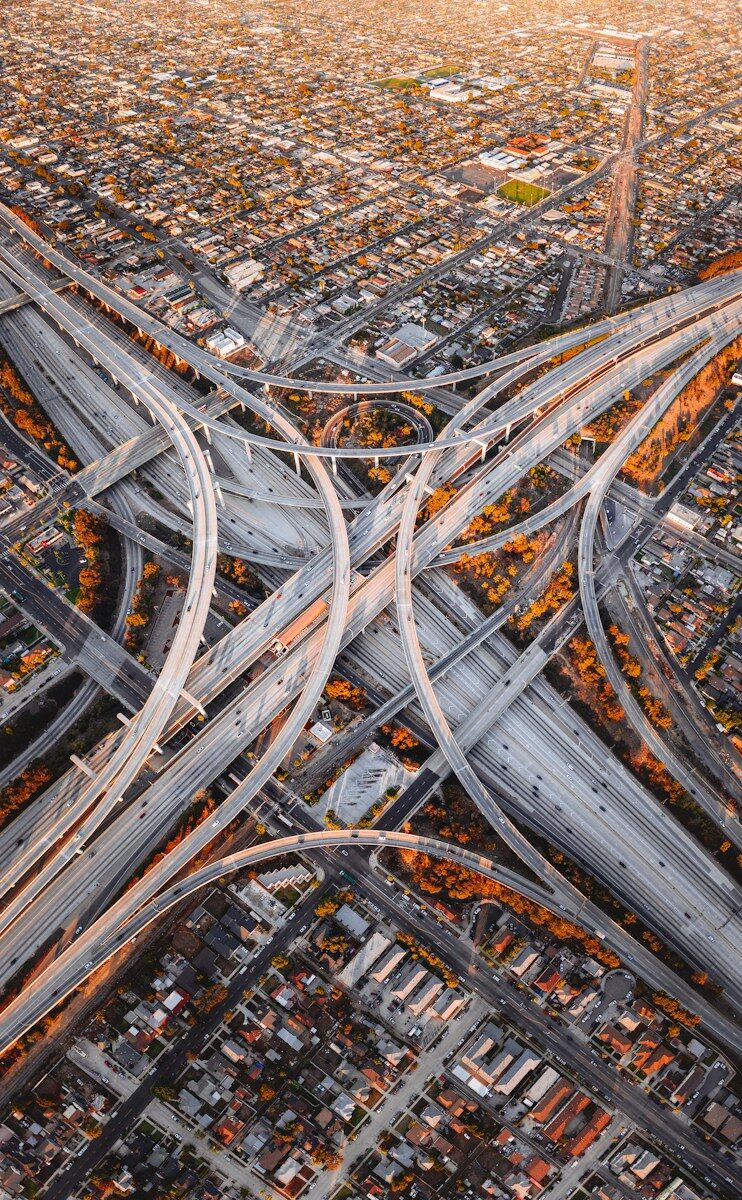
Every driver who has watched a promising highway project stall for years under “further environmental review” owes a strange debt to a folk singer in Golden Gate Park and a 342-acre zoo in Memphis. The mid-century wave of anti-car protests that swept American cities from the 1950s through the early 1970s rarely had anything to do with hating automobiles. They were revolts against unchecked engineering power – state highway departments and federal agencies that could bulldoze a neighborhood or bisect a park with barely a public hearing. The people who fought back didn’t just win individual battles. They rewired the legal and political machinery that still decides where, whether, and how fast a road gets built in this country.
That machinery got its blank check earlier than most people realize. California’s 1947 Collier-Burns Act let the state build freeways without tolls, paid for by a 50 percent hike in the gas tax, and reoriented the state highway system away from rural roads and straight into city centers. The same funding logic underpinned the 1956 Interstate Highway Act nationally: more urban driving meant more gas tax revenue, so highway departments had every incentive to route freeways straight through downtowns, parks, and whatever neighborhoods stood in the way. For most of the 1950s, almost nobody stopped them.
San Francisco Tears Up Its Own Blueprint
San Francisco opened its first stretch of true freeway, the Bayshore, in October 1953, and the California Division of Highways followed up with a sprawling plan to crisscross the city with freeways, including one along the waterfront, one slicing under Russian Hill toward the Golden Gate Bridge, and one carving through the Panhandle and Golden Gate Park itself. Construction on the elevated Embarcadero Freeway was already underway in 1958 when opposition organized fast: more than 30,000 residents signed petitions at neighborhood meetings from the Sunset to Telegraph Hill to Potrero. In 1959, the Board of Supervisors did something no city had really done before: it voted to cancel 75 percent of the freeway routes the state had already planned through San Francisco.
The Embarcadero Freeway itself was too far along to kill outright; it got built only as far as Broadway and stood there, unloved, a physical monument to the fight, until the 1989 Loma Prieta earthquake finally gave the city an excuse to tear it down. The Panhandle fight took longer to resolve. At a May 17, 1964 rally at the Polo Grounds in Golden Gate Park, folk singer Malvina Reynolds debuted her original protest song “Cement Octopus” and poet Kenneth Rexroth spoke against the plan. By October, the Board of Supervisors’ transportation committee had received a petition with 15,000 signatures, 20,000 letters and telegrams, and formal opposition from 77 community organizations. On October 13, 1964, the board rejected the Panhandle freeway 6-5, with the deciding vote cast by Supervisor Terry Francois. When state highway officials revived the plan in 1966, this time citing hundreds of millions in federal funding at risk, even organized labor switched sides to oppose it. The board killed it again, 6-5, on March 21, 1966.
None of this was a boycott of the automobile. It was homeowners, shopkeepers, and eventually labor unions insisting that an elected body, not a state engineering office, got the final word on what happened to their streets. The tactic of organizing hyperlocal pressure directly on city supervisors, rather than lobbying a distant highway department, is the same playbook every neighborhood group fighting a road project still runs today. It also had a side effect nobody planned for: the freeway money and momentum that got shut down helped free up Bay Bridge toll surplus for BART’s transbay tube, and pushed the city’s political establishment to back rapid transit instead.
Memphis Takes the Fight to the Supreme Court
Overton Park sat on 342 acres in the middle of Memphis, with a zoo, a nine-hole municipal golf course, an outdoor theater, nature trails, a bridle path, an art academy, and 170 acres of forest. In the 1950s and 1960s, federal and state highway officials planned to run Interstate 40 straight through it as a six-lane expressway, severing the zoo from the rest of the park and destroying 26 acres in the process. The route had been approved by the Bureau of Public Roads back in 1956 and reaffirmed by the Federal Highway Administrator in 1966.
But Congress had raised the bar in the meantime. Section 4(f) of the Department of Transportation Act of 1966 and Section 138 of the Federal-Aid Highway Act of 1968 barred federal highway money from funding a road through a public park unless there was no “feasible and prudent” alternative route, and required “all possible planning to minimize harm” if there genuinely wasn’t one. In April 1968, the Secretary of Transportation announced he’d go with the park route anyway. Tennessee bought the 26-acre right-of-way from the city in September 1969, paying Memphis $2 million for the land and another $206,000 to replace the park facilities it would destroy. Final design approval came in November 1969, without a single written finding explaining why alternative routes to the north or south, or tunneling options citizens had proposed, weren’t good enough.
Citizens to Preserve Overton Park, a coalition of residents and conservation groups, sued and lost in district court and again at the Sixth Circuit. The Supreme Court froze construction with a stay before agreeing to hear the case, and on March 2, 1971, ruled decisively for the citizens. Writing for the Court in Citizens to Preserve Overton Park v. Volpe, Justice Thurgood Marshall held that the Secretary’s decision was subject to judicial review, and that courts had to give it a “thorough, probing, in-depth review” rather than rubber-stamping it, striking down agency decisions that were “arbitrary, capricious, an abuse of discretion, or otherwise not in accordance with law.” The case went back to the district court, this time to be judged on the government’s actual administrative record instead of affidavits its own lawyers had drafted for the litigation.
That ruling did more for road-building oversight than any picket line. It’s the foundation of what administrative law scholars call the “hard look doctrine,” and it’s the direct ancestor of the Section 4(f) reviews that federal transportation officials still have to run today before a road project can touch a park, wildlife refuge, or historic site. It’s also why environmental impact statements, alternatives analyses, and public comment periods are now a standard, expensive, years-long part of building anything bigger than a cul-de-sac. Citizen groups gained something they’d never really had: the standing to force a federal agency to show its work in open court.
The Fight Changed Vehicles, Not Its Nature
The question that animated the Panhandle rally and the Overton Park lawsuit, who gets to decide how vehicles move through public space without asking the people who live there, never actually went away. It just changed hardware. Congress is now fighting over where robotaxis get manufactured, the same legislative-pushback instinct that once targeted state highway departments. Across the Atlantic, a UK petition asking Parliament to ban commercial driverless taxis crossed the same threshold of public anxiety that filled Golden Gate Park in 1964, just aimed at software instead of concrete.
The federal-versus-state tug-of-war Overton Park first mapped out hasn’t gone anywhere either. A federal judge recently blocked an EPA attempt to strip California of its vehicle emissions waivers through a paperwork maneuver, a fight over whether an agency can sidestep the kind of justified, on-the-record decision-making the Supreme Court demanded of the Transportation Department in 1971. And the same public-pressure machinery the freeway revolts pioneered now runs in the other direction too: California enthusiasts are petitioning Sacramento for Leno’s Law, which would let more 1980s classics skip smog checks, proof that organized public pressure on regulators isn’t just a tool for stopping cars from encroaching on communities anymore, but for keeping older cars legally on the road.
What This Actually Means If You Own or Care About Cars
For enthusiasts, the practical fallout of these fights shows up anytime a road project you’re excited about seems to vanish into bureaucratic silence for years. A widening project, a new interchange, or a bypass around a historic district can stall specifically because Section 4(f) or its companion environmental laws require the agency to document why an alternative wasn’t chosen, and that documentation can be challenged in court by anyone with standing. It adds real time and real money to construction budgets, but it’s also the reason a park, a historic downtown, or a stretch of coastline hasn’t been paved over on the strength of a decades-old traffic study nobody bothered to update.
The people who stood in the Panhandle in 1964 or fought for a Memphis zoo through the 1960s into 1971 weren’t trying to kill the automobile. They were insisting that whoever had the power to reroute a highway through their front yard ought to be able to explain the decision somewhere more accountable than an internal memo. Six decades later, that’s still the rule everyone building a road, or a robotaxi network, has to follow.
Your Turn: Does your city still carry scars from the freeway-building era? Tell us about it in the comments.
About the Author