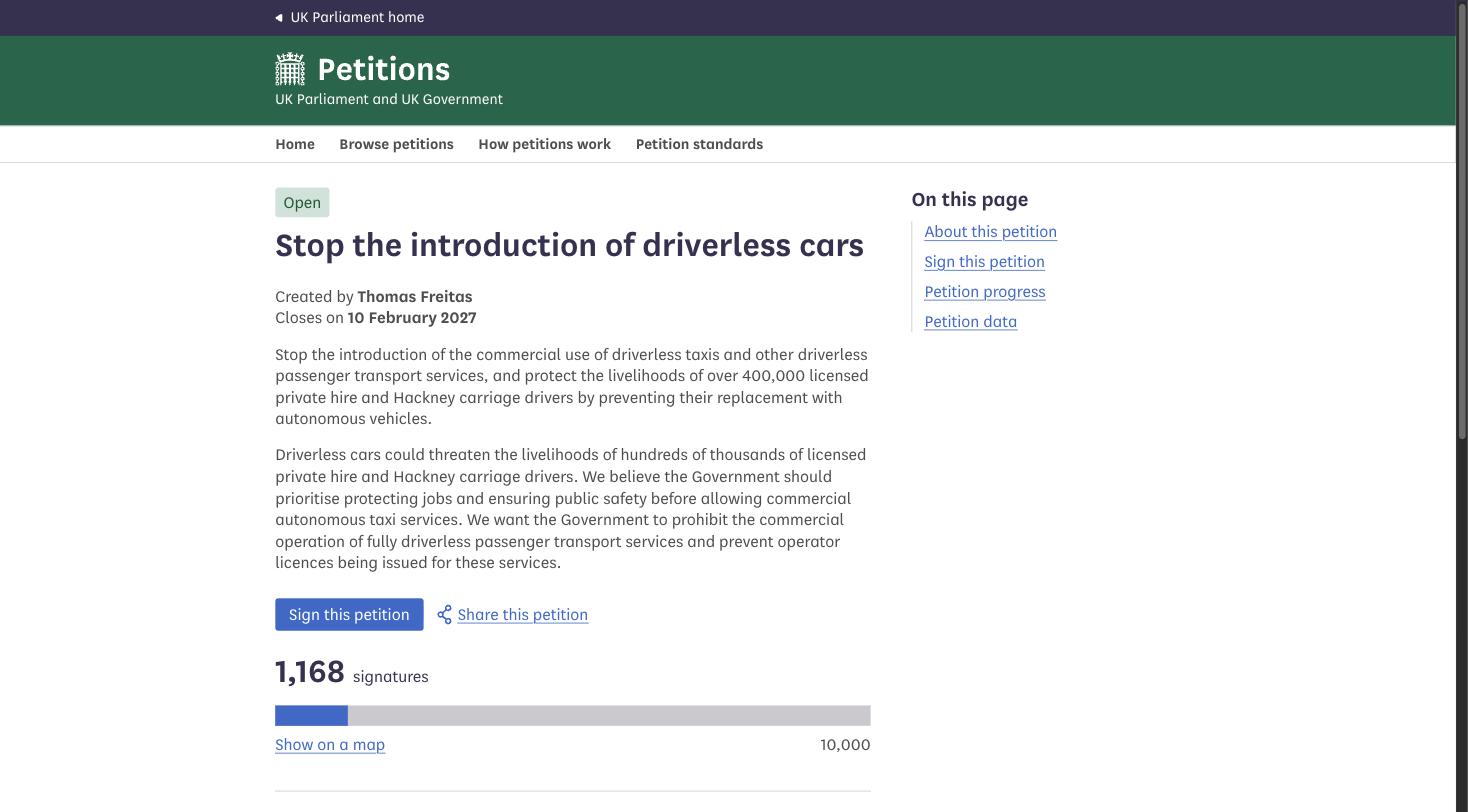
The UK Parliament petition "Stop the introduction of driverless cars," created by Thomas Freitas, had passed 1,000 signatures as of late August 2026. Screenshot: petition.parliament.uk
A parliamentary petition calling on the UK government to ban commercial driverless taxis has ticked past 1,000 signatures, sitting at 1,168 when we checked this week. That is nowhere near the number that forces anyone in Westminster to actually do something. Ten thousand signatures gets a written government response. One hundred thousand gets a shot at a real debate in the House of Commons. At its current pace, this petition is a rounding error next to those thresholds, which is exactly why it is the least interesting part of this story.
The petition, titled “Stop the introduction of driverless cars” and created by a driver named Thomas Freitas, asks the government to block commercial driverless taxi and passenger transport services outright and to stop issuing operator permits for them. The stated goal is protecting the livelihoods of over 400,000 licensed private hire and Hackney carriage drivers. It is a fair worry on its face, and one that every taxi and rideshare market on the planet will eventually have to answer. But while the petition sits in a queue waiting for signatures, the actual machinery that decides whether robotaxis show up on British streets has already been built, tested and switched on.
The Permitting Scheme Already Beat the Petition to the Punch
Britain did not wait for a petition to clear a debate threshold before deciding how driverless taxis get approved. Under the Automated Vehicles Act 2024, the Department for Transport built an entirely separate licensing lane for self-driving passenger services called the Automated Passenger Services, or APS, permitting scheme. In April 2026, the government laid the Automated Vehicles (Permits for Automated Passenger Services) Regulations 2026 before Parliament, and from spring 2026 companies have been able to apply to run commercial self-driving passenger pilots without a safety driver in England, Scotland and Wales. None of that required the petition to get anywhere close to 10,000 signatures. It was always going to happen on its own schedule.
Two Different Agencies Decide Two Different Questions
Here is the part most coverage glosses over, and it happens to be the most useful thing to understand if you want to know how any country will eventually regulate this technology. Whether a vehicle is mechanically and technologically capable of driving itself is not the same question as whether it is allowed to operate as a taxi in a given town, and Britain split those two questions between completely different agencies. The Vehicle Certification Agency, the DfT’s type-approval arm, has to certify that a vehicle’s automated driving system is safe enough to be “listed,” and eventually formally “authorised.” The Driver and Vehicle Standards Agency, the outfit better known for policing HGV and bus compliance, is the one that actually processes the permit application, requests consent from local licensing authorities and polices the service once it is running. A robotaxi can be a certified, roadworthy, VCA-approved machine and still get blocked from picking up fares in a specific city if DVSA cannot secure local consent. Roadworthiness and market access are two separate gates, not one.
Local Authorities Get Six Weeks, Then Lose Their Veto
That local consent step has a wrinkle worth knowing if you are a driver, a council member, or just someone who assumes local government moves at local government speed. Where a proposed automated passenger service resembles a taxi or private hire operation, the relevant licensing authority gets six weeks to approve or refuse it once DVSA makes a formal request. If that authority does nothing, or refuses without putting written reasons on paper, the law treats consent as granted anyway. Silence is not a neutral outcome in this system. It is a yes by default. For a trade that already worries about being outmaneuvered by companies with deeper pockets and faster legal teams, a six-week clock that defaults to approval is not a small detail buried in a schedule.
Who Is Liable When the Software Is Driving
The insurance question is where this gets genuinely interesting for anyone used to thinking about liability the old-fashioned way. Under the Automated and Electric Vehicles Act 2018, which still governs the current pilot period, the vehicle’s insurer is on the hook for any crash that happens while the car is driving itself. That is a temporary bridge. Once the Automated Vehicles Act 2024 is fully implemented, expected in the second half of 2027, that structure gets replaced by a split between an Authorised Self-Driving Entity, essentially the company responsible for the driving software, and a No User-in-Charge Operator responsible for the day-to-day running of journeys with nobody in the driver’s seat. An APS permit holder can be a completely different company from either of those, responsible only for passenger-facing obligations like accessibility and safeguarding rather than anything mechanical. Three organizations, three separate legal responsibilities, one trip. That is not a bureaucratic accident. It is a deliberate attempt to assign blame before the first commercial no-driver ride ever happens, and it is a far more granular liability map than most human-driven taxi trips ever get.
The Fight Sounds Familiar Because It Is
None of this is unique to Britain, and that is the more useful takeaway for anyone who does not hold a Hackney carriage badge. American truckers made a nearly identical argument through the Teamsters when California quietly reopened the door to driverless big rigs, and Waymo has spent 2026 getting leaned on by San Francisco’s mayor and by federal regulators over robotaxis that behave beautifully right up until the moment something unusual happens. The specifics differ, a badge versus a commercial license, a six-week consent window versus a state legislature, but the pattern is identical everywhere this technology shows up. The companies building the vehicles move on a technology timeline, regulators quietly build permitting systems that outpace public debate, and the people whose jobs are on the line find out how the rules actually work only after the paperwork is already signed.
For UK drivers, the practical move is not waiting to see if a petition hits 100,000 names. It is watching which cities get asked for consent first, since that six-week window is the only real point of local leverage anyone has before a pilot launches. For everyone else, it is a preview. The regulatory template Britain just finished assembling, separate certification and market-access gates, a default-to-consent clock, and a three-way liability split, is the closest thing on paper right now to a blueprint for how driverless taxis get greenlit anywhere. Whether American regulators borrow from it, ignore it, or reinvent it badly is the next chapter, not this one.
About the Author