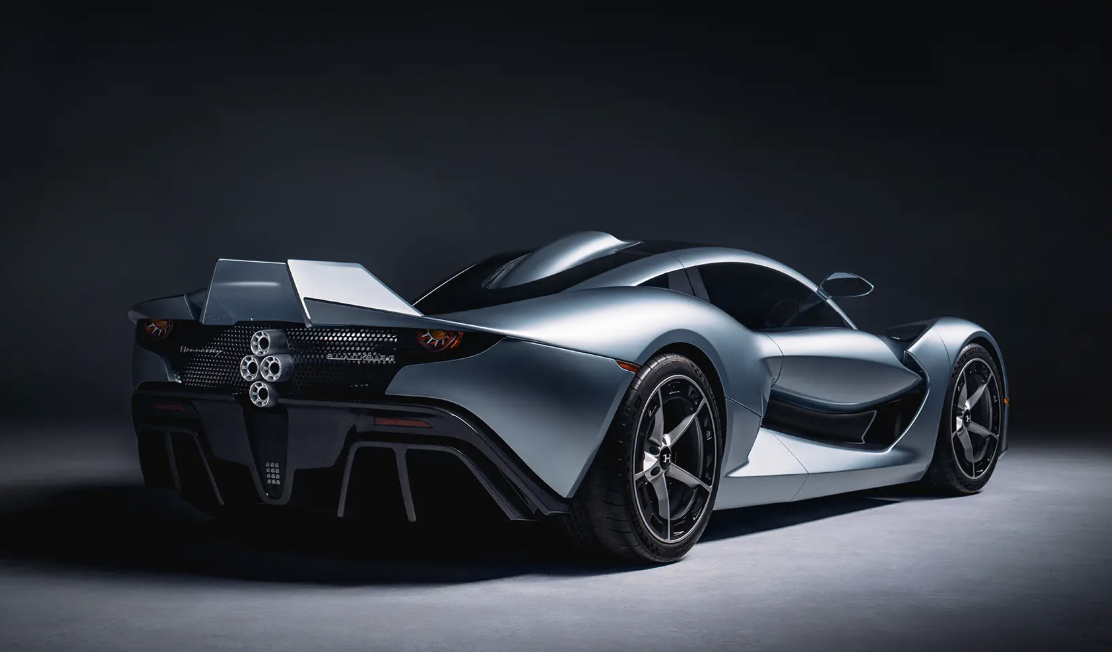
Customers won’t get a Hennessey Blackbird until the end of the decade, but someone has already put it in uniform. Brian Monaco, the automotive renderer behind Monaco Auto Design in West Palm Beach, has posted digital reinterpretations of Hennessey’s new hypercar on his Instagram. One wears a flag-inspired patriotic scheme, and another takes a military-flavored approach. None of it exists outside a render engine. Hennessey hasn’t announced liveries like these, and no customer has ordered one.
It still makes a useful thought experiment. The Blackbird is a $2.5 million car with moving aero, a glass-covered engine bay, and a production run of 71. If an owner really did want to go full Fourth of July on one, it’s worth asking what would happen.
The Car Under the Costume
Here’s what Hennessey actually put on the table in August. According to the company’s official press release, the Blackbird uses an all-new naturally aspirated 6.2-liter V8 developed with Ilmor Engineering. It targets 800 to 850 hp and more than 9,000 rpm, and it drives the rear wheels through a six-speed gated manual only. There is no automatic option and no all-wheel drive.
The chassis is a bespoke full-carbon tub with carbon-fiber bodywork and inboard adaptive suspension. Hennessey is targeting a dry weight under 3,000 pounds, a 0-60 mph time of 2.5 seconds, and a 220-mph top speed. Pricing starts at $2.5 million before taxes. Customer production is targeted for 2029 to 2030, and Hennessey says more than two-thirds of the 71 build slots were spoken for before the car’s public debut at The Quail.
Related Articles
- Europe Gets Another Shot at the Mustang GTD — but Applications Close October 16
- Toyota Put the Street-Legal GR GT Next to Its GR GT3 Racer at Laguna Seca, and That Was the Whole Point
Run the math and the numbers get interesting. At 850 hp from 6.2 liters, the V8 makes roughly 137 hp per liter without turbos. That’s race-engine territory for a road car that also promises four cupholders and room for two carry-on bags. At the target weight, the car carries about 3.5 pounds per horsepower dry. Hennessey expects this to be the most powerful and highest-revving naturally aspirated road-car V8. For comparison, the twin-turbo Venom F5 makes 1,817 bhp, according to the company’s own corporate boilerplate.
That comparison is the point. John Hennessey’s pitch is right there in the release: “This is not a numbers car.” It’s a claim made with a straight face about a 220-mph manual, and you have to respect the commitment.
Why the Military Angle Writes Itself
Monaco didn’t have to reach far for the theme. Hennessey built the car around Lockheed’s spy plane, and it put its biggest aviation references in the aero hardware.
The active rear stabilizers deploy automatically at 71 mph and sit at plus or minus 71 degrees, a direct nod to the aircraft’s designation. Owners can also raise them manually at any speed. The diamond-shaped quad exhaust copies the nozzle layout of the Bell X-1, the first airplane to fly faster than sound. The cabin gets a dash-mounted whiskey compass, which is the sort of detail a pilot would appreciate and a GPS would find insulting.
The real SR-71’s credentials are easy to check. The Air Force museum lists an absolute speed record of 2,193.167 mph set on July 28, 1976. The Air Force retired the fleet in January 1990 over budget and operating costs. The Smithsonian’s object record notes that the airframe was mostly titanium, but the vertical tail fins were made of a composite to cut radar cross-section. Hennessey’s fins are part of a carbon-bodied car, so the composite connection holds up better than most marketing tie-ins do.
There’s an even better piece of trivia for V8 fans. The SR-71’s J58 engines needed a special start cart, and according to Beale Air Force Base, that cart used two Buick Wildcat V8s of 425 cubic inches each to spin the jets to 3,200 rpm. In other words, the original Blackbird needed American V8 power just to wake up. The Hennessey version simply cut out the middleman.
If Someone Actually Did It
This is where the fantasy runs into the shop floor. On a car like this, a full paint job is almost certainly the wrong call. Refinishing carbon bodywork on a 71-unit car erases factory originality, and collectors pay for that originality. A vinyl wrap is the realistic route because it’s reversible, but the Blackbird makes wrapping harder than usual in three ways.
The first problem is the moving fins. Panels that articulate at speed put stress on film edges, and wrap installers will tell you that edges are where failures start. Any installer would need to wrap the fins so they don’t catch air or peel back when the stabilizers deploy on the highway.
The second is heat. Hennessey says glass covers the engine bay and that the car uses Formula One-style side pods to feed the mid-mounted V8. Film near heat-exchanger outlets and exhaust exits lives a harder life than film on a door skin.
The third is the underlying finish. The release doesn’t say whether customer cars will wear exposed or painted carbon, and that matters. Pulling a wrap off a poorly cured clear coat can take the finish with it, and fixing that on a bespoke carbon panel isn’t a job for a strip-mall detailer.
The practical move for any owner is to put paint protection film on the car first, wrap over the top if the patriotic urge strikes, and keep the original surface untouched underneath.
The Flag Question
A flag-themed livery also has a legal wrinkle, though it’s a small one. The federal Flag Code, in 4 U.S.C. § 8, is written almost entirely in “should” language. For example, it says the flag “should never be used as wearing apparel, bedding, or drapery.” It reads as etiquette, not a speeding ticket. A livery inspired by the flag is also a different thing from an actual flag bolted to a car. Nobody is getting pulled over for stars and stripes on a quarter panel.
Related Articles
- A Diesel Pickup Answered a Corvette’s Middle Finger With a Soot Bomb, and Nobody Won
- Bugatti’s New One-Off Program Debuted With a Car Named After a Horse — and It’s Already Sold
The military-style scheme is the one that deserves some care. Camouflage on its own is a style choice. Real unit insignia, official-looking government markings, or anything that could pass for an emergency or official vehicle gets into state law, and those rules vary. If you’re copying real markings rather than a general aesthetic, check your state’s rules before the vinyl goes on.
The Money Side
Anyone insuring a car like this will almost certainly be on an agreed-value collector policy. Any wrap should be disclosed to the insurer and documented along with the car’s original specification. The goal is that a claim restores the car to how it left Sealy, Texas, not just to how it looked on a given Tuesday.
Resale is where the logic gets simple. With production capped at 71 and most slots already allocated, the Blackbird’s long-term value will likely depend on documentation and originality. A reversible wrap keeps both intact, while a permanent respray trades them for a look.
That’s also why these renderings work best exactly where they are, as pixels. Monaco’s versions show how strongly the car’s aviation theme invites dress-up. Hennessey already built the patriotism into the hardware with the Texas assembly, the X-1 exhaust, and a V8 bloodline that goes back to a pair of Buicks on a flight line at Beale. The black paint might be the most American option on the order sheet.
Images Via: Hennessey
About the Author