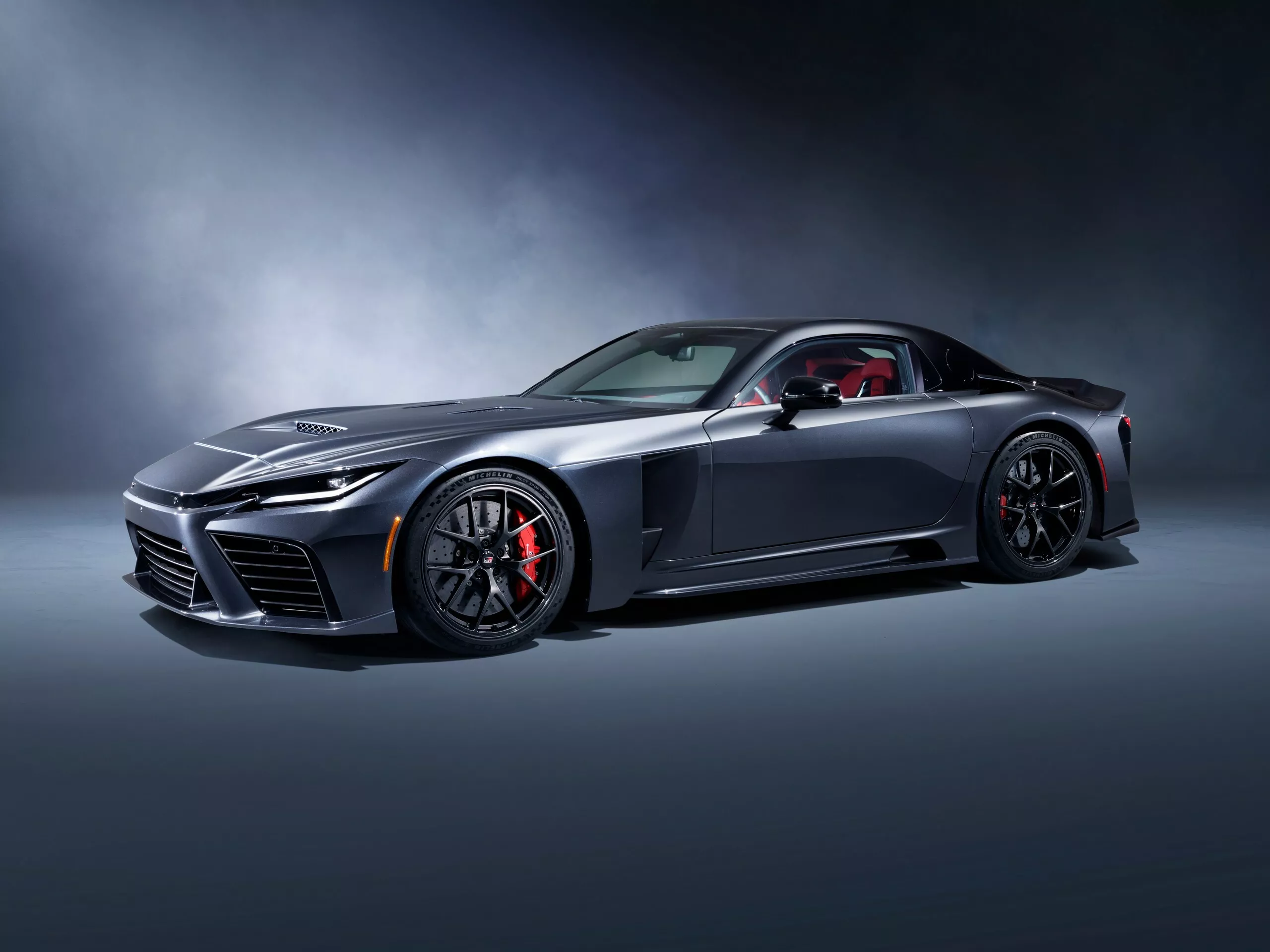
Toyota Gazoo Racing’s Spanish arm posted the proof itself on September 3: the GR GT and GR GT3 running side by side through Laguna Seca’s Corkscrew during Monterey Car Week, with the GR GT also popping up at The Quail wearing a new silver finish for its global debut in that color. It’s a small moment in the calendar of a car that won’t reach customers until around 2027, but it’s a useful one, because it shows the road car and the race car doing the same lap, at the same time, built from the same bones.
TGR and Lexus gave both cars their world premiere on December 4, 2025, unveiling under-development prototypes inside the Inventor Garage at Woven City, Toyota’s working prototype city near Mt. Fuji built to test future mobility ideas before they leave the lab. The GR GT is pitched as TGR’s new flagship, a road-legal race car in the tradition of the Toyota 2000GT and Lexus LFA. The GR GT3 is the customer racing version, built to FIA GT3 specification for the drivers who actually want to take one wheel-to-wheel.
The interesting part isn’t that Toyota built a fast road car and then handed a stripped version to the motorsport department, which is how this usually goes. TGR ran development the other way: both cars share the same aluminum space-frame chassis architecture (Toyota’s first all-aluminum body frame in a production car), the same basic double-wishbone suspension geometry front and rear, and a nearly identical 4.0-liter twin-turbo V8 architecture. That’s not a marketing footnote. Shared underpinnings mean lower homologation costs for the GT3 program, simpler parts logistics for TGR’s customer teams, and a feedback loop where lessons from circuit testing land directly in the road car’s development rather than getting reverse-engineered months later.
Toyota also flipped the usual styling order. Exterior design for the GR GT started with aerodynamics, not the other way around. Aero engineers pulled from TGR’s FIA WEC prototype program worked out the ideal shape first, then handed that aerodynamic model to designers to turn into something buildable. With a development target north of 320 km/h, nearly 199 mph, that sequencing isn’t vanity: cooling and downforce needs dictated the shape before anyone worried about how it would photograph.
Under the bodywork, the GR GT pairs a new 3,998cc twin-turbo V8 with a single electric motor built into a rear-mounted transaxle, targeting 650 PS, roughly 641 horsepower, and 850 Nm or more. The engine uses a hot-V layout, meaning both turbos sit inside the V rather than hanging off the outside of the banks. That shortens the exhaust plumbing for quicker boost response and helps keep the engine’s overall height down, which matters when your entire design brief is lowering the center of gravity, but it also concentrates heat right where the intake sits, which is why the dry-sump lubrication and packaging around it got so much engineering attention. Power reaches the rear wheels through a newly developed 8-speed automatic that uses a wet-start clutch instead of a torque converter, a setup borrowed from race-derived transmissions that engages more directly and sheds weight, at the cost of a bit of the low-speed softness you’d get from a traditional converter. The GR GT3 carries over much of that engine’s structure into its own FIA-spec build.
Toyota also had Michelin develop the Pilot Sport Cup 2 tires specifically for this car, paired with Brembo carbon-ceramic brakes. Bespoke tire compounds tend to come with a catch for owners down the line: smaller distribution networks and higher replacement costs than anything you can grab off a shelf at a chain shop, worth keeping in mind for anyone picturing this as a car they’ll actually track regularly once it arrives.
The people behind the project matter as much as the parts list. Development ran under a one-team approach centered on Chairman Akio Toyoda, who races under the alias Morizo, alongside professional drivers Tatsuya Kataoka, Hiroaki Ishiura, and Naoya Gamou, plus gentleman driver Daisuke Toyoda. Toyota frames the whole program as a kind of Shikinen Sengu, the Shinto practice of periodically tearing down and rebuilding a shrine using the same techniques so the craft passes intact to the next generation of builders. In practice, that meant pulling engineers who worked on the Lexus LFA back in to mentor the team building its successor, rather than just filing the old car’s data away.
We’ve already reported that Toyota signaled pricing for the GR GT well below LFA territory, which matters more than it sounds given how expensive it is to build a car with this much bespoke hardware. Hitting that number by 2027 means engineering around increasingly strict emissions rules for a production twin-turbo V8, which is likely why testing keeps spreading across Toyota’s Shimoyama test course, Fuji Speedway, the Nurburgring, and now public roads and a Monterey concours lawn, rather than wrapping up quietly on a single track.
For anyone thinking about the GT3 side of this as a way in, it’s worth knowing what FIA GT3 actually is: the top tier of production-based customer racing, the category running underneath GTD in IMSA and across most SRO-sanctioned series worldwide, including the Nurburgring 24 Hours. TGR says it’s building a dedicated customer support structure around the GR GT3, which is the part that actually determines whether a season is fun or financially miserable. Factory-backed GT3 programs routinely run well into six figures per season once you add spares, transport, and trackside support on top of the car itself, and that’s before insuring a low-volume race car that can’t just be replaced with a phone call to a dealer.
None of this happens in isolation. TGR spent this year proving it’ll chase a genuinely different powertrain when the application calls for it, skipping combustion entirely on its 2027 Dakar Hilux in favor of a hydrogen fuel cell, and it just refreshed the GR86 by fixing what owners actually complained about instead of chasing a bigger horsepower number. The GR GT and GR GT3 fit that same pattern: build the thing the drivers and the data actually ask for, then let it prove itself in front of people who’ll notice if it doesn’t. Laguna Seca was just the first place doing that in public, on American pavement, with a paying audience watching.
Your Turn: Would you rather have the street-legal GR GT or the full-race GR GT3? Tell us which one you’d park in your garage.
About the Author