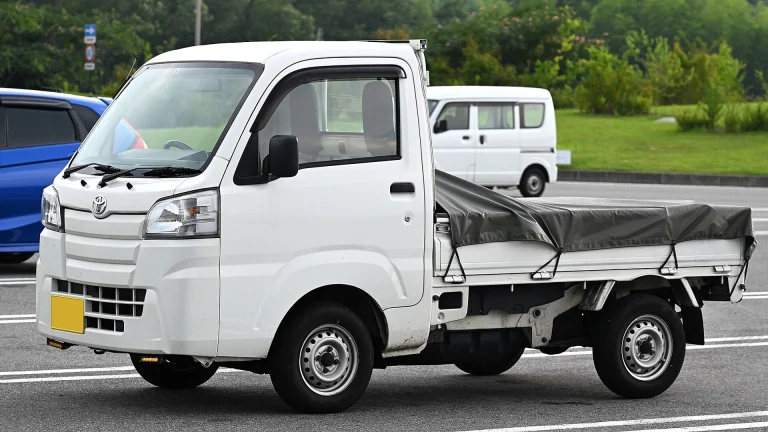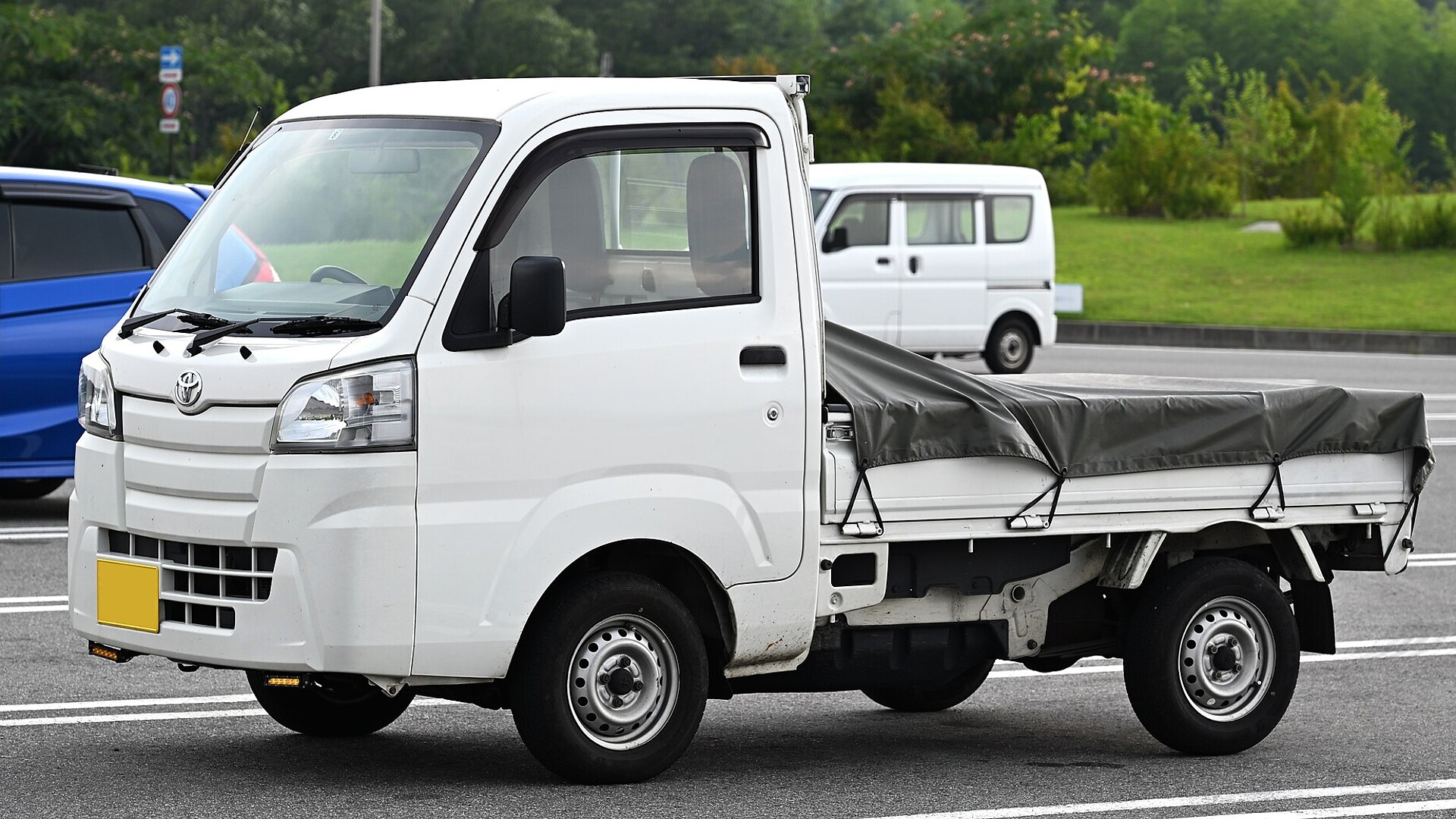
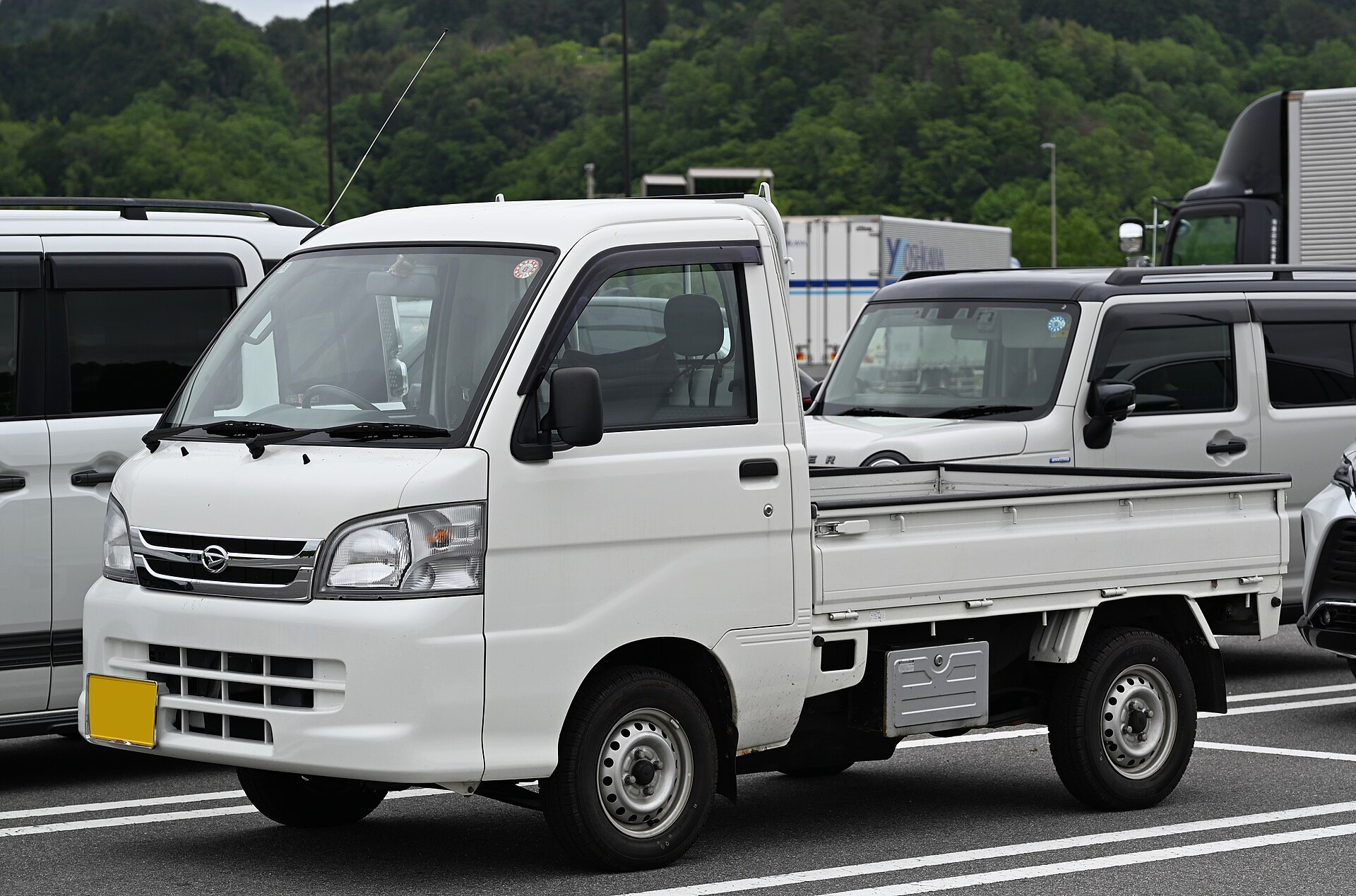
Toyota Pixis Truck (Japan). Image credit: TTTNIS / Wikimedia Commons (CC0).
Toyota’s KEI-01 is just over 11 feet long, has a 660cc three-cylinder engine and will be assembled in Indiana, but the figure that shapes everything else about it is the 25 mph top speed in Toyota’s own release. That number puts the truck in the federal low-speed vehicle class, where the rules on what a vehicle must survive are not the ones a Tacoma has to meet.
Toyota Motor North America announced the truck and a revived Scion by Toyota brand on Nov. 10 from Plano, Texas, a day after reveal events in Ypsilanti Township, Michigan, and Frisco, Texas. The KEI-01 reaches the U.S. in the second half of 2027 with a continuously variable transmission, standard selectable four-wheel drive, a bed rated for up to 600 pounds and a right-hand-drive cab under 5 feet wide. Toyota did not give horsepower, fuel economy, a towing rating or a price.
The company calls the truck intentionally low-volume and niche. It will go first to fleets through Scion by Toyota dealers chosen from the existing Toyota network, and Toyota says only that it “may consider” limited retail sales later.
Why a 25 mph cap is how a truck this small gets built here
Toyota says the KEI-01 is designed to comply with Federal Motor Vehicle Safety Standard No. 500. NHTSA’s definition of a low-speed vehicle, effective June 5, 2006, is a four-wheeled vehicle that can reach more than 20 mph but no more than 25 mph, with a gross vehicle weight rating under 3,000 pounds.
The test procedure NHTSA uses for the standard is a checklist: headlamps, turn signals, taillamps, stop lamps, reflectors, mirrors, a parking brake, a DOT-marked windshield, a 17-character VIN and lap or lap-and-shoulder belts at every seat. The procedure covers equipment, loading and a speed run. It contains no crash test.
NHTSA did not hide the trade-off. When it raised the weight limit in 2005, the agency wrote in a Federal Register notice that a low-speed vehicle lacks the occupant protection of other four-wheeled vehicles, and that such vehicles could not meet standards written for larger ones, such as the 30 mph barrier crash standards. The same notice warned of greater risk of injury or death on roads with a posted limit of 35 mph and encouraged states to be careful about allowing low-speed vehicles on public roads.
Toyota has not said why it chose this category. My read is that the cap buys a vehicle that can be built in small numbers without a full crash-structure program, and that the price is paid in where the truck can go. The federal standard defines the vehicle; states decide where it may run. A KEI-01 will be a farm, campus, resort or municipal tool long before it is anyone’s commuter.
What Washington has said about tiny cars
A Jan. 13 White House release listed the authorization of production of affordable, efficient “tiny cars” among the administration’s regulatory changes. Toyota’s release mentions no president or administration, and nothing in the documents I reviewed connects the KEI-01 to that line.
The Transportation Department’s Sept. 28 announcement of the final fuel economy rule, published in the Federal Register on Sept. 30 (Vol. 91, No. 188, docket NHTSA-2025-0491), does not mention kei cars or microcars. It does say existing rules discourage hatchbacks, wagons and smaller-footprint vehicles, and that reclassifying small crossovers could add lower-cost options. Beginning with model year 2030, vehicles would be classed by intended use, and the department projects the fleet moving from about 70% light trucks to about 70% passenger cars.
That rule sets standards for passenger cars and light trucks for model years 2022 to 2031. The KEI-01 is designed for a different standard and Toyota gives no fuel economy number. Rules still steer what lands on a truck, but nothing published so far shows this policy producing this truck.
Fifty jobs and a pilot-sized plan in Princeton
Toyota is putting $34 million into Toyota Motor Manufacturing Indiana for the KEI-01, which it says adds about 50 jobs and upgrades production and logistics infrastructure. That works out to $680,000 per job, Backfire News’s arithmetic, though the money covers equipment and logistics, not wages. The Princeton plant builds the Grand Highlander, Highlander, Lexus TX and Sienna Hybrid, and Toyota lists 427,844 vehicles built there in 2025 by more than 7,380 employees. Fitting a niche model into a plant running that volume is a familiar squeeze.
Toyota’s own kei experience comes from Japan, where it sells commercial vehicles it sources from Daihatsu. A Feb. 2 Toyota Global release describes the battery-electric Pixis Van as an OEM vehicle based on the Daihatsu Hijet Cargo, built at Daihatsu’s Oita (Nakatsu) plant, and says kei commercial vehicles make up about 60% of Japan’s commercial vehicle fleet. The U.S. release does not say where the KEI-01’s platform or engine comes from, which matters to anyone who will have to buy parts for a right-hand-drive 660cc three-cylinder. Japan’s kei class was built around Japanese rules that the U.S. does not share, a gap that also keeps a Japan-only Corvette convertible out of this country.
What to watch before 2027
Four details will settle what this truck is. Price comes first, since Toyota has promised more information only “as plans are finalized.” Next is the gross vehicle weight rating, which has to stay under 3,000 pounds and decides how much of the 600-pound bed is usable with two people in the cab. Third is which states let a 25 mph four-wheel-drive truck onto which roads. Last is whether the retail option ever opens, because fleet-only sales through hand-picked dealers mean most buyers will never see one.
Would you park an 11-foot, 25 mph, four-wheel-drive truck at your farm or shop, or does a truck that can’t keep up with traffic fall short of the small, cheap pickup the “tiny cars” talk suggested?
About the Author