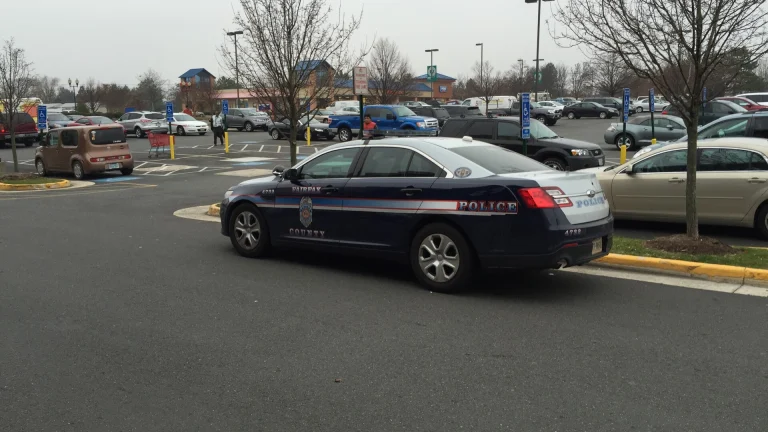
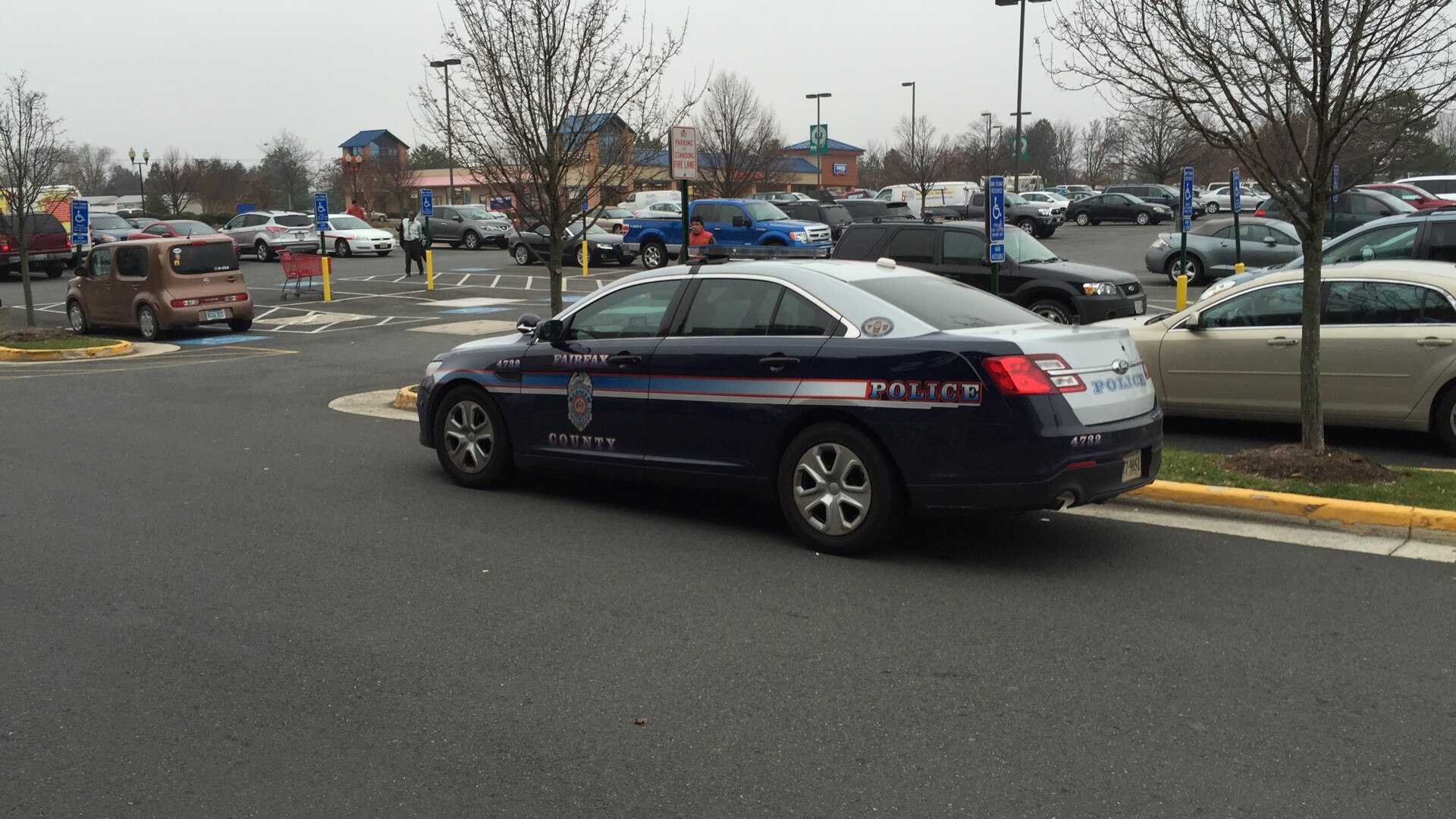
A Fairfax County Police Department cruiser in Chantilly, Virginia. Photo: Famartin / Wikimedia Commons, CC BY-SA 4.0
On Nov. 20 at about 1:40 p.m., a Fairfax County police officer in McLean, Virginia, saw a white Dodge Ram running red and blue emergency lights near Leesburg Pike and Tyco Road. According to the department’s release, the Ram’s driver pulled up next to another vehicle, interacted with the person behind the wheel, switched the lights off and kept heading west on Leesburg Pike. The officer pulled the Ram over.
Police identified the driver as Charles Dablow, 55, of Reston, a civilian employee of the Bureau of Alcohol, Tobacco, Firearms and Explosives. The truck belonged to ATF, according to the release, which says investigators found Dablow “was using an ATF vehicle to conduct illegal traffic stops.” A search of the Ram turned up a loaded firearm that police described as unsecured. Two children under 14 were riding in the truck when the officer stopped it.
Dablow was taken to the Fairfax County Adult Detention Center and charged with two counts of impersonating a law enforcement officer, one count of possession of a concealed weapon and one count of possession of an unsecured firearm around a child under 14. Police said he was held without bond. Those are accusations; he has not been convicted of anything. In a statement reported by DC News Now, ATF confirmed that one of its civilian employees had been arrested and said, “ATF is cooperating fully with local authorities in their investigation.” The station reported that an ATF spokesperson, speaking on background, confirmed Dablow is not a law enforcement officer or agent, and that the agency declined to comment on personnel matters.
A Gallows Road gas station, two weeks earlier
The Nov. 20 stop is how police caught up with the Ram, but the case starts on Nov. 6. At about 12:51 p.m. that day, officers investigated a report of police impersonation near a gas station off Gallows Road in McLean. According to the release, the driver of a white Ram equipped with red and blue lights switched them on, pulled over another vehicle, approached the driver, made comments about that person’s driving, then walked back to the truck and left. Detectives from FCPD’s Criminal Intelligence Unit took over the case after the Nov. 20 stop and linked Dablow to the Gallows Road incident.
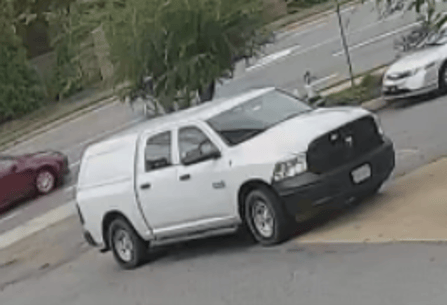
The photo police released shows a white Ram crew-cab pickup with a matching camper shell and no police markings visible. The release does not say what was said to either driver, why the children were in the truck or how long Dablow had access to it. Detectives are asking anyone who recognizes the truck, or who thinks Dablow may have stopped them, to call FCPD’s Major Crimes Bureau at 703-246-7800, option 3.
Virginia reserves those lights for law enforcement vehicles
Virginia Code § 46.2-1022 limits flashing blue, blue-and-red, blue-and-white and red-white-and-blue warning lights to law-enforcement vehicles, Department of Corrections vehicles the department’s director designates, and certain National Guard and Department of Military Affairs vehicles used for law-enforcement work. In most fake-cop cases that rule does a lot of the prosecution’s work, because a private car with strobes behind the grille is evidence before anyone opens a door. When a New Mexico security guard made a fake traffic stop that Backfire News covered in September, the stop broke the law on more than one count before police arrived.
The McLean case is different on that point. Police say the Ram belonged to a federal law-enforcement agency, which is the kind of vehicle the statute allows to carry red and blue lights. The release does not say whether ATF installed the lights, what job Dablow does for the agency or whether he was authorized to drive the truck on either date. To the driver pulled over at the Gallows Road gas station, a white government pickup with working emergency lights looked much like an unmarked federal unit.
Federal rules govern the truck side of the case. The General Services Administration’s fleet regulation, 41 C.F.R. § 102-34.200, defines official use of a government motor vehicle as using it to perform the agency’s mission, as authorized by that agency. A separate law, 31 U.S.C. § 1349(b), says a federal employee who willfully uses a government passenger vehicle for something other than an official purpose shall be suspended without pay for at least one month, and longer or dismissed when the circumstances call for it. ATF has not said whether it is reviewing Dablow’s use of the truck.
What the four charges carry under Virginia law
I read each statute behind the charges. Section 18.2-174 covers anyone who falsely assumes or exercises the powers of a local, state or federal law-enforcement officer, or who pretends to be one to deceive someone. A first offense is a Class 1 misdemeanor, which under § 18.2-11 means up to 12 months in jail, a fine of up to $2,500, or both. The statute makes a second or subsequent offense a Class 6 felony, which under § 18.2-10 carries one to five years in prison, or up to 12 months in jail and a $2,500 fine at the discretion of the judge or jury. Police charged two counts. The release does not say whether prosecutors will treat either one as a felony.
The General Assembly rewrote § 18.2-174 this year, in 2026 Acts chapters 867 and 875. The new subsection B makes impersonating an officer while wearing a mask, balaclava or similar face covering a Class 5 felony, and subsection C makes it a Class 6 felony when it is tied to crimes such as murder, abduction or rape. Nothing in the police release alleges either.
The two gun charges are also Class 1 misdemeanors. Section 18.2-56.2(A) makes it a crime to recklessly leave a loaded, unsecured firearm where it endangers the life or limb of a child under 14. Section 18.2-308(A) covers carrying a pistol or similar weapon hidden from common observation; Virginians with a concealed handgun permit are covered by a separate section, and the release does not say whether Dablow had one. As charged, each of the four counts carries a maximum of 12 months in jail and a $2,500 fine.
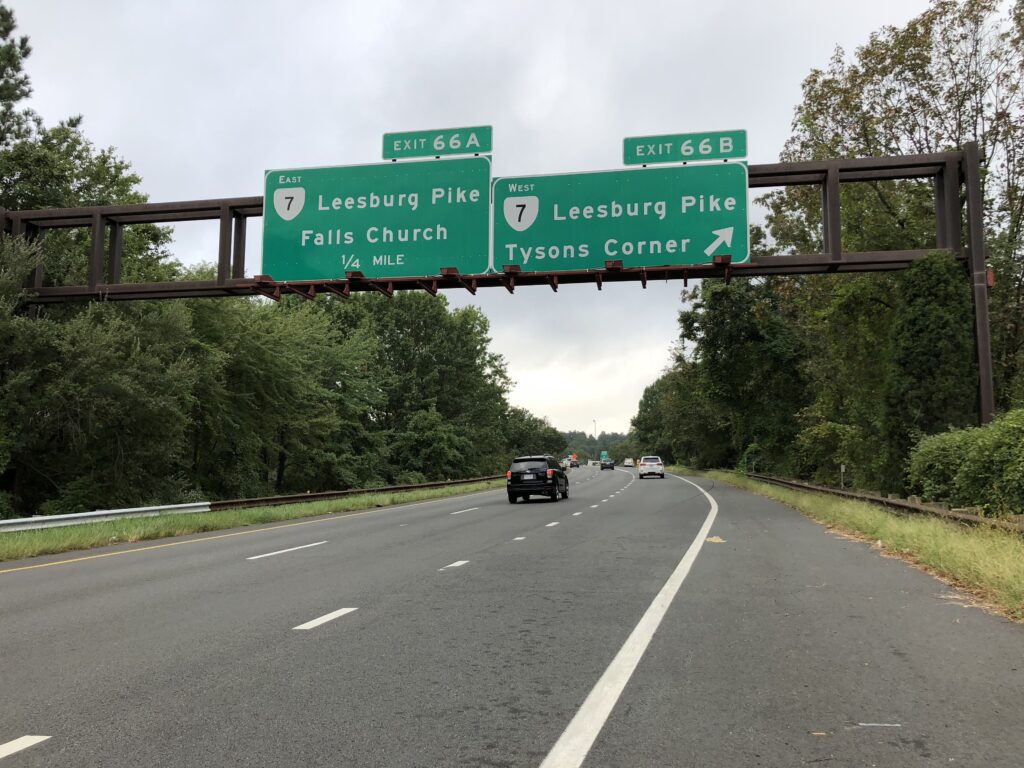
Virginia’s eluding law gives drivers who doubt a stop a defense
For a driver on Leesburg Pike, the practical question is what happens if you don’t stop for lights you don’t trust. Under § 46.2-817(A), willfully disregarding a law-enforcement officer’s signal to stop is a Class 2 misdemeanor, punishable by up to six months in jail and a $1,000 fine. If the driving endangers a person or the police vehicle, subsection B makes it a Class 6 felony. Any conviction under the section also comes with a court-ordered license suspension of at least 30 days.
Both subsections carry the same affirmative defense: the driver can beat the charge by showing he “reasonably believed he was being pursued by a person other than a law-enforcement officer.” The burden sits with the driver, and whether the belief was reasonable gets decided by a judge or jury after the fact. A driver who signals, holds the speed limit and stops at the next lit, busy parking lot has a much easier case to make than one who floors it. That defense is written into Virginia’s statute; other states set their own rules.
Fairfax County’s own policy describes what a real stop should sound like. FCPD General Order 603 says that, absent mitigating or exigent circumstances, an officer making a traffic stop identifies themselves to the driver and states the reason for the stop. Fairfax defense attorney Jonathan Katz told DC News Now that he advises drivers who doubt an officer’s identity to ask for proof or suggest meeting in the lobby of the nearest police station. FCPD’s non-emergency number is 703-691-2131.
Fairfax County has charged fake cops on its roads before
In May 2018, WTOP reported that a man was charged with impersonating a police officer after he put another driver in handcuffs at a crash scene in Chantilly. The man in that case told FOX 5 he worked for a security company and said the accusation was wrong; the New Mexico suspect was also a security guard. Police say the McLean stops were made from a truck owned by a federal agency whose job includes enforcing gun laws, with a loaded gun and two children inside. That puts a question in front of ATF about who can take its vehicles and where, and the agency has not answered it publicly.
What happens next in the McLean case
As of the Nov. 22 release, Dablow was being held without bond. The release lists no court date, and neither it nor local coverage names a defense attorney. Each count under § 18.2-174 is tied to a separate incident, so any further stop detectives connect to the Ram could add another charge, which is why FCPD is asking other drivers to come forward. ATF has said it is cooperating with Fairfax County police and has not discussed what, if anything, it will do about the employee or the truck.
Virginia already lets a driver beat an eluding charge by showing he reasonably believed the lights behind him weren’t police. Should the law go further and say outright that you can keep rolling to a lit, busy lot before stopping for an unmarked truck, or would that make real stops more dangerous for officers?
About the Author