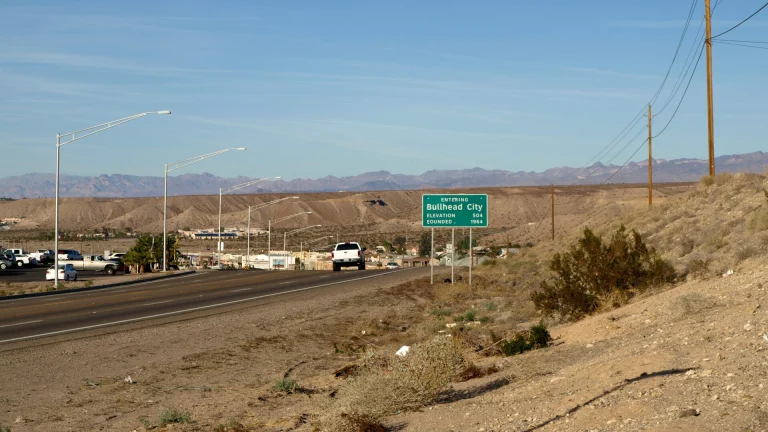
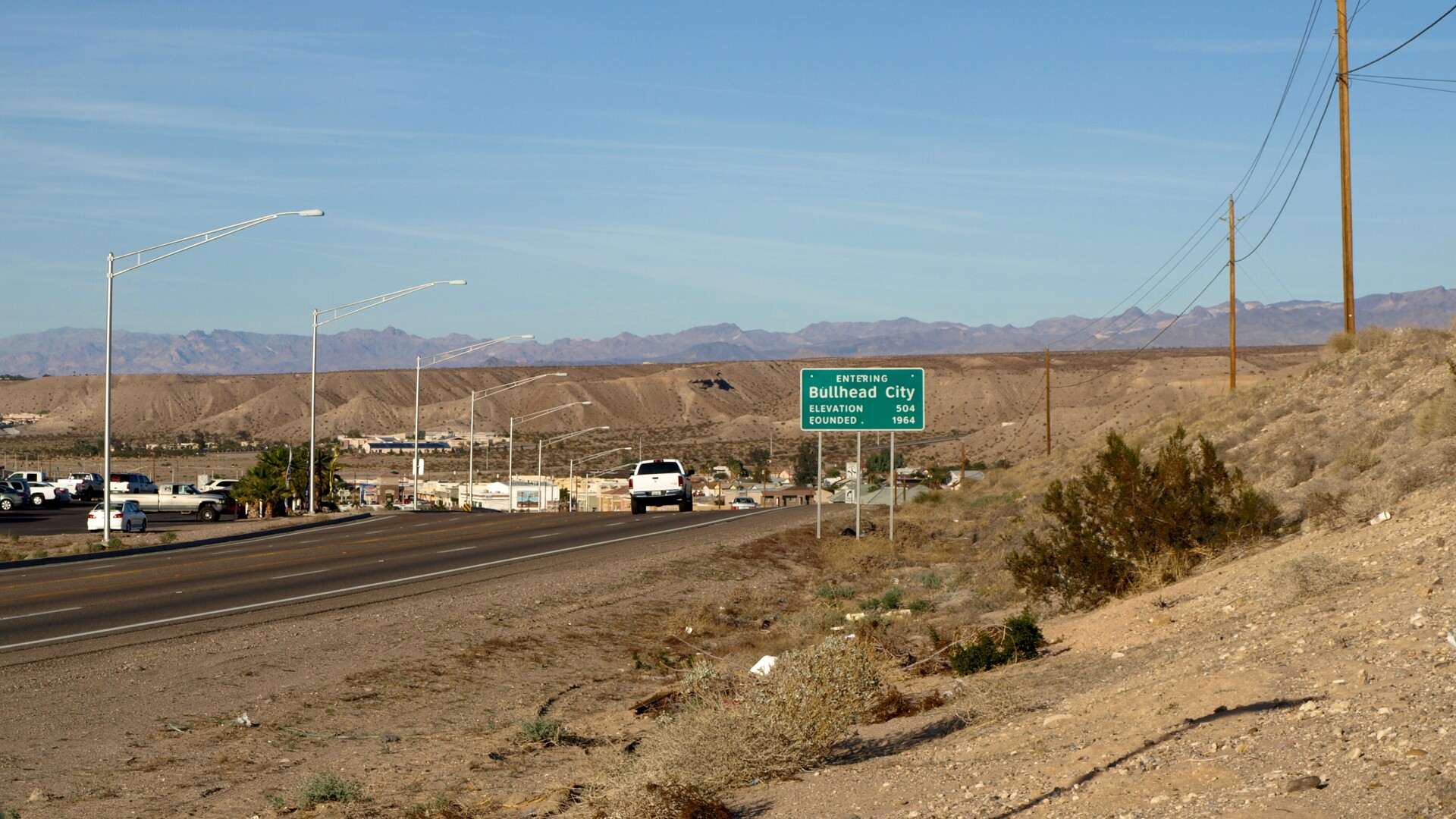
Bullhead City's southern city limits sign on State Route 95. Photo: <a href="https://commons.wikimedia.org/wiki/File:Bullhead_City,_Arizona_southern_city_limits_sign_(2012).jpg">Amin Eshaiker / Wikimedia Commons</a> (<a href="https://creativecommons.org/licenses/by-sa/3.0/">CC BY-SA 3.0</a>)
Bullhead City, Arizona, police say a 44-year-old driver who followed another car after it cut him off on Highway 95 Saturday was shot in the leg, and the person who fired was a woman riding in the car he followed.
Nearly everything public about the fight comes from her. In its release on Facebook, the Bullhead City Police Department said the woman told officers she and her boyfriend were driving through the 600 block of Highway 95 around noon on Nov. 21 when he accidentally cut off another vehicle. That driver followed them until they pulled over near Landon Drive and Highway 68. He got out and got into a physical fight with the boyfriend. According to the woman, he started choking her boyfriend. She took a gun from the glove compartment, ordered him to stop and warned she would shoot if he didn’t. When he reportedly kept going, she fired one shot and hit him in the leg.
Las Vegas station KLAS (8 News Now) placed that stretch of Highway 95 just southeast of the bridge to Laughlin, Nev., and described Highway 68 as the road to Kingman. Bullhead City Fire Department paramedics took the man to Western Arizona Medical Center. Police haven’t named anyone involved or released his condition.
No one has been arrested. The department said the case is going to the Mohave County Attorney’s Office “for review and consideration of potential charges,” and it didn’t say against whom.
If prosecutors accept her account, Arizona’s self-defense statutes and a 2006 change in who carries the burden of proof put the woman on solid legal ground, and the driver who followed a car over a lane change is the one with the problem. The man’s version hasn’t been made public, though, and the case turns on what happened in the seconds before she fired.

Arizona lets a bystander use deadly force to protect someone else
Arizona’s defense-of-others law, A.R.S. 13-406, lets a person threaten or use force, including deadly force, to protect a third person when the person being protected would have been justified in using that force himself, judged by what a reasonable person would believe. The question in front of prosecutors is whether the boyfriend could have fired that shot.
For deadly force, A.R.S. 13-405 requires that a reasonable person would see it as immediately necessary to stop the other person’s unlawful deadly physical force. It also says there’s no duty to retreat for someone who is somewhere he’s allowed to be and isn’t breaking the law. The state’s definitions section, A.R.S. 13-105, counts as deadly physical force anything that, by the way it’s used, can create a substantial risk of death or serious physical injury. Hands closing off a man’s throat fit that description, if the prosecutor believes it happened the way she told it.
Her warning helps her. Section 13-405 covers threatening deadly force as well as using it, and the release says she told the man to stop and that she would shoot before she did. A warning, a refusal and then one shot to the leg is a sequence that speaks to the “immediately necessary” question, because it shows she gave him a way out first.
Arizona’s crime-prevention statute, A.R.S. 13-411, offers another route. It allows deadly force to prevent a list of crimes that includes murder, manslaughter and aggravated assault involving serious physical injury, it applies in vehicles and anywhere else a person has a right to be, and it presumes that someone acting to stop one of those crimes acted reasonably.
The soft spot for any defense claim is provocation. Under A.R.S. 13-404, force isn’t justified in response to words alone, or for someone who provoked the other person’s unlawful force and didn’t withdraw. An accidental cut-off is a driving mistake, not force. If the man tells investigators the boyfriend threw the first punch after they pulled over, that fact would change the analysis, and nothing released so far says who swung first.
Since 2006, Arizona prosecutors have had to disprove self-defense
The rule that carries the most weight here is A.R.S. 13-205. Once a defendant puts forward evidence of justification, the state must prove “beyond a reasonable doubt that the defendant did not act with justification.”
That wasn’t always Arizona law. Before Senate Bill 1145 was signed on April 24, 2006, the statute made defendants prove justification themselves by a preponderance of the evidence, as the Legislature’s summary of the bill lays out. The Arizona Supreme Court ruled in Garcia v. Browning in 2007 that the new burden applied only to offenses committed on or after that date, and in State v. Carson in 2018 it held that if any evidence supports self-defense, prosecutors have to disprove it.
Backfire News’s reading of what that means in Kingman: a prosecutor weighing a charge against the woman would have to expect to convince a jury, beyond a reasonable doubt, that she wasn’t justified, when the one public account of the fight is hers and it describes a stranger choking her boyfriend after following their car. Unless the man’s version, a witness or a video tells a different story, that is a hard case to file.
The same chapter has a civil consequence. A.R.S. 13-413 says no one in Arizona faces civil liability for conduct justified under it. If her shot was justified, a lawsuit over the leg wound has nowhere to go.
Arizona’s strangulation felony doesn’t cover strangers
The man’s own exposure runs into a limit in Arizona’s assault law. The state has a specific aggravated assault for strangulation in A.R.S. 13-1204(B): intentionally or knowingly impeding someone’s normal breathing or blood circulation by pressure on the throat or neck, or by blocking the nose and mouth. It’s a class 4 felony. It applies only when the people involved share one of the domestic relationships listed in A.R.S. 13-3601, such as marriage, a shared household, a child in common, family ties or a dating relationship. Two drivers who met over a lane change don’t qualify.
That leaves the general statutes. Under A.R.S. 13-1203, intentionally or knowingly causing physical injury is assault, a class 1 misdemeanor. It becomes aggravated assault under 13-1204(A) if, among other things, it causes serious physical injury or temporary but substantial impairment. Whether prosecutors see grounds for any of that depends on what the boyfriend’s injuries were, which police haven’t described, and on whose account they believe. The man who was shot hasn’t been charged, and the release relays the choking allegation as the woman’s account.
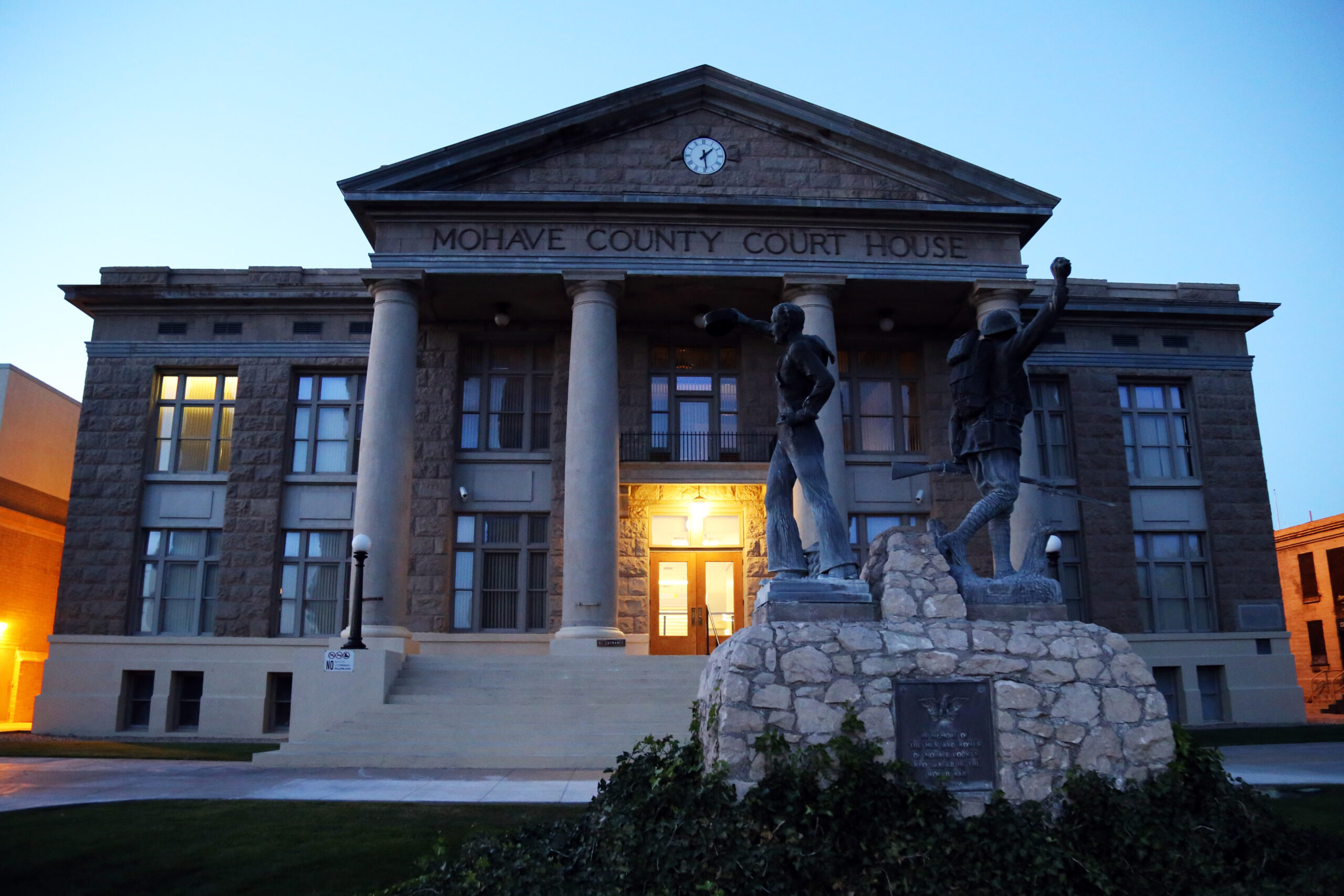
What Mohave County prosecutors decide next
The police release gave no timeline for the county attorney’s review, and with no charges filed there’s no court date. The next things to watch are whether the man’s account surfaces and whether any charging decision names him, the woman or neither.
Watch how fast the roles flipped. When he was cut off, the man was the one who had been wronged, even if only by a lane-change mistake. Once he followed the couple, got out and, by her account, put his hands on her boyfriend’s throat, he became the person whose conduct sits at the center of a self-defense statute, and the woman who fired holds the advantage of a law that makes the state disprove her justification.
If a stranger follows your car over a traffic mistake and gets his hands on your passenger’s throat, is a warning and one shot to the leg the right call, or should anyone who answers a roadside fight with a gun have to explain it to a jury?
About the Author