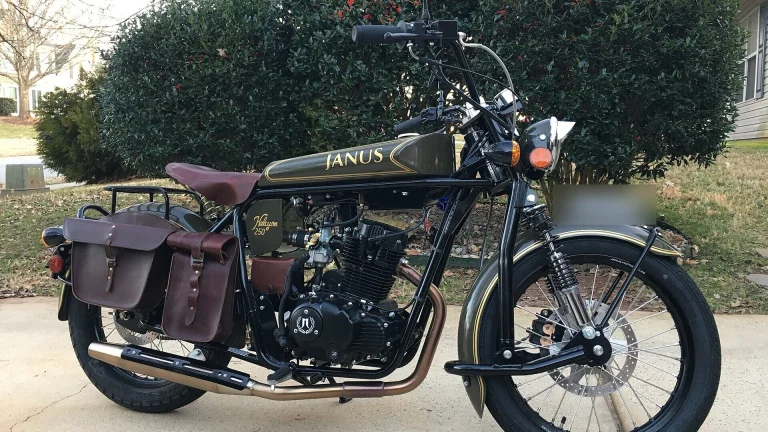
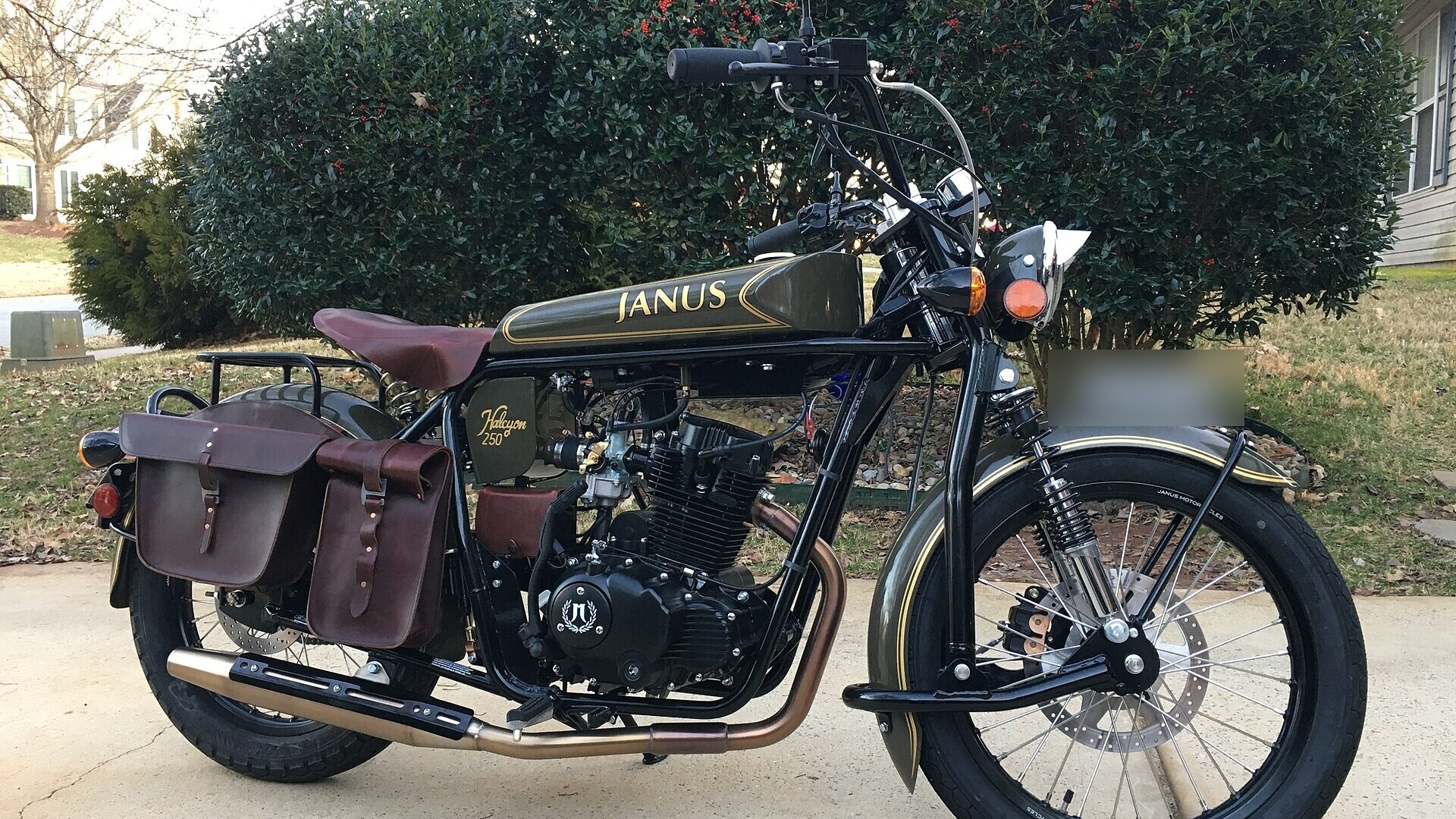
A 2021 Janus Halcyon 250. Photo: <a href="https://commons.wikimedia.org/wiki/File:2021_Model_Year_Janus_Halcyon_250_Motorcycle.jpg">NTrimbach/Wikimedia Commons</a>, <a href="https://creativecommons.org/licenses/by-sa/4.0/">CC BY-SA 4.0</a>; plate obscured by Backfire News.
Janus Motorcycles, which has built small motorcycles by hand in a converted dry-cleaning building in downtown Goshen, Indiana, for 15 years, has stopped production, and its founder is asking the company’s own customers to help him find someone to buy it.
Richard Worsham, Janus’s founder and CEO, laid out the situation in a letter addressed to owners and posted on his LinkedIn page last week. Production is suspended while the company works out its future, he wrote. He is looking for an individual, an investor group or another company to take Janus over, has been talking with interested parties, and has no finished deal. He put the blame on overhead that grew faster than the business and did not point at anyone else: “I take responsibility for the decisions that brought us here.”
The letter doesn’t say how many workers are still on the payroll. As of Tuesday, Janus’s own website carried no notice about the shutdown and was still advertising a free-earplugs promotion that ended Oct. 31. Its newest blog post, from Oct. 21, compares foam and filtered earplugs.
Tariffs are part of what happened here, and Janus’s own posts show where they bit. The rest is in the paperwork the company filed with the Securities and Exchange Commission a year ago, when it sold shares to the public online. That filing describes a company with less than a month of cash at its own burn rate. It also lists who Janus owes, which tells customers waiting on bikes and the 199 people who bought shares roughly where they stand if the company is sold off or liquidated: near the back.
What Janus Told Investors in Late 2025
Paragon Motorcycles Inc., the Indiana corporation that does business as Janus, filed a Regulation Crowdfunding offering statement with the SEC in December 2025. The figures reproduced on its Wefunder offering page show a business that grew and lost money in both years it reported. Revenue rose from $3,082,031 in 2023 to $4,057,702 in 2024, while net losses were $926,354 and $899,391. At the end of 2024, liabilities of $2,708,549 exceeded assets of $2,066,617.
The newer numbers were tighter. Janus reported $63,367 in cash as of November 2025. Over the previous three months it averaged $324,514 a month in revenue, $252,385 in cost of goods sold and $164,829 in operating expenses, which the filing itself put at a burn rate of $92,700 a month. At that pace, the cash on hand covered about 20 days. That’s Backfire News’s math, not the company’s.
The filing said that hitting only the minimum raise would leave about two months of runway, and that Janus needed the full $1 million to be confident of turning a profit within six months. The first risk factor it listed said the company had never had enough capital to get production to break-even. The raise closed in April with $469,519 from 199 investors, according to Wefunder, less than half the target. In a closing update to investors on April 28, Worsham rounded that to $470,000 and pointed to a long-term goal of building Janus into a $20 million company by 2030.
The crowd money was a small slice. In a January update on the same page, the company said it had taken in more than $3.6 million in new equity since March 2025, and Worsham predicted 2026 would be a great year. The offering’s fundraising table shows insiders lending, too, including $500,000 from a single director in June 2025 at 12 percent interest, due in 2028.
The One Major Part Janus Never Made Near Goshen
Janus sold itself on local manufacturing, and for most of the motorcycle the claim holds. Purdue University’s manufacturing extension program, in its Made in Indiana profile of the company, says more than 80 percent of a Janus is fabricated and sourced within 20 miles of the Goshen shop. The Wefunder offering described the line as predominantly U.S.-made.
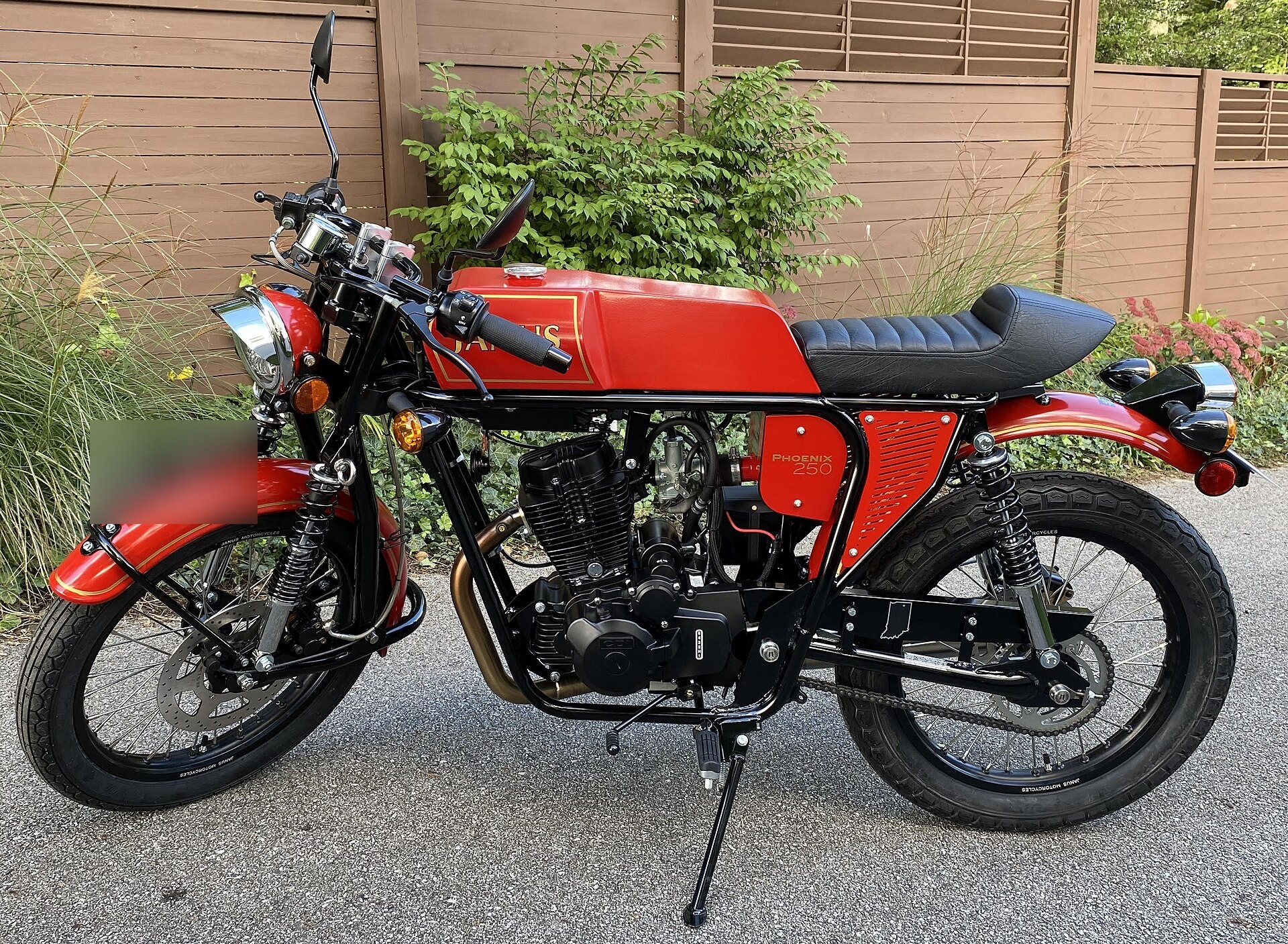
The engine was always the exception. Janus has bought every engine it has used from another manufacturer, and its 250s run a design the company traces to Honda’s CG125 family. In a July 2 announcement, Janus said future 450 models would switch from an SWM engine to one from Hartford Industrial of Taiwan. The company’s stated reasons: the cost of getting the SWM engines out of China by way of Italy had climbed sharply, and tariff changes, trade uncertainty and long shipping delays piled on top. Janus said the new engine can’t be retrofitted to earlier 450s, and promised to keep stocking parts for SWM-powered bikes.
The offering, written months before that switch, shows what a parts problem does to a shop like this one. Janus told investors that revenue would probably stay between $300,000 and $400,000 a month, against $400,000 to $500,000 in expenses, until it had enough parts on hand to lift revenue to $500,000. The money it was raising, it said, would go mostly to parts, so it could build 10 to 12 bikes a week without running short. Worsham told Northwest Indiana Business Magazine this year that a bike missing a single part can’t ship. For a company that builds every bike to order, one late crate of engines stalls the whole line.
Why Shipping a Chinese Engine Through Italy Doesn’t Change the Tariff
U.S. duties follow an import’s country of origin, not the last port it left. Under Customs and Border Protection’s marking rules at 19 CFR 134.1, work done in a second country changes an article’s origin only if it substantially transforms the article. An engine built in China and passed through Italy stays Chinese for tariff purposes unless something done in Italy turns it into a different product. Janus hasn’t said what, if anything, happened to its engines in Italy, what duties it paid, or whether it or a supplier was the importer of record.
If those engines arrived as Chinese goods in 2025, the timing was brutal. The emergency “reciprocal” tariff on Chinese products reached 125 percent on April 10, 2025, on top of separate fentanyl-related duties, before the administration cut it to 10 percent effective May 14. A November 2025 executive order recounts that sequence. Tariff math has steered where JLR plans to build a Defender pickup; at Janus, the duty landed on a single component the company had no domestic source for.
Janus didn’t pass those costs along as a line item. In a LinkedIn post that Worsham reposted this summer, chief operating officer Mark Zweig wrote that a Janus came with no documentation fee, no dealer prep, no destination charge and no added tariff cost. A Halcyon 450 Origin is listed from $10,995 on the company’s site. When a company absorbs a duty on its most expensive purchased part, the money comes out of margin, and Janus was covering its margin with board money.
The law changed after the damage was done. On Feb. 20, 2026, in Learning Resources, Inc. v. Trump, the Supreme Court ruled 6-3 that the International Emergency Economic Powers Act doesn’t give the president power to impose tariffs, which took down the reciprocal and fentanyl duties. The court didn’t order refunds, and that question went back to the lower courts. If Janus was the importer of record and paid those duties, a refund claim would be an asset a buyer would want to know about. The company hasn’t said whether it has one.
Worsham’s Own Diagnosis Is Overhead
Worsham’s letter barely mentions trade. He wrote that Janus spent heavily on people, equipment, engineering, marketing and infrastructure in anticipation of production and sales volumes that its supply chain and capital couldn’t support, until overhead outgrew the business. He argued that a smaller, leaner Janus focused on the models it already knows how to build could work.
His LinkedIn feed shows the build-up. Between roughly June and August, Janus posted openings at the Goshen plant for a sales representative, a junior designer, an inventory coordinator and a production scheduler. The offering’s revenue-per-employee figure, $135,256.73, works out to about 30 employees in 2024. That’s far below the 100-employee line for the federal WARN Act, which requires 60 days’ notice before a plant closing, so federal law wouldn’t have required Janus to give its workers advance warning before stopping the line.
Both explanations are true at once, and the documents rank them. The July engine announcement shows tariffs and shipping raised Janus’s costs and slowed its parts. The offering shows a company that, by its own account, had never had enough money to reach break-even, was spending about $92,700 a month more than it took in, and had roughly three weeks of cash in November 2025. A business with no cushion has nothing to absorb a bad year for its one imported part, and 2025 was that year.
Who Is in Line Ahead of Janus Customers and Shareholders
The offering’s outstanding-debt table, current to late November 2025, lists two loans from First Source Bank ($400,000 due Dec. 31, 2025, and $251,851 due at the end of 2028), plus a $476,825 Small Business Administration loan due in 2052 and smaller balances owed to Ford Motor Credit and Penske. The bank and SBA loans alone total about $1.13 million, by Backfire News’s math. The filing doesn’t say whether the $400,000 loan was renewed when it came due. The same table lists about $1.27 million owed to directors, shareholders and a former general manager, most of it at 12 percent interest. Janus said any money left from the crowdfunding raise would go to debt, bank loans first and the insiders second.
Behind all of those lenders are the 199 Wefunder investors, who bought common stock at $33 a share through a special-purpose vehicle, at a $6 million pre-money valuation. Common stock gets paid after every creditor, whether the company is sold in pieces or wound down.
Customers with deposits sit in between, and their protection is limited. If Janus ends up in bankruptcy, 11 U.S.C. § 507(a)(7) gives an individual’s deposit on goods for personal or household use that were never delivered a priority claim, but only up to $3,800 per person, the amount set in the April 1, 2025, adjustment. That priority ranks behind secured lenders’ collateral and higher-priority claims such as administrative costs and unpaid employee wages. Anything over $3,800 becomes a general unsecured claim. Outside bankruptcy, no such rule applies, and a buyer of Janus’s assets would generally decide which open orders and warranties it takes on. Worsham’s letter acknowledged the uncertainty for customers waiting on motorcycles and owners worried about future support.
What Happens Next for Janus Owners and Investors
Worsham’s letter describes a search for a buyer, not a bankruptcy filing. Because Janus sold shares under Regulation Crowdfunding, SEC rules at 17 CFR 227.202 require an annual report on Form C-AR within 120 days after each fiscal year ends, until the company qualifies to stop reporting. As of Nov. 24, the company’s EDGAR record showed only the December 2025 offering statement and a May 2025 Form D. The next look at Janus’s books, if one comes, will be a C-AR or a deal announcement.
For the people who already own a Janus, the July promise of continued parts and service for SWM-powered 450s came from a company that has since stopped building motorcycles. Whether that promise survives depends on who buys Janus, what they pay, and which obligations they agree to carry. Customers with bikes still on order are waiting on the same answer.
Should tariff policy exempt parts no U.S. supplier makes, like a small-batch motorcycle engine, or is paying that tariff the price of pushing production back home?
About the Author