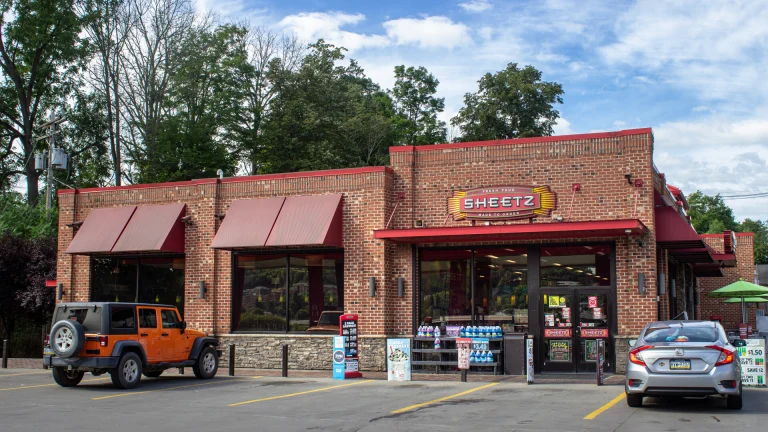
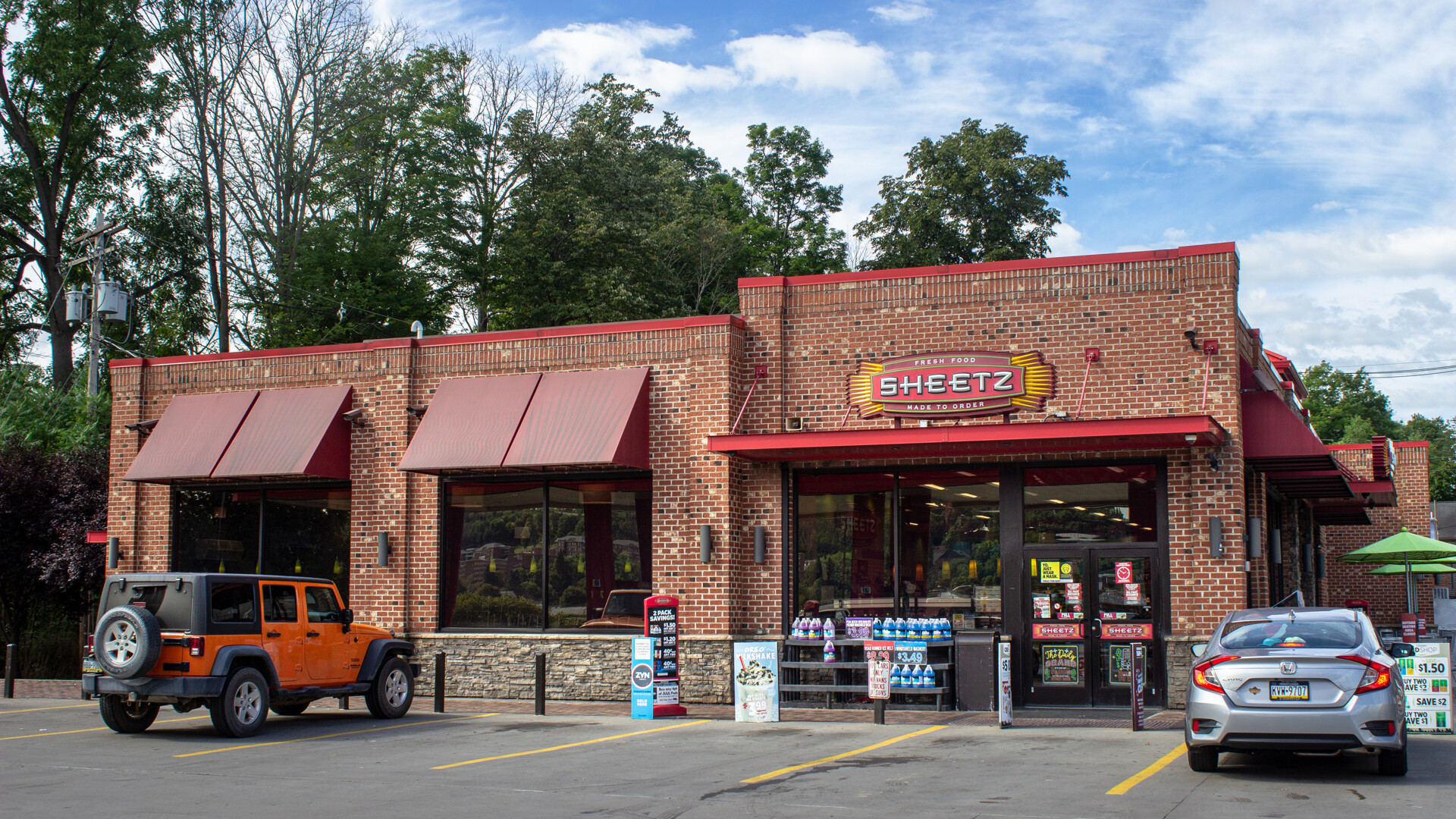
A Sheetz store in Mansfield, Pa., not the Raleigh location. Photo: Scottb211 via <a href="https://commons.wikimedia.org/wiki/File:Sheetz,_Mansfield,_PA_(50332260152).jpg">Wikimedia Commons</a>, <a href="https://creativecommons.org/licenses/by/2.0/">CC BY 2.0</a>
Darryl Avery Fulton’s car was the one being stolen. He’s the one who was denied bond. The 59-year-old Raleigh, North Carolina, man faces four criminal charges over the theft of his own car.
Raleigh police said Fulton was inside the Sheetz at 8101 Glenwood Avenue, just north of Lynn Road, at about 2:50 a.m. on Wednesday, Nov. 11, when a woman got into the car he had left running in the lot and started driving away. According to police, he fired several shots into the air, then fired at the car and hit it several times. Officers found the car nearby with the woman, Essence Larita Abraham, 29, still in it. Nobody was hurt.
The Raleigh Police Department’s Northwest District station sits at 8016 Glenwood Ave., directly across the street from that Sheetz. Court records reviewed by WRAL show a bullet struck the station while people were inside.
The department’s first release, as ABC11 reported it, listed three charges against Fulton and one against Abraham. The warrants WRAL later reviewed list four for him: felony discharge of a weapon into an occupied vehicle, felony discharge of a weapon into occupied property, misdemeanor discharge of a firearm within city limits, and misdemeanor assault with a deadly weapon. Abraham is charged with two felonies, larceny of a motor vehicle and possession of a stolen motor vehicle. Her arrest warrant says she was intoxicated when she took the car while it was running at a store, according to WRAL.
Abraham was booked into the Wake County Detention Center under a $25,000 bond. Fulton went to the same jail with no bond at all, according to the judge’s release order as WRAL reported it, even though the judge noted he had no relevant criminal history, no record of missing court, and “was also the victim of his vehicle being stolen.”
Both were scheduled for a first appearance at 1:30 p.m. on Nov. 12. North Carolina’s online court records sit behind a security check that kept me from confirming whether a judge has changed either defendant’s release conditions since then, and WRAL’s report included no statement from a lawyer for either of them.
The difference in those two bond outcomes comes from a statute. Since Dec. 1, 2025, North Carolina has classified one of Fulton’s charges as a violent offense that presumes the defendant stays in jail, and it treats car theft as an ordinary felony that carries no such presumption.
North Carolina’s deadly-force law protects people, not cars
Under G.S. 14-51.3, a person is justified in using deadly force only when he reasonably believes it is necessary to prevent imminent death or great bodily harm to himself or someone else. The section says nothing about property.
The state’s castle-doctrine statute, G.S. 14-51.2, does cover motor vehicles, alongside homes and workplaces. But the presumption of reasonable fear it creates belongs to a lawful occupant facing someone who is unlawfully and forcibly entering, or who is dragging a person out against their will. Police say Fulton was in the store, not the car, and the person he fired at was driving away from him. Irving Joyner, a law professor at North Carolina Central University, told WRAL that firing at an occupied car is what turned Fulton from a theft victim into a suspect.
That line runs between two situations that feel alike at 3 a.m. A driver sitting behind the wheel when someone yanks the door open is the person the castle-doctrine presumption was written for. A driver watching his car leave a parking lot from the doorway of a gas station is not. That puts him in the same position as a Bexar County, Texas, man deputies say shotgunned a repo truck’s tires: a car owner who reached for a gun and became the defendant.
How firing into an occupied car outranks stealing it
G.S. 14-34.1 makes it a Class E felony to willfully or wantonly fire a gun into an occupied building or vehicle. The class rises to D when the target is an occupied vehicle that is in operation, which describes a car being driven off a gas station lot. The warrants, as reported, don’t state which class prosecutors charged, so that reading is mine, from the statute’s text.
The theft side sits three classes lower. Larceny of goods worth more than $1,000 is a Class H felony under G.S. 14-72, and possessing a stolen motor vehicle is also Class H under G.S. 14-71.2.
North Carolina’s felony sentencing chart shows what those letters mean for someone with no prior record. A Class D conviction carries a presumptive minimum of 51 to 64 months, and active prison time is the only sentence the chart allows. Class E carries 20 to 25 months, with probation-based intermediate punishment available. Class H carries 5 to 6 months, and a judge can choose community punishment, intermediate punishment, or jail. Nobody in this case has been convicted of anything, but those are the stakes each charge sheet carries: a first offender convicted at the top of Fulton’s list would be looking at years in prison, while one convicted at the top of Abraham’s list could walk out on probation.
Iryna’s Law turned one of his charges into a bond decision
The General Assembly passed Session Law 2025-93, House Bill 307, known as Iryna’s Law, after Iryna Zarutska was killed on a Charlotte light-rail train in August 2025. Its pretrial-release changes took effect Dec. 1, 2025. According to an analysis by the UNC School of Government, the law’s definition of a “violent offense” in G.S. 15A-531(9) covers Class A through G felonies with assault or force as an element, and it also names specific statutes outright. G.S. 14-34.1, firing into occupied property, is one of them.
That label matters because G.S. 15A-534(b1) now sets a rebuttable presumption against pretrial release for anyone charged with a violent offense. The School of Government’s Jan. 6, 2026, post on the provision says it applies based on the charge alone. A prior record isn’t required. If a judge does grant release, the order needs written findings explaining why, and unsecured bonds are off the table.
Larceny of a motor vehicle and possession of a stolen vehicle aren’t on that list, so Abraham’s release fell under the ordinary rules, and she got a dollar figure. Fulton’s charge sheet triggered the presumption the moment the firing-into-property count was filed. That is how a judge can write that a defendant is a crime victim with a clean record and still hold him without bond: the presumption attaches to the offense, and the statute doesn’t spell out what it takes to overcome it.
Officers who fire at stolen cars get reviewed too
Shooting at a moving car with someone inside draws scrutiny even when a police officer does it. In New Jersey, a Newark officer who shot at a stolen Porsche’s driver had his case go before a grand jury before he was cleared. Fulton doesn’t have a use-of-force policy or a badge to point to, only a statute that, as written, doesn’t reach property.

What comes next for Fulton and Abraham in Wake County
Both cases are felony cases in Wake County, where the next markers are any bond review, a grand jury indictment, and whether prosecutors keep the occupied-vehicle count at the class the statute’s “in operation” language allows.
For other North Carolina drivers, the statutes are blunt about where the line sits. The deadly-force law turns on a threat to a person, and the castle-doctrine presumption protects someone inside the vehicle when another person forces their way in. Neither provision, as written, covers firing at a car that is leaving with only the person taking it inside, and the state’s new bond law treats that act as a violent offense from the moment it is charged.
He fired at his own car as it left a Sheetz at 2:50 a.m. with someone else at the wheel. Should a judge weigh that differently from any other shooting into an occupied car?
About the Author