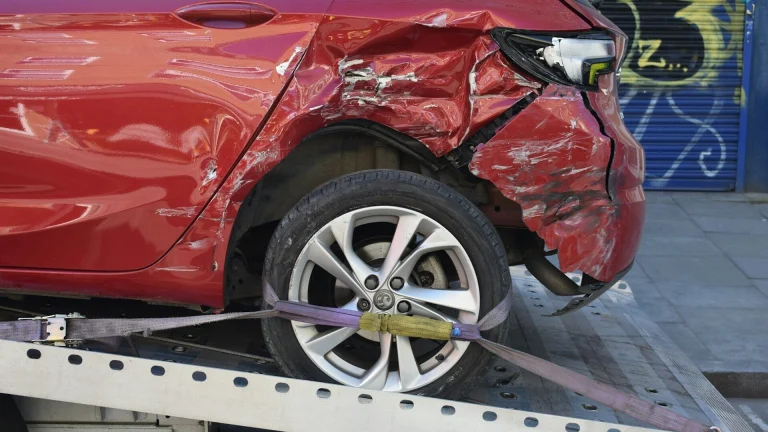
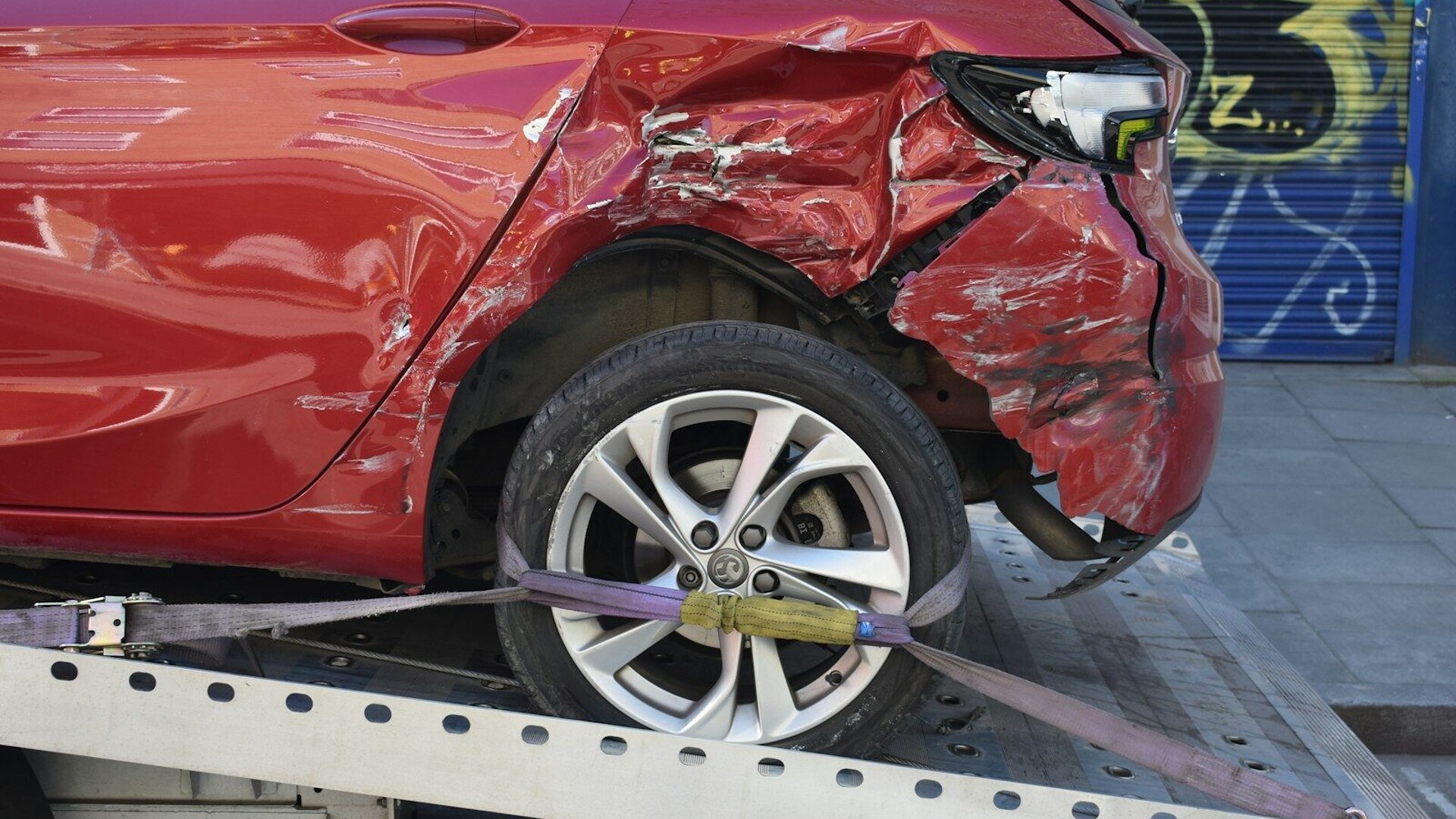
A crash-damaged car strapped to a flatbed. Representative image; not a vehicle from the Brooklyn case. Photo: Usman Malik / Unsplash
Brooklyn prosecutors say Steven Ventura’s tow trucks found crashes by listening to the police radio, and that the cars they hauled to his Crown Heights body shop then sat until their owners were handed storage bills as high as $30,000. Ventura, 35, of Davenport, Florida, and his company, State to State Automotive LLC of 1332 Atlantic Avenue, were arraigned Tuesday on a 29-count indictment, the Brooklyn District Attorney’s Office said.
Under New York City’s towing law, a tower without a city license cannot charge a dollar for towing or storage. Prosecutors say neither Ventura nor State to State ever held that license. If that holds up, every one of those bills was unlawful before a jury ever gets to the question of fraud.
A 3 a.m. Tow on St. Johns Place
At about 3 a.m. on July 20, 2025, a 38-year-old woman was still sitting in her car after a crash on St. Johns Place, between Brooklyn Avenue and New York Avenue, when Ventura and an associate walked up, according to the DA’s office. Prosecutors say Ventura told her he worked with the NYPD and would have to tow her vehicle. He took it to his shop. She went back to demand it repeatedly, and on Aug. 4, 2025, she was given an invoice for about $5,220. She paid. Prosecutors say no repairs had been made.
The indictment covers 12 victims between May 7, 2024, and Dec. 10, 2025, with storage demands ranging from $2,500 to $30,000. The DA’s release describes three more:
- On May 7, 2024, near Pacific Street, Ventura allegedly offered a 36-year-old woman a tow and a repair within three weeks. Six months of excuses later, she was allegedly told she owed $150 a day in storage, about $30,000, which prosecutors say was more than the car was worth. She took the story to the news media, and after a critical report aired, the car came back repaired on Feb. 12, 2025.
- On Dec. 8, 2024, a 28-year-old man’s parked car was hit on Eastern Parkway between Dean and Pacific streets. He had not called a tow truck. Ventura allegedly showed up anyway and took the car to State to State, where it sat until the NYPD recovered it, unrepaired, under a search warrant on Dec. 10, 2025, more than a year later.
- On July 25, 2025, an associate of the shop allegedly approached a 51-year-old man after a crash near Park and Marcy avenues. When the man came for his car on Oct. 1, 2025, he was handed a $10,680 invoice for “storage fees.” He refused to pay, and the NYPD helped him recover the car that day.
The DA’s office said most of the cars in the case went back to their owners only after the NYPD stepped in. CBS New York reported in January, citing NYPD sources, that officers executing that December search warrant removed 14 cars parked illegally outside the shop and eight more from inside the garage. The station also reported the shop had closed, and one customer told it his insurer had paid the shop $13,000 while his repair kept getting pushed back.
Why the Lawful Storage Bill Was Zero
Three of the charge types come from Subchapter 31 of the city’s Administrative Code, the towing chapter the Department of Consumer and Worker Protection enforces. Section 20-496(b) bars anyone from driving a tow truck without a tow truck operator’s license. Section 20-515(d) bars anyone at a crash scene from offering to make repairs, or offering anything of value, to steer a wrecked car to a particular shop. Section 20-509(d)(2) covers the money: no charge for towing and storage may be imposed by a person who does not hold a towing license at the time the work is done.
Licensed towers face a ceiling too. When police dispatch a tow through the NYPD’s Directed Accident Response Program, DCWP rules cap storage at $25 a day for the first three days and $27 a day after that. At $150 a day, the $30,000 bill in the May 2024 case works out to 200 days of storage. A licensed accident tower charging the city maximum for those same 200 days could bill $5,394, by Backfire News’s math. Prosecutors say State to State wasn’t licensed, so the figure it could lawfully charge was $0.
That gap is also what turns a towing violation into a felony case. Breaking the city’s towing rules is a misdemeanor under Section 20-522, with a fine of $500 to $3,000, up to 90 days in jail, and a civil penalty of the same range on top. The bills are what carry the heavier counts. Third-degree grand larceny is a class D felony once the property tops $3,000, and first-degree scheme to defraud, a class E felony, can rest on a course of conduct aimed at 10 or more people. The indictment lists 12.
A 1987 Ban on Tow Trucks With Police Radios
The radio count rests on state law. New York’s Vehicle and Traffic Law Section 397 makes it a misdemeanor for anyone other than police to equip a vehicle with a radio that can receive police frequencies without a permit, punishable by up to a $1,000 fine and six months in jail. New York City added its own rule for towers. In findings attached to a 1987 local law, the City Council described tow operators monitoring police transmissions and racing to crash sites to lock up the towing and repair work, and it banned both soliciting at crash scenes and keeping police-band radios in a towing business.
Police Commissioner Jessica Tisch said in the DA’s release that the defendants could only carry out the alleged scheme by “illegally monitoring police radio channels,” then rushing to collisions to solicit business. Thirty-nine years later, prosecutors are describing that exact playbook, police radio included.
Who Is Supposed to Tow a Wrecked Car in New York City
Under Section 20-518 of the code, a tow truck operator generally may not head to a crash or remove a vehicle from one without a specific request from the person in charge of the car or a direction from police. When police make the call, the job goes to a licensed company through the Directed Accident Response Program, known as DARP. Crash tows feed repair jobs and insurance payouts, and the rotation has been gamed before. In 2022, three former NYPD officers from the 107th Precinct in Queens pleaded guilty in federal court to a scheme that steered crash-damaged cars around DARP to a tow and repair business operated by one of them, a former officer, in exchange for bribes. Under their pleas, they agreed to forfeit $25,000, about $26,011 and about $158,277.
The unlicensed side of the business is bigger than one shop. Gothamist reported that an investigation it published in February counted more than 700 unlicensed tow trucks working city streets. Brooklyn Borough President Antonio Reynoso said in the DA’s release that the borough has seen “an alarming increase in illegal towing practices.” Tow operators elsewhere have drawn the same kind of charges lately, from an Arkansas tow boss accused of lien washing to a lawsuit over driveway tows in University City, Missouri.
Ventura Is Due Back in Brooklyn Supreme Court Feb. 24, 2027
Ventura was arrested in Osceola County, Florida, on Nov. 13 and pleaded not guilty, Gothamist reported. The DA’s office said he was arraigned before Brooklyn Supreme Court Justice Danny Chun, released without bail and ordered back to court on Feb. 24, 2027. An indictment is an accusation, and none of the charges has been proven.
The rules the city leans on put most of the burden on a driver standing next to a wreck. The DA’s office tells drivers to turn down unsolicited tows, check a tower’s license with DCWP, and get a written tow authorization showing the company, its license number, where the car is going and what it will cost. Agreeing to a tow does not authorize repairs, and a DCWP rule says an authorization to repair cannot be signed at the accident scene at all. Licensed tow companies must also take credit cards, which leaves a paper trail that cash doesn’t.
The bigger fight may come at City Hall. Bronx Council Member Justin Sanchez told Gothamist he plans to introduce a bill moving towing oversight from DCWP, which relies on civilian inspectors, to the Business Integrity Commission, which has law enforcement authority and was created to regulate private trash hauling. A commission spokesperson told Gothamist it would review the bill once it is introduced.
Should rolling an unlicensed tow truck up to a crash be a felony on its own, even if no bill ever goes out, or is a misdemeanor capped at $3,000 enough?
About the Author