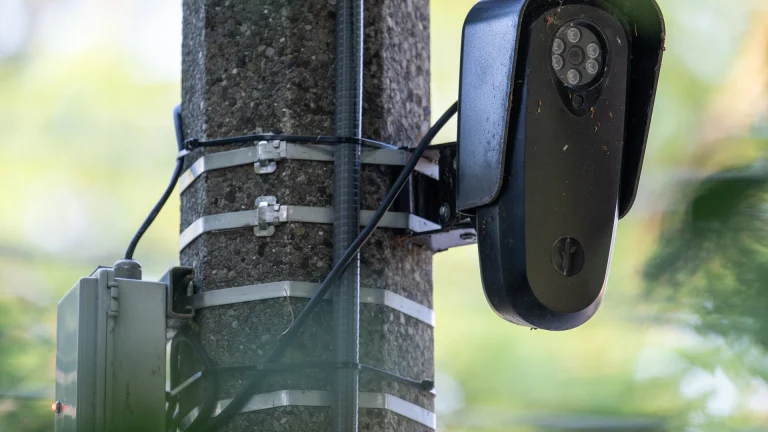
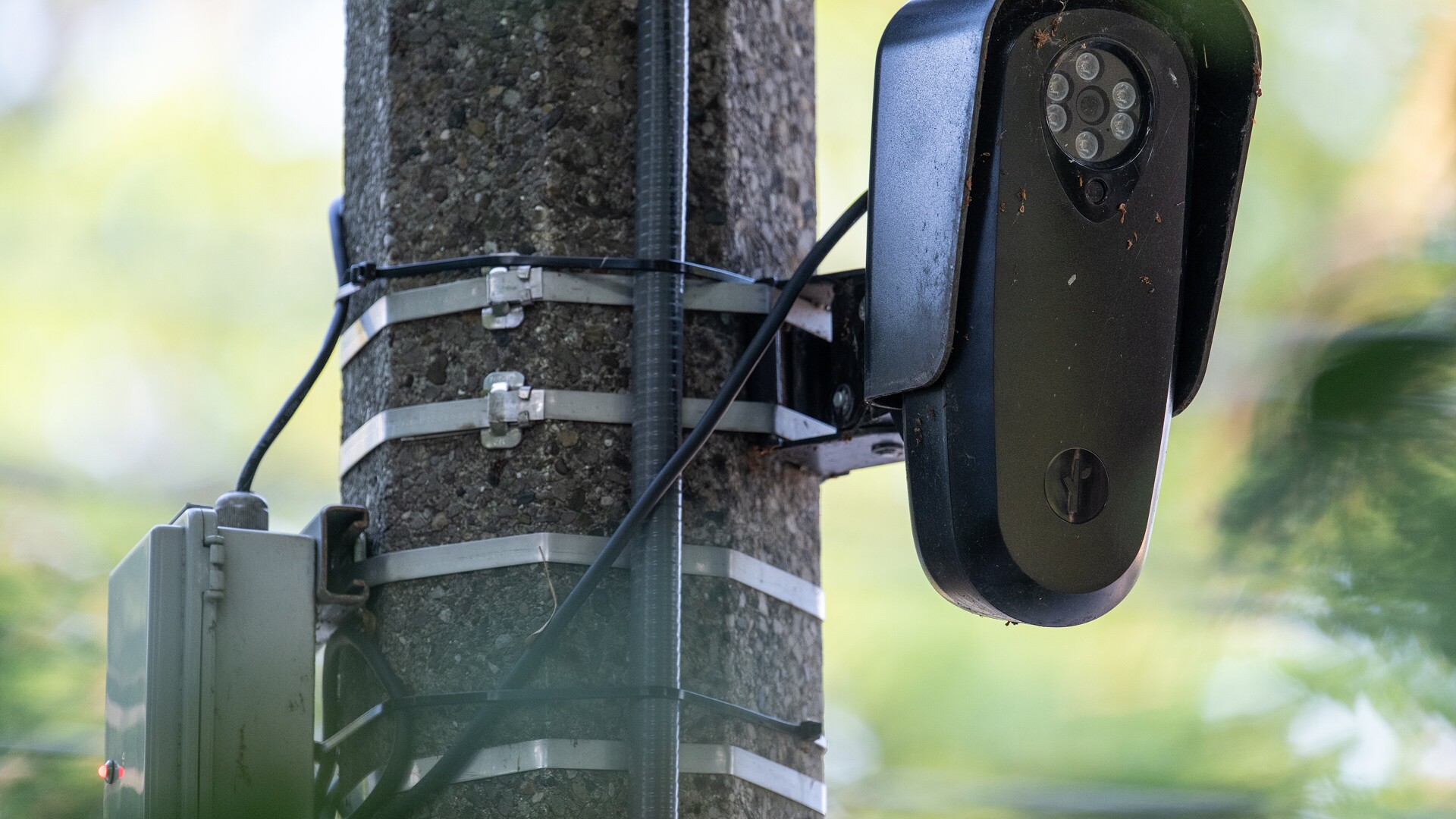
A Flock Safety license plate reader camera. File photo; not the camera involved in the St. Johns County case. Photo: <a href="https://commons.wikimedia.org/wiki/File:Flock_Camera_(54703882783).jpg">Paul Goyette via Wikimedia Commons</a>, <a href="https://creativecommons.org/licenses/by/4.0/">CC BY 4.0</a>
After a license plate reader flagged a stolen tag on a white Kia Soul on Nov. 16, a St. Johns County, Florida, deputy found the car at the Durbin Pavilion Walmart. He says the driver hit 118 mph before the chase ended outside the Publix on Palm Valley Road in Ponte Vedra Beach.
That account comes from a St. Johns County Sheriff’s Office arrest report, as described by the St. Johns Citizen. The plate-reader hit came 27 days after the St. Johns County Commission voted 3-2 to revoke the sheriff’s permits for readers on county roads. The Kia case is the kind of result Sheriff Rob Hardwick has used to defend the cameras, and it arrived while those cameras sit in a revoked-but-not-removed limbo that no one has put a date on.
The chase from Durbin Pavilion to Palm Valley Road, per the arrest report
The deputy saw the Kia pull out of a parking space at the Walmart and turned on his lights and siren. The driver sped away, ran several red lights and nearly hit several vehicles, the deputy wrote. At one point the driver made a U-turn and a passenger got out. The driver turned around again and kept going, and the deputy wrote that he paced the Kia at 118 mph as it passed other traffic.
The Kia then turned into the Publix parking lot on Palm Valley Road. As it headed back toward the road, a deputy used his patrol car to spin it around, according to the report. The driver then drove straight at a second patrol car, and that deputy boxed the Kia in and ordered him out.
Deputies arrested Tony Currelley, 46, of Jacksonville. According to the report, he told the deputy that his brother had told him to drive the car and later told him to flee, and when asked again who owned the Kia, he said he did not know. Deputies said the Kia and its license plate had been reported stolen separately in Jacksonville. They also reported finding a glass pipe and three bags of a crystalline substance that field-tested positive for methamphetamine.
The arrest report lists charges including fleeing or eluding law enforcement, driving at least 100 mph in a manner that threatened people or property, grand theft of a motor vehicle and possession of a controlled substance. Those are the arresting agency’s charges. The State Attorney’s Office for Florida’s 7th Judicial Circuit, which prosecutes St. Johns County cases, decides what is formally filed. Currelley has not been convicted of anything. Backfire News did not find a statement from a defense attorney, or a sheriff’s office release or video about the chase.

A Jacksonville theft report, caught by a camera in St. Johns County
A plate reader works by comparing what it photographs against a list. The St. Johns County Sheriff’s Office has said that when one of its Flock cameras photographs a plate, the plate is automatically checked against the National Crime Information Center, the FBI-run database where police log stolen cars and plates. A sheriff’s sergeant told News4Jax earlier this year that dispatchers and the agency’s real-time intelligence center get an alert when a plate comes back tied to a stolen vehicle, a missing person or a wanted person.
That is how a theft reported in one county gets caught in another. Duval County has mostly stopped looking: on Aug. 31, the Jacksonville Sheriff’s Office said it was discontinuing license plate reader technology throughout the county, effective immediately. The Kia and its tag were reported stolen in Jacksonville, by the deputies’ account, and flagged by a reader in the county next door.
Two Florida speed laws on one charge sheet
The 118 mph reading shows up twice in the charges, with very different stakes. Under section 316.1935, fleeing a marked patrol car with its lights and siren on is a third-degree felony. If the driver “drives at high speed” during the flight, it becomes a second-degree felony, which Florida punishes with up to 15 years in prison. A conviction under that section also requires the court to revoke the driver’s license for one to five years.
The speed count comes from a much newer law. Florida’s dangerous excessive speeding statute, section 316.1922, took effect July 1, 2025, under House Bill 351. It covers driving 50 mph or more over the limit, or driving 100 mph or more in a way that threatens other people or property or interferes with other vehicles. Under that second clause, the speed alone is not the offense; the danger to others is part of what prosecutors have to show. A first conviction carries up to 30 days in jail, a $500 fine, or both. A second within five years brings up to 90 days, a $1,000 fine and a license revocation of 180 days to a year.
Next to the felony fleeing count, the new speeding charge is small. Its weight falls mostly on drivers who never ran from anyone: someone clocked at 100-plus on an open road, who before July 2025 would have faced a noncriminal speeding citation unless an officer wrote it up as reckless driving. In a chase case like this one, the fleeing count is the one that can cost a driver years and a license.
The county-road cameras St. Johns commissioners voted to revoke
On Aug. 31, the Florida Department of Transportation revoked local agencies’ permits for plate readers in state highway rights-of-way and gave them 30 days to take the cameras down, citing reports of misuse and privacy concerns. The St. Johns sheriff’s office removed 84 readers in September to comply, according to News4Jax.
That left the readers on county roads, which sit on county right-of-way permits. On Oct. 20, the Board of County Commissioners voted 3-2 “to revoke license plate readers on County rights-of-way in St. Johns County,” according to the board’s minutes. Commissioner Christian Whitehurst made the motion, Commissioner Sarah Arnold seconded it and Commissioner Ann Taylor voted with them. Chair Clay Murphy and Commissioner Krista Joseph voted no. The minutes set no removal date, and the sheriff’s office told News4Jax that an effective date for disabling the systems had not been set. Readers on private property and those run by homeowners associations are not covered by the vote.
Hardwick, who did not attend the meeting, said in a social media statement that the decision “encroaches on my ability to keep our community safe,” Jacksonville Today reported. His office’s 2026 figures, as reported by News4Jax, credit the readers with recovering 29 stolen vehicles and 23 stolen tags. Chief investigator Howard “Skip” Cole told commissioners, according to Jacksonville Today, that the agency had cut its data sharing from about 2,600 outside agencies to none after an audit. On the other side, Debra Campbell, founder of the group DeFlock St. Johns, told commissioners in early October that records she requested showed cameras had captured her plate 154 times in 30 days.
The arrest report, as the Citizen describes it, does not say whose camera flagged the Kia. It could have been a sheriff’s reader on a county road, one of the private or HOA cameras the vote left alone, or a reader somewhere else. Either way, the system that caught the tag is running under a revocation that has not taken effect. Residents who asked for the cameras to come down still have them, and deputies who rely on them have no date to plan around.
What comes next for the case and the cameras
Currelley’s case now sits with 7th Circuit prosecutors, who decide which of the deputies’ charges to file. If the fleeing count holds as a high-speed felony, the license revocation that comes with a conviction is mandatory, whatever happens to the newer speeding charge.
The camera fight has moved past the county too. Whitehurst said he would favor bringing the readers back once lawmakers put guardrails on the technology, and Cole told the board the sheriff’s office would resume outside data sharing only if the Legislature passes statewide rules. That puts the next real decision in Tallahassee. Until then, the county’s revocation has no effective date.
A camera the county already voted to kill caught this Kia. Does that change your mind about plate readers, or prove why they need rules first?
About the Author