
Pi.1415926535 / Wikimedia Commons, CC BY-SA 4.0
Juan Americo Marty Del Toro, 74, of Pembroke Pines, Fla., was driving a 2014 Nissan NV200 west on Interstate 84 in Tolland, Conn., on the afternoon of Nov. 18 when a brake rotor from an eastbound 2019 Kenworth tractor-trailer came through his windshield. Connecticut State Police said the truck’s brakes failed and its rotors came apart and went airborne. One crossed the highway, went through the windshield of the Nissan in the left lane just west of Exit 69, and hit him. He died at the scene.
His passenger was taken to Manchester Hospital with what police described as minor injuries, and the truck’s driver had no apparent injury, according to the state police crash summary WTNH reported. The medical examiner ruled the death an accident, WFSB reported. The crash happened around 12:45 p.m. and closed both sides of I-84 for more than five hours. Tolland Town Manager Brian Foley told FOX61 the shutdown left the town in “absolute gridlock for several hours” and said he has again asked state police and the state Department of Transportation for a better way to get traffic off the highway when it happens.
Mr. Mann Trucking’s federal file lists two trucks, one driver and no roadside inspections
WFSB and NBC Connecticut identified the truck’s operator as Mr. Mann Trucking of Tariffville, a village in Simsbury. I pulled the company’s FMCSA SAFER snapshot. Mr Mann Trucking LLC, USDOT No. 3789105, is authorized as a for-hire interstate carrier of general freight, fresh produce, refrigerated food and paper products. On its last registration update, dated Oct. 7, 2025, the company reported two power units, one driver and 69,447 miles for 2025.
The same snapshot, current through Nov. 17, the day before the crash, shows zero roadside inspections and zero reportable crashes in the prior 24 months, and no federal safety rating. That is a blank record, not a clean one. FMCSA’s own note on the page says roadside inspections are separate from the annual inspection every truck must pass, so the zero means only that no inspector pulled one of the company’s trucks aside in two years. It also means investigators have no outside inspection report on that Kenworth’s brakes to start from.
Both stations reported that the company had not responded to their requests for comment.
Federal rules put the annual brake check in the carrier’s own files
The Connecticut Department of Motor Vehicles is working with state police and federal authorities to determine whether the truck was safe to be on the road, and investigators will review the carrier’s compliance and maintenance records, NBC Connecticut reported. Those records are where federal rules place most of the responsibility for a truck like this one.
Under 49 CFR Part 396, every motor carrier “must systematically inspect, repair, and maintain” its trucks. Each truck must have passed a periodic inspection “at least once during the preceding 12 months,” and the carrier keeps the report for 14 months. The inspector does not have to work for the government. Section 396.19 lets a carrier use anyone who understands the federal standards and has the training or experience to identify defective parts, which can be the company’s own mechanic or an owner-operator.
The driver has a separate duty. Before driving, Section 396.13 says the driver must “Be satisfied that the motor vehicle is in safe operating condition.” The paper record of that check is thin. Under Section 396.11, drivers “are not required to prepare a report if no defect or deficiency is discovered by or reported to the driver,” so a day with nothing noticed leaves no daily inspection report behind. And a failing part does not always make itself known to the person in the cab, as the driver of MUNA’s burning tour bus on I-5 in Burbank found out.
How a heavy-truck brake rotor comes apart
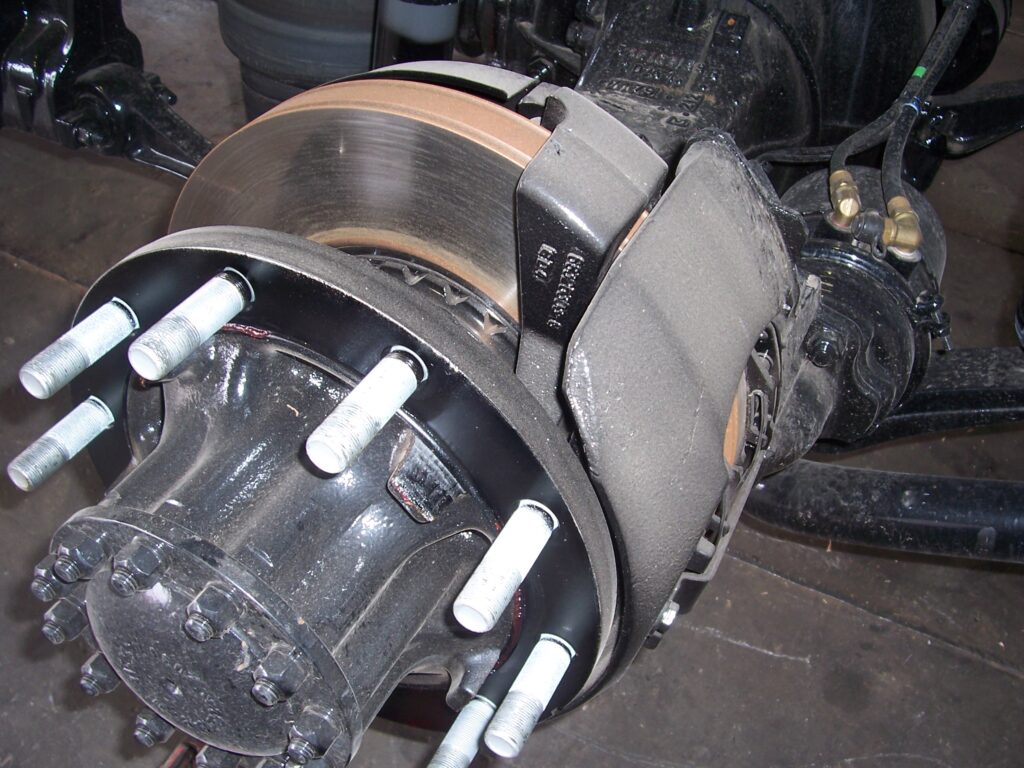
Police have not said what failed first on the Kenworth, or whether the rotors were on the tractor or the trailer. On a disc brake, the rotor is an iron disc that turns with the wheel hub while pads in a caliper clamp it to slow the truck. An 18-wheeler’s rotor is about four times the size of a car’s and much heavier, WFSB reported.
The federal inspection standard in Appendix A to Part 396 fails a rotor with any external crack or cracks that open when the brakes are applied, or with any portion missing or in danger of falling away. It tells inspectors not to confuse those with short hairline heat-check cracks, the fine surface lines that come from repeated heating and cooling. The difference is what makes a bad rotor dangerous: a structural crack can keep working through braking cycles while the brake still stops the truck, until the disc breaks while the wheel is turning at highway speed. Connecticut DMV Police Chief Matthew Galante told WFSB, “Brakes, tires, things strapped down in the back, those are the things we are looking for.”
Inspectors logged 32 broken air-disc rotors in a single August week
The Commercial Vehicle Safety Alliance made drums and rotors the focus of its 2026 Brake Safety Week, Aug. 23-29. In results released Nov. 6, 12 days before the Tolland crash, CVSA said inspectors in Canada, Mexico and the U.S. checked 15,528 commercial vehicles and put 2,369 out of service for brake violations, a 15.3% rate. In the U.S. alone it was 2,134 of 14,165, or 15.1%.
Inspectors recorded 141 drum and rotor violations, and 64 vehicles were taken out of service for them. On air disc brakes, CVSA counted 32 broken rotors, 45 rusted rotors and 20 cases of metal-to-metal contact, where the pad material is gone and steel is grinding on the rotor. Those numbers come only from trucks that were pulled in for a look. A carrier with no inspections in two years is not part of that sample.
Connecticut ran more than 28,000 commercial vehicle inspections last year and took about 4,800 vehicles and 2,100 drivers out of service, according to figures NBC Connecticut reported. Those checks happen at weigh stations and during random stops by DMV inspectors and a state police unit.
What happens next in the Tolland investigation
As of the latest reports, police had announced no charges or citations, and the crash remains under investigation. State police are asking anyone with information or dashcam video to contact Trooper Nicholas Desrosiers, No. 1122, at nicholas.desrosiers@ct.gov, according to FOX61.
Connecticut’s negligent homicide statute for drivers, Section 14-222a, covers a death caused “in consequence of the negligent operation of a motor vehicle” and carries a fine of up to $3,500, up to three years in prison, or both. Its text is about how a vehicle is driven and says nothing about maintenance. A brake that comes apart mid-trip points investigators at the maintenance file instead, which is a federal regulatory question and, for Marty Del Toro’s family, a possible civil one. That file should show whether this Kenworth passed its annual inspection, who performed it, and what was done to its brakes afterward.
Any driver can check a truck the way I checked this one. The USDOT number on the cab door goes into FMCSA’s free SAFER lookup, which shows a carrier’s fleet size, roadside inspections, out-of-service rates and reported crashes for the past two years.
Under federal rules, a two-truck carrier’s annual brake check can be signed off by its own mechanic and kept in its own files. Should it get to grade its own brakes?
About the Author