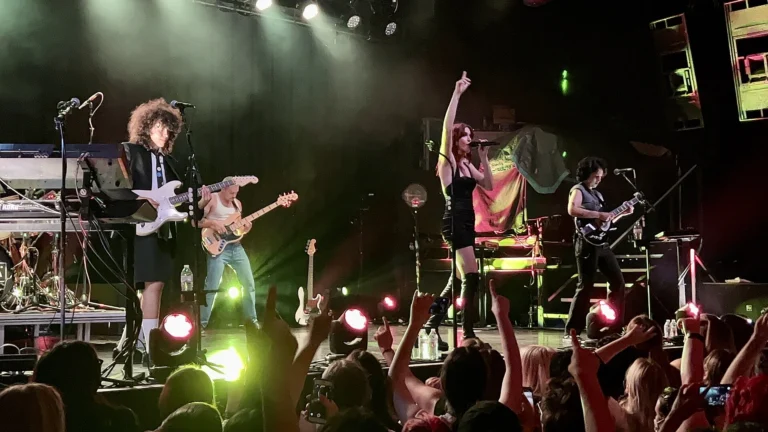
MUNA on stage at First Avenue in Minneapolis, Aug. 8, 2022. Photo: erintheredmc via Flickr/Wikimedia Commons, CC BY 2.0.
When the California Highway Patrol got the call about MUNA’s tour bus at about 8:20 a.m. Monday, the bus was on fire and still rolling down the southbound 5 Freeway in Burbank. According to KTLA, the driver didn’t know.
The coach finally pulled over just past the Buena Vista Street offramp, where the Burbank Fire Department put the fire out. Passengers got off quickly and no injuries were reported. By the time KTLA’s Sky5 helicopter was overhead just after 9 a.m., the back end of the bus looked heavily burned, and several lanes of the 5 were shut down until it was towed away.
The band confirmed it was aboard by posting a frame of KTLA’s coverage to its Instagram account: “the band MUNA as seen on the news this morning. many personal items were lost but we’re all safe, thank goodness.”
The Los Angeles trio had played Frost Amphitheater at Stanford University the night before, a Stanford Live and Goldenvoice date on the Gets So Hot tour with hemlocke springs. A southbound coach in Burbank at breakfast time fits an overnight run of more than 300 miles home, though no one has said where the bus was going.
What nobody has said yet
The cause is under investigation, and that is the extent of the public record. No agency or company has identified who owns or operates the coach, what make it is, where on the bus the fire started, how long it burned before the driver stopped, or who placed the 8:20 call. The band hasn’t said whether instruments were among the “many personal items,” or how many people were aboard.
Forty feet from the engine
A driver missing a fire on the bus they are driving sounds implausible until you look at how these coaches are laid out. Entertainer coaches are generally conversions of rear-engine motorcoach shells. On a 45-foot coach, the engine bay and the rear axles sit around 40 feet behind the driver’s seat, on the far side of the bunks and the back lounge. The mirrors show the flanks. Smoke from the back trails behind a coach doing freeway speed.
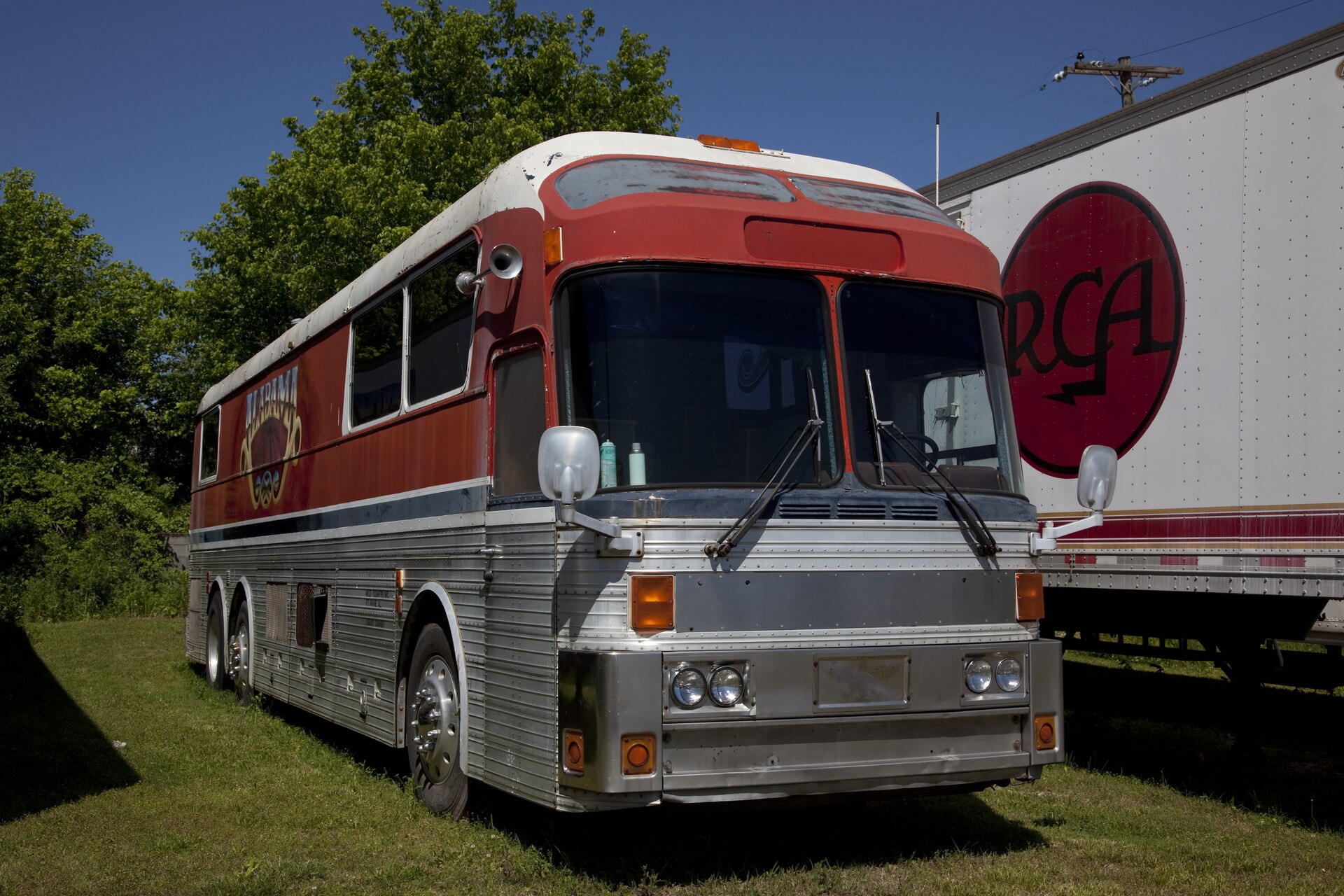
The back of the bus is also where coach fires start. A 2009 study by the U.S. DOT’s Volpe Center for the Federal Motor Carrier Safety Administration counted about 160 reported motorcoach fires a year from 2004 to 2006. The engine compartment and the wheel wells each accounted for about 35 percent of them. Across the full 1995–2008 data set, brakes, tires, turbochargers, wheel bearings and engine electrics made up 66 percent of known ignition points.
The deadliest modern example started the same way and was spotted the same way. On Sept. 23, 2005, a motorcoach carrying nursing-home residents away from Hurricane Rita caught fire on Interstate 45 near Wilmer, Texas. A passing motorist saw the right-rear wheel glowing red and warned the driver. The NTSB traced it to insufficient lubrication in a tag-axle wheel bearing. Twenty-three passengers died.
No detector required
In 2007 the NTSB asked NHTSA for wheel-well temperature monitoring that would warn drivers early (Safety Recommendation H-07-06) and to evaluate a federal standard requiring fire detection and suppression systems (H-07-07). NHTSA answered in a July 1, 2016 letter. Test procedures it developed with Southwest Research Institute turned out to be specific to individual bus designs and “not conducive to a FMVSS,” it wrote, suggesting industry standards and insurance incentives instead. It asked the NTSB to close all four recommendations from the Wilmer fire.
The 2009 study had put a number on what those systems could do: failure detection for tires and turbochargers “could prevent 42 percent of all motorcoach fires,” and engine-compartment detection and suppression could reduce the risk of 36 percent. Whether MUNA’s coach carried anything like that is one more thing nobody has said.
MUNA is booked at Red Rocks Amphitheatre in Morrison, Colorado, tonight, Oct. 21, and had announced no changes as of this writing. Where on the coach the fire started, wheel well or engine bay, should be in the Burbank Fire or CHP report, if either releases one.
Should NHTSA require fire detection in the engine bays and wheel wells of every motorcoach, or is it right to leave that to bus builders and their insurers?
Sources: KTLA; MUNA (@whereismuna) on Instagram; Stanford Live event listing; AXS event listing; Volpe Center/FMCSA, “Motorcoach Fire Safety Analysis” (2009); NTSB Highway Accident Report HAR-07/01; NHTSA letter to the NTSB, July 1, 2016. Photos: erintheredmc via Wikimedia Commons (CC BY 2.0); Carol M. Highsmith, Library of Congress (public domain).
About the Author