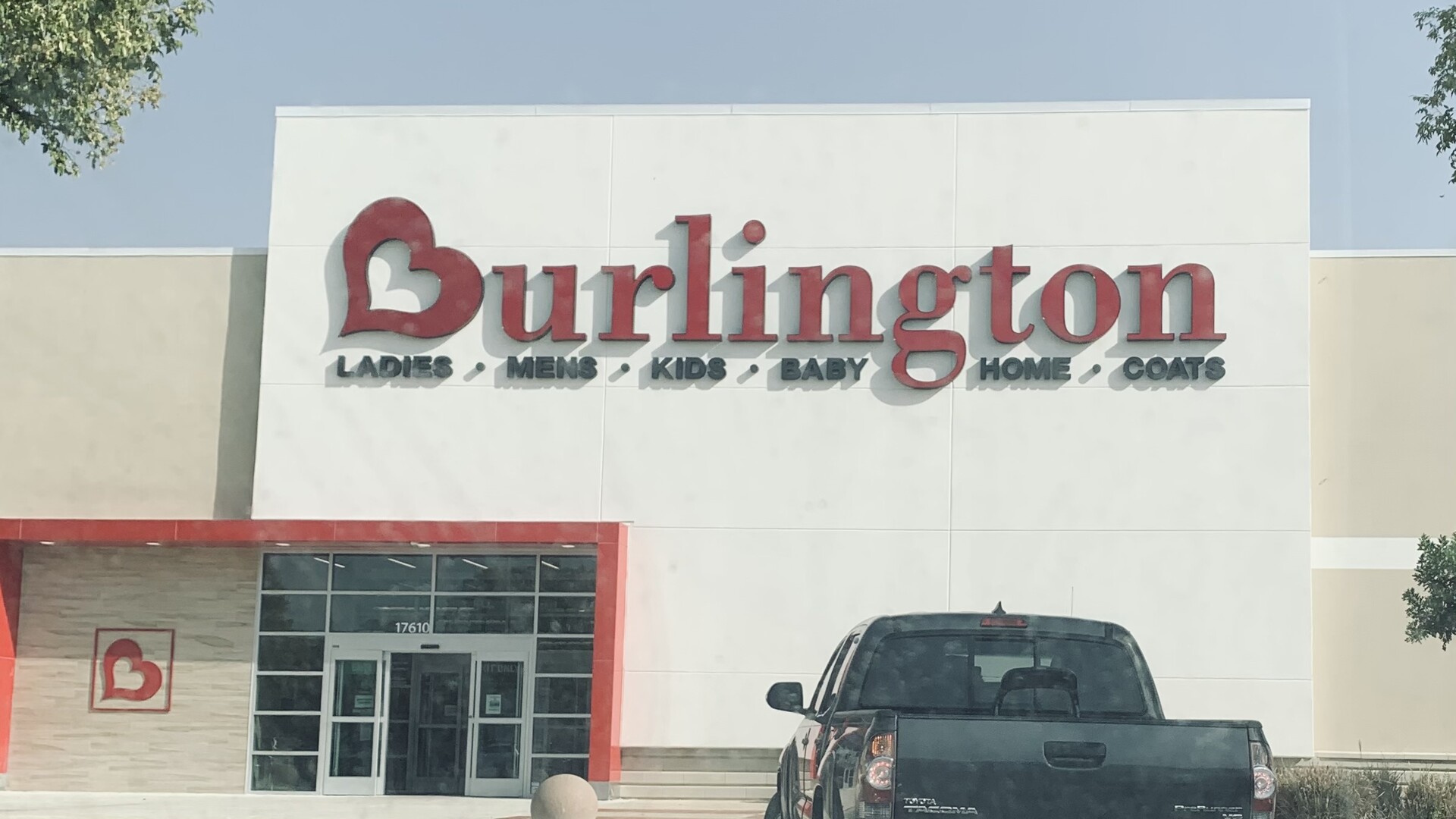
A Burlington store in San Antonio, Texas, not the North Charleston location in this case. Photo: Jay1095 / Wikimedia Commons, CC BY-SA 4.0
A tow operator sent to Northwoods Mall in North Charleston, South Carolina, to repossess a car over missed payments found two children alone in the back seat, with the doors locked and the engine running, according to the North Charleston Police Department’s arrest post. Officers were called shortly after 1 p.m. on Wednesday, Nov. 18, on a report of possible child neglect.
The car belonged to Kayla Brooke Adams, 28, of Moncks Corner, police said. According to the complainant’s account in the department’s post, Adams saw the car being secured to the tow truck, ran out of a nearby business, got behind the wheel and tried to drive away while it was still attached. The post does not say whether the children were still inside at that moment or how far the car moved.
Adams told officers she had gone into Burlington Coat Factory to buy a jacket and acknowledged leaving the children in the locked, running car, police said. She told them physical limitations kept her from taking the children into the store; the officers wrote that they saw no apparent physical limitations while talking to her. As they explained how serious the situation was, police said, she kept coming back to one point: she had only been inside for about 10 minutes.
Officers arrested her on one count of unlawful conduct toward a child and took her to the Al Cannon Detention Center. Family members took custody of the children. The charge is an accusation, and she has not been convicted of anything.
Her 10-minute defense runs into a problem: South Carolina’s law has no clock in it, and the person who walked up to her car while she shopped was a stranger with a tow rig. This time the stranger was a repo operator doing a lawful job, and he called it in when he saw the kids.
South Carolina’s child-endangerment statute measures risk, not minutes
The charge comes from Section 63-5-70 of the South Carolina Code. It makes it unlawful for a parent or anyone responsible for a child to “place the child at unreasonable risk of harm affecting the child’s life, physical or mental health, or safety.” The statute sets no number of minutes. It is a felony, punishable on conviction by a fine at the court’s discretion, up to 10 years in prison, or both.
Because the test is risk, the questions a prosecutor and a judge ask are about conditions: how old the children were, whether the car was running, whether the doors were locked, how hot or cold it was, and what could reach them. The police post does not give the children’s ages. It does establish two conditions that tend to matter: the engine was running, and someone other than their mother was able to get to the car and start preparing to tow it before she came back.
Florida does write a time limit into its law, and it shows how lawmakers there treated a running engine. Florida Statute 316.6135 bars leaving a child younger than 6 unattended in a vehicle for more than 15 minutes, but it drops the grace period entirely “if the motor of the vehicle is running,” or if the child’s health is in danger or the child appears to be in distress. Under Florida’s rule, Adams’s 10 minutes would not have helped her either.
South Carolina also has a traffic rule that covers the car itself. Section 56-5-2570 says a driver may not leave a vehicle standing unattended without stopping the engine, locking the ignition, removing the key and setting the brake. In December 2018, Rep. McKnight prefiled H. 3314 to repeal that section outright. It was referred to the Committee on Education and Public Works on Jan. 8, 2019, and never came out. The police post lists no traffic citation under that section in this case.

South Carolina makes lenders wait 20 days after a cure notice before repossessing
The repossession had its own legal track. Under the South Carolina Consumer Protection Code, a creditor on a consumer loan can send a written notice of the right to cure once a borrower has been in default for 10 days over a missed payment. Section 37-5-111 then bars the creditor from accelerating the debt or taking the car until 20 days after that notice is given. During that window, the borrower can catch up by paying what is past due plus any delinquency charges, and the loan goes back to normal. A repossession that skips this step is void under the statute, and the creditor is liable for conversion.
The protection has limits. Once a lender has sent that notice on a debt, the borrower generally doesn’t get another cure right on the same obligation. And after the window closes, Section 37-5-112 lets the creditor take the car without a court order, as long as it does so without entering a home and “without the use of force or other breach of the peace.” A store parking lot is not a dwelling. Nothing in the statute requires the owner to be present or to be warned on the day the truck arrives.
That is where the owner’s legal footing sits: the cure notice, the 20 days, and the right to challenge a repossession that broke those rules afterward, in court. Climbing into a car that is being secured to a tow truck and putting it in gear is not on that list. Police have not charged Adams over the attempted drive-off, and the post does not say whether the repossession was completed or what the lender did about the loan. Those details belong to the lender and the borrower, and neither has made them public.
North Charleston police have filed this charge at store lots before
The same department has used the same statute for children left in running cars outside other stores. On Feb. 8, 2026, North Charleston police arrested a 35-year-old Summerville woman accused of leaving her child unattended in a running vehicle outside the Target on Rivers Avenue, according to the department’s arrest post, and charged her with unlawful conduct toward a child. In June 2019, officers charged a Goose Creek man with the same offense after a 2-year-old and a 4-year-old were found in his Chevy Tahoe in the Northwoods Mall lot, Live 5 News reported, citing the police report and jail records. His bond was set at $10,000, which was posted, the station reported.
Nationally, the risk a repo truck made visible in North Charleston usually arrives as a car theft. Kids and Car Safety, a nonprofit advocacy group, says it documented at least 264 children in 2022 who were left alone in vehicles that were then stolen. That figure is the group’s own count, built largely from news reports. There is no official one: the National Center for Missing & Exploited Children has pointed out that law enforcement has no single crime category for a child taken in a stolen car, so those cases get filed as car thefts, carjackings, abductions or neglect.
Kids and Car Safety says thieves look for cars left running or with keys inside, and most don’t realize a child is in the back until they are already driving. The tow operator at Northwoods Mall had a legal right to that car, and he found the children before he moved it.
Where the Northwoods Mall case goes from here
As of Nov. 23, the police department’s post listed one count of unlawful conduct toward a child. It did not give a bond amount or a first court date, and neither did the local reports on the arrest. A prosecutor will decide whether to pursue the felony as charged, reduce it or drop it, and the children’s ages and the conditions inside the car will carry weight in that decision. I found no public statement from Adams or from an attorney on her behalf.
For South Carolina drivers, two facts from this case apply well beyond it. The child-endangerment statute has no safe number of minutes, and the traffic code already requires the engine off and the key out whenever a car is left unattended. And a borrower who falls behind has a defined window, starting with the cure notice, to pay what is past due before a lender may lawfully send a truck. Once that window closes, the truck can come to a mall parking lot on a Wednesday afternoon without warning.
Florida puts a clock on leaving kids in a car. South Carolina leaves it to whichever officer pulls into the lot. Which would you rather be judged by?
About the Author