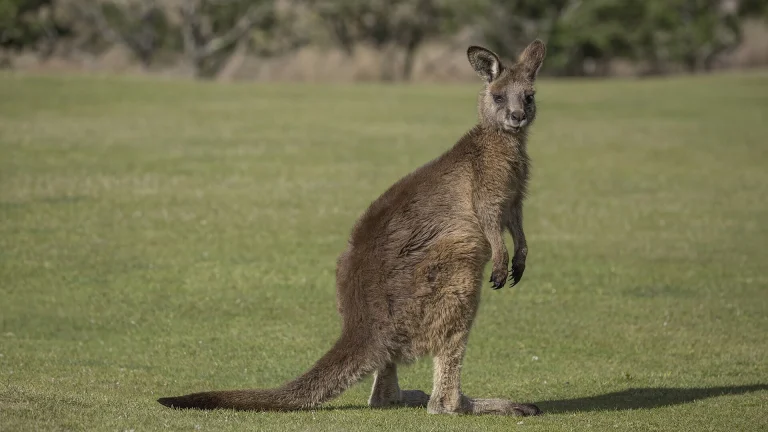
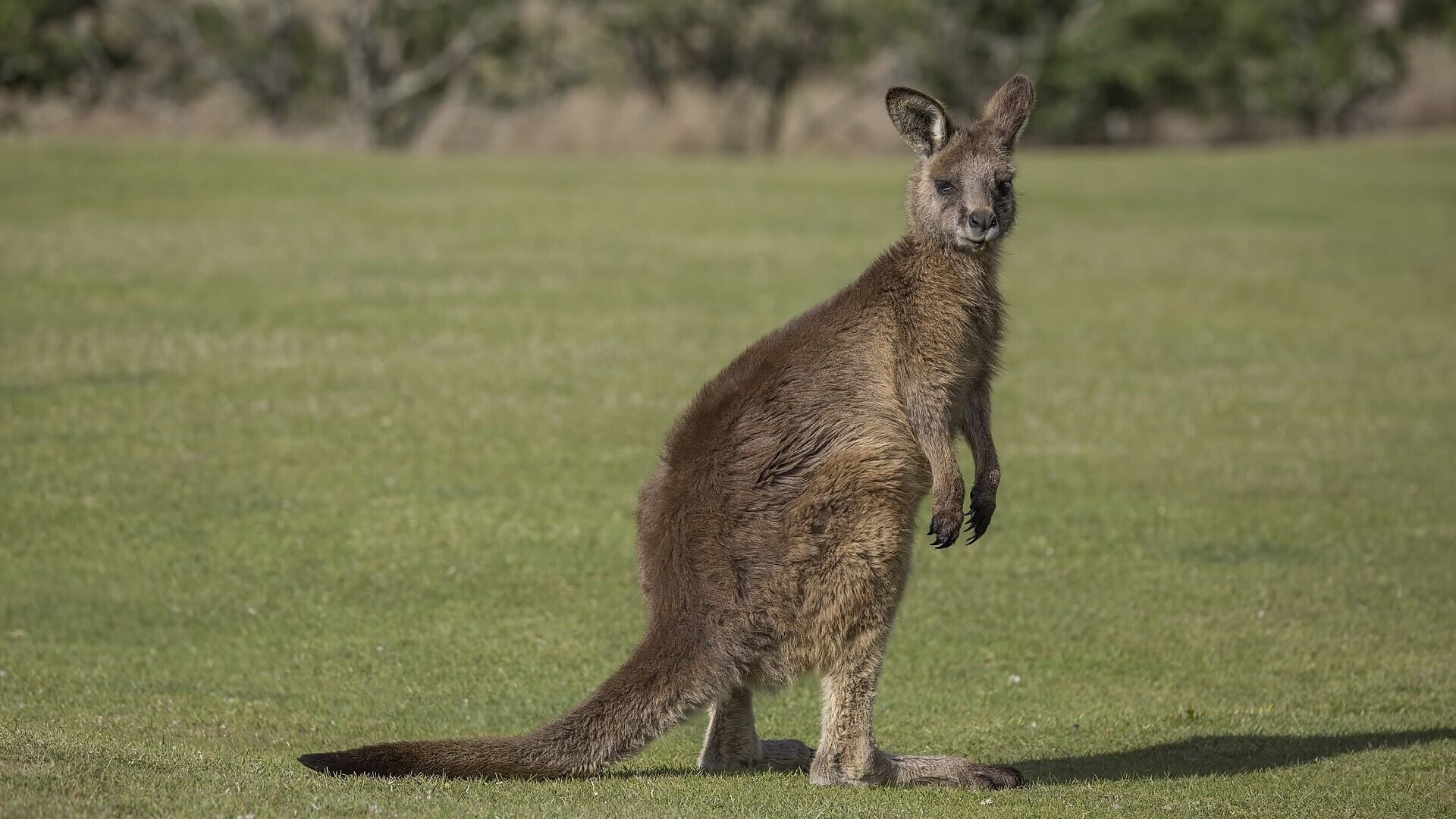
A forester kangaroo, a subspecies of the eastern grey, in Tasmania. This is not the Lee County animal. Photo: Charles J. Sharp / <a href="https://commons.wikimedia.org/wiki/File:Forester_kangaroo_(Macropus_giganteus_tasmaniensis)_Esk_Valley.jpg">Wikimedia Commons</a>, <a href="https://creativecommons.org/licenses/by-sa/4.0/">CC BY-SA 4.0</a>
A kangaroo spent a couple of days crossing roads in Lee County, Iowa, this June, and its owner asked the sheriff’s office to have it put down, according to the office. Two deputies caught it alive instead on June 5, using a Taser to get it under control, and the animal went home.
The Lee County Iowa Sheriff’s Office posted the bodycam footage to Facebook on Nov. 20, more than five months later, and said it was releasing the video because of the number of media requests it had received. The post names the deputies as Hennigar and Crenshaw; KCRG, which reported the release first, identified them as Bryson Hennigar and Colin Crenshaw. The office wrote that the kangaroo had been crossing the roadway, “creating a traffic hazard and safety concern for motorists,” and that it is doing well today.
The deputies decided the kangaroo would live. Iowa’s statutes had little to say about any of it: the state has a law against keeping dangerous wild animals and a law making livestock owners answer for animals that stray onto public roads, and a kangaroo fits neither one. For two days, the only thing standing between Lee County drivers and a loose marsupial was whoever the sheriff could send.
What the Lee County bodycam footage shows
I went through the 2-minute, 49-second release frame by frame. It is cut together from body camera footage stamped June 5, 2026, and opens in a sloping field of tall grass below a road, with two white SUVs parked along the top of the hill. Most of the chase is grass, boots and a blur of brown fur. In one stretch a deputy holds the Taser in his right hand; a few seconds later it lies in the grass while both deputies pin the kangaroo by hand.
The second half moves indoors. The kangaroo, wrapped in a blue blanket, is carried into a building lined with wire cages and set down there, with the faces of the people present blurred. The office’s statement says only that “a Taser was deployed in an effort to safely control and capture the kangaroo,” without saying how many times it was fired, and the edited video doesn’t settle it.
The post says the deputies captured the kangaroo “without causing it serious harm,” which stops short of saying the animal wasn’t hurt at all. Back in June, the office’s first update said no deputies were injured, no citations were issued and “the suspect was released on its own recognizance.”
The camera’s on-screen stamp reads Axon Body 4. Axon, the company formerly called Taser International, makes both the camera that filmed this and the device the deputies used.
Iowa’s dangerous-animal law skips kangaroos
Iowa lawmakers created the state’s dangerous wild animal chapter in 2007, and Iowa Code section 717F.3 bars a person from owning, possessing, breeding or bringing into the state any animal on its list. That list, in section 717F.1(5), is specific: wolves and other wild members of the dog family, hyenas, wild cats from lions to servals, bears, rhinos, elephants, nonhuman primates, crocodilians, water and crocodile monitors, Gila monsters and beaded lizards, venomous snakes, reticulated pythons, anacondas, African rock pythons, and Eurasian wild boar. Kangaroos and the rest of their family aren’t on it.
The state’s rules for animals that wander off a farm don’t reach them either. Iowa Code chapter 169C lets a landowner or a local authority take custody of livestock found on their land or a public road, and section 169C.4 makes the owner liable for the landowner’s damages and the cost of keeping the animal. The chapter defines livestock as cattle, goats, horses, sheep, swine, ostriches, rheas, emus, farm deer and poultry. A stray steer on a county blacktop triggers that cost-recovery process. A stray kangaroo does not.
That gap fits what the sheriff’s office reported. Its June update said no citations were issued, and the office has not named the owner. Counties and cities can write their own animal ordinances, so the state code isn’t the whole picture everywhere, but I found nothing in either state chapter that would have put a price on two days of a kangaroo crossing Lee County roads.
Southeast Iowa already leads the state in animal crashes
Lee County drivers didn’t need a new animal to worry about. The Iowa Department of Natural Resources’ latest deer program report counts approximately 7,300 animal-related vehicle collisions reported in Iowa in 2025, down 6% from 2024, and most of them involve white-tailed deer. Iowa State University’s Institute for Transportation found that animal crashes account for 13.5% of all reported crashes in the state and are most common in southeast and northeast Iowa, along routes that follow rivers. Lee County is the state’s southeastern tip, bounded by the Mississippi and Des Moines rivers.
A deer has no owner to look to after a crash. A kangaroo does, because someone chose to keep it. How much that matters after a crash depends on state law and the facts of the case, and Iowa’s livestock chapter talks about custody and trespass costs, not collisions. Kangaroos can do real damage to a car; one ended Christopher Mies’ Bathurst 12 Hour at 250 km/h. The Lee County animal never hit anyone, according to everything the sheriff’s office has released.
Why the video waited until November
Iowa’s public records law gives agencies a lot of room on police video. Iowa Code section 22.7(5) lets peace officers’ investigative reports be kept confidential, while the date, time, specific location and immediate facts of an incident generally have to be released. In practice that leaves the decision about footage largely with the agency, and Lee County’s office released this video months after the fact, on its own Facebook page, because reporters kept asking. KCCI picked up the footage Monday.
The office’s own verdict is in the post: it called the capture “a great example of our deputies using good judgment, compassion, and professionalism.” On the evidence it released, that holds up. The owner had asked for it to be put down, the deputies caught it with a Taser and their hands, and the kangaroo went back home, as the office put it. What nobody has addressed is how it got out, whether it has gotten out before, or what keeps it from walking back onto the road. Nothing in the two state chapters above requires the owner to answer them.
Nobody has said how the kangaroo got out or what keeps it off the road next time. Should exotic-pet owners answer for a loose animal the way cattle farmers do?
About the Author