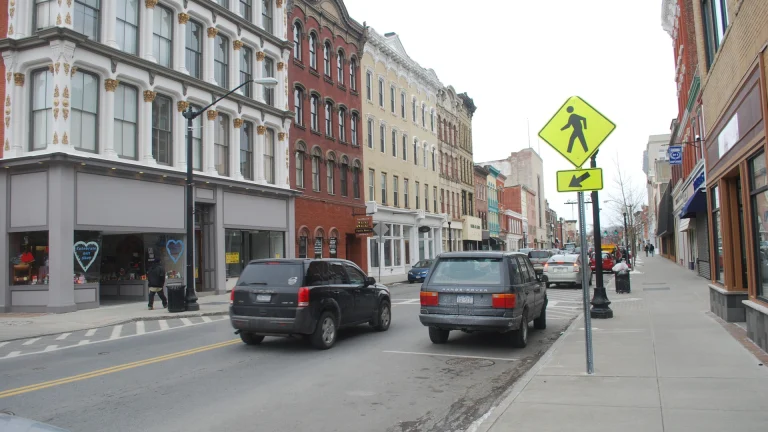
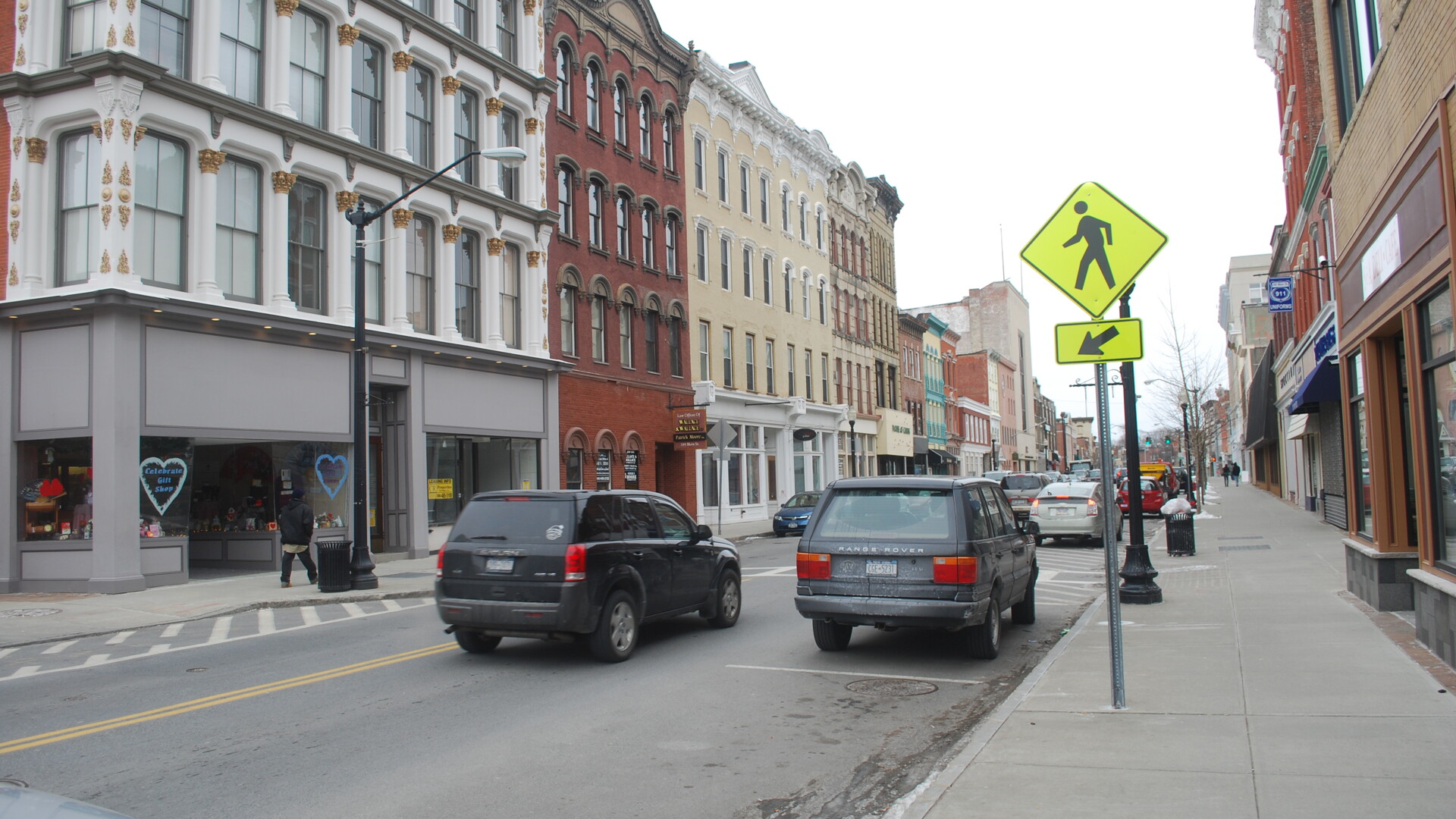
Main Street in Poughkeepsie, N.Y. Photo: Juliancolton via Wikimedia Commons (public domain)
On Nov. 19, the day after Poughkeepsie, New York, joined the cities taking Flock license plate cameras off their streets, a girl walking home from Warring Elementary School said a man standing beside a parked truck called her by name and told her, “Come here, I am gonna take you home.” She didn’t recognize him. She ran to the crossing guard near Mansion and Smith streets, was brought back to the school, and the school reported it to police, according to Mid Hudson News, which based its account on sources close to the investigation.
The man and the truck were gone by the time officers arrived. Until Nov. 18, the department had several Flock cameras covering that part of the city, the outlet reported. This time officers went to residents and businesses nearby and collected private security video, and that footage helped them identify the truck they were looking for. Mid Hudson News reported no arrest or charge, and I found no police announcement of one as of Monday afternoon.
The City of Poughkeepsie PBA told the outlet that losing Flock substantially delayed the investigation. Its president, Kevin Van Wagner, said officers “now rely heavily on the cooperation of private citizens and businesses” for video, and he asked the Common Council to bring the cameras back. His complaint is about time. Detectives still identified the truck. What the council gave up was Flock’s last weeks in the city before the contract ran out in January, and it wrote that no replacement goes up until Poughkeepsie adopts rules it has never had.
How a Flock search would have worked on Mansion Street
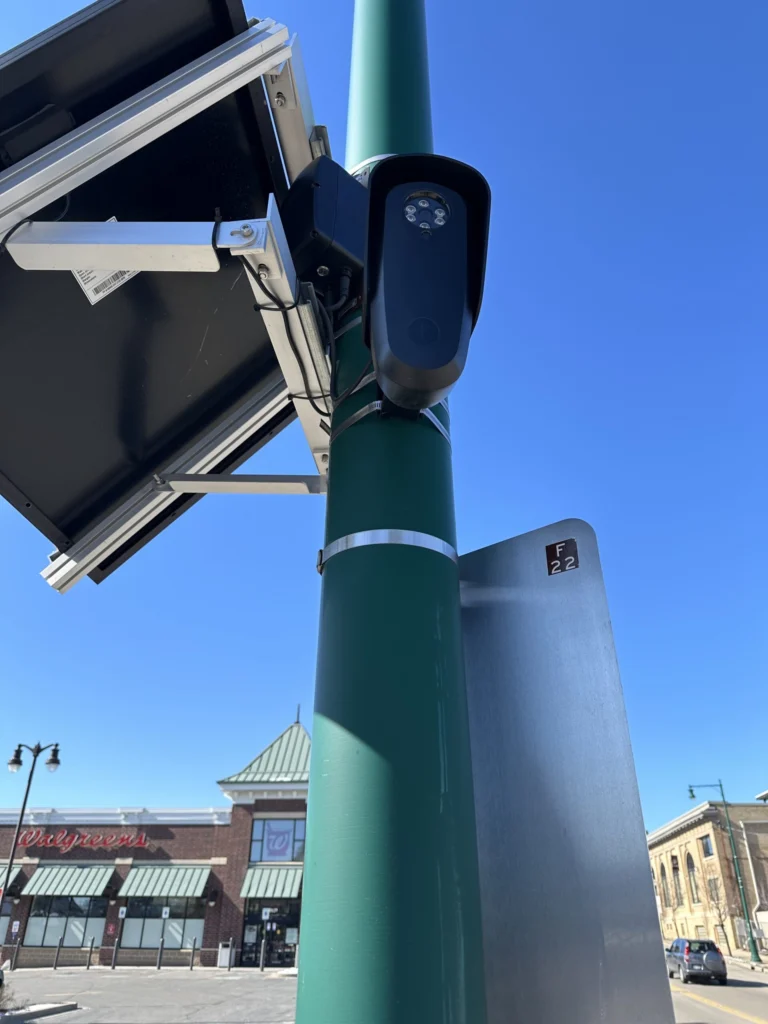
A plate number isn’t needed to run one. Flock’s own explainer for customers says its Vehicle Signature system can search by make, color and body type, plus details such as roof racks, bumper stickers and damage. A description as thin as a truck near the school around dismissal becomes a query across every camera in the network, and the results come back with plates attached. A door-to-door canvass reaches the same answer only after someone answers the door, agrees to share, and turns out to own a camera pointed at the street. That is the delay the union is describing.
Identifying the truck is where the legal work begins. New York’s luring-a-child statute, Penal Law 120.70, applies to a child under 17 and requires prosecutors to show the person lured the child into a vehicle, building or isolated area intending to commit one of a list of serious crimes, from kidnapping to sex offenses. It is a class E felony, raised to a class D or C felony when the intended crime is a class B or A felony. A plate camera can put a truck on a block at dismissal time. It can’t show what the driver meant to do, and intent is what the statute turns on. Mid Hudson News described the Nov. 19 call as a possible child-luring incident.
What R-26-66 ordered, and how the override made it law
The Common Council adopted Resolution R-26-66 on Oct. 20, 8-1, after a motion by Councilman Nathan Shook to table it until the next meeting failed 4-5, according to the clerk’s record. The resolution directs the city and its police department to end the Flock contract at the earliest possible opportunity, ideally within four weeks, orders every city agency and employee to stop using Flock cameras and databases immediately, and gives Flock two weeks to pull its hardware before the city removes it and sends Flock the bill for removal and storage.
Mayor Yvonne Flowers vetoed it Oct. 29. Her veto message says the veto “does not mean I am in favor of Flock,” notes that the city has used the cameras since 2021, and asks the council to wait for the contract’s scheduled expiration in January 2027 while the administration and police review alternatives. She also flagged a budget line: the city’s preliminary 2027 budget counts on about $2 million in revenue from planned speed and red-light camera enforcement, which she wrote could be delayed or jeopardized depending on the scope of the council’s restrictions.
On Nov. 17, the council passed R-26-72, a one-paragraph resolution overriding the veto so that R-26-66 took effect on adoption. The clerk’s vote record shows it passed 8-1, with Council Chairman Da’Ron Wilson, Majority Leader Nedra Patterson-Thompson and Councilmembers Ernest Henry, Evan Menist, Terriciena Brown, Ondie James, Christopher Grant and Daniel Atonna voting yes. Shook, the council’s vice chair, voted no again. “I support moving on from FLOCK, letting the contract expire in January,” he said, according to Mid Hudson News, warning of unintended consequences. Police Chief Richard Wilson told the outlet the cameras were disabled Nov. 18.
The council’s case for shutting Flock off before January
After the override, Patterson-Thompson said, “The Council’s decision was not made in haste, nor was it made without consideration for public safety,” and noted that residents had raised mass-surveillance concerns for months. The resolution lays out the rest. It says more than 55 municipalities have canceled or refused Flock contracts since June 2025, that the Dutchess County district attorney and sheriff began canceling theirs in September, and that Flock’s default setting keeps vehicle location data for a full month. Mid Hudson News’s report on the Warring Elementary case did not include a response from council members to the union.
Van Wagner’s strongest point is local. He told Mid Hudson News there has been no instance of Flock misuse in Dutchess County. When the council first voted, members cited misuse in other parts of the country, Mid Hudson News reported, the kind of case where a North Manchester, Indiana, council critic’s plate drew 63 searches. Plate readers also do what police buy them for: in Florida, a single reader placed a fleeing Mercedes close enough for a Polk County sergeant to catch it at a red light.
Other New York cities picked different ends of the same choice. Newburgh’s council voted in September to stop routine use of Flock within 14 days and unwind its contracts, WAMC reported. Troy went the regulation route, with a law requiring police to delete plate-reader data after 72 hours unless it is flagged for a criminal investigation, and its council overrode Mayor Carmella Mantello’s veto to do it. Against the month-long default Poughkeepsie’s resolution describes, Troy’s rule cuts the retention window by 90%, by Backfire News’s math.
What happens next in Poughkeepsie
Flock’s two weeks to remove its equipment run from the Nov. 17 override, which puts the deadline around Dec. 1 by my count. Dec. 1 is also the date the council has scheduled a public hearing on the 2027 budget, the document carrying the mayor’s roughly $2 million in expected camera-ticket revenue.
For drivers, the last clause of R-26-66 sets how long the city goes without plate readers. Neither the city nor its police department can sign with any other plate-reader company until the council holds a public hearing on plate readers and data sharing, decides whether to use them at all, and adopts limits on use, sharing and retention. Until then, the city has no plate-reader network of its own, and the mayor has warned that her planned speed and red-light camera programs could slip depending on how far the restrictions reach.
Detectives found the truck on neighbors’ and businesses’ cameras anyway. Did Poughkeepsie lose something real when it switched Flock off, or just speed?
About the Author