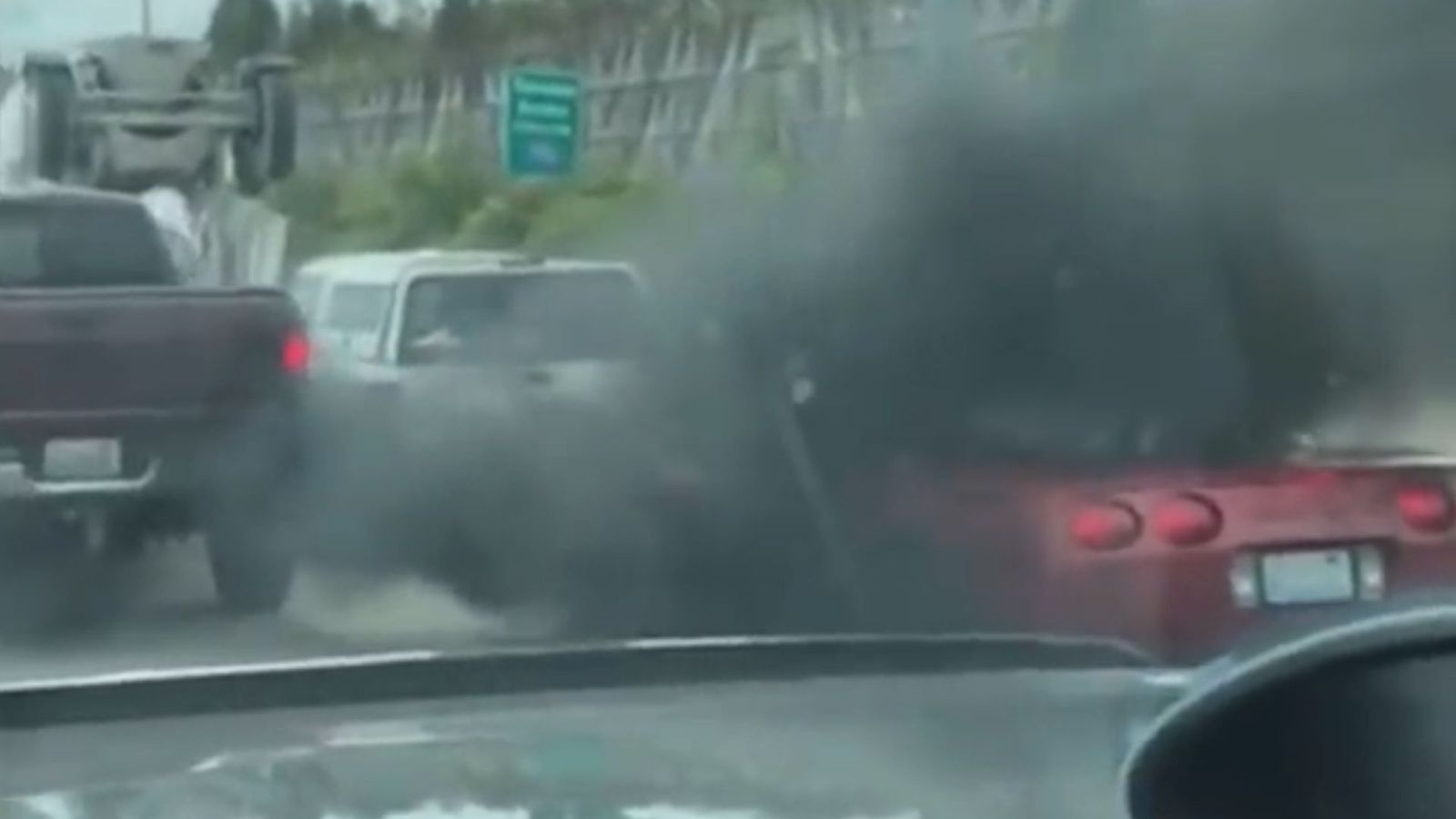
Two drivers, one disappearing lane and zero adults present. That’s the whole cast list of a 43-second clip that has been bouncing around the internet since 2018 and still racks up fresh views: a dark red pickup muscles toward a merge, a red C4-generation Corvette refuses to yield, and the truck answers by burying the Chevy in a cloud of black diesel soot thick enough to lose a Buick in.
The video’s YouTube description says it was filmed June 28, 2018, in Tacoma, Washington, and claims the Corvette driver flipped off the truck driver during the merge. The footage itself, shot from a car a few lengths back, shows the payoff: the pickup’s exhaust pointed squarely at the Corvette’s flank while the sports car drives straight through a wall of smoke. More than 3.3 million people have watched it. Very few of them, we suspect, came away thinking either driver had a great day.
So let’s do what the comment section never does and actually score this thing.
Round One: The Merge
Here’s the part that should end most of these fights before they start. Traffic engineers have an answer to the “who goes first” question, and it’s not “whoever has the bigger ego.” The Minnesota Department of Transportation, which has been preaching this gospel for years, tells drivers in heavy, slow traffic to use both lanes all the way to the merge point and then take turns. MnDOT says doing it that way can cut the total length of a backup by as much as 40 percent, and it keeps the two lanes moving at similar speeds so nobody feels like they’re being cut off.
The catch: that’s the rule for stop-and-go traffic. When everything is moving at highway speed, MnDOT’s advice flips, and drivers should slide into the open lane early. Which means the late-merging truck and the lane-guarding Corvette can each claim to be half right, depending on how fast traffic was crawling. In a jam, the truck was entitled to its turn. The Corvette’s job was to let one vehicle in. One. That’s the whole zipper.
How our highways ended up funneling everyone into these pinch points in the first place is its own long, strange story, and the freeway revolts of the 1960s still have a lot to answer for.
Round Two: The Soot Bomb
Rolling coal looks like a party trick, but mechanically it’s just a diesel being deliberately fed more fuel than it has air to burn. A tuner commands extra injection, the combustion chamber runs rich, and the unburned fuel exits the tailpipe as soot. You are, quite literally, watching money leave the truck as a cloud. Hard overfueling also drives up exhaust gas temperatures, which is not something pistons and turbochargers enjoy on a regular basis.
There’s a second requirement, too. Diesel pickups built under the federal rules that kicked in around the 2007 model year carry a diesel particulate filter, which traps exactly the stuff that makes a coal cloud black. For a newer truck to smoke like that, the filter typically has to be removed or bypassed. That’s where a juvenile stunt turns into a federal problem.
Section 203 of the Clean Air Act, 42 U.S.C. § 7522, makes it illegal to remove or disable emissions equipment on a certified vehicle, and illegal to sell or install parts built to defeat it. The EPA takes the math seriously. The agency says known sales of defeat devices for certain diesel trucks built between 2009 and 2020 will produce more than 570,000 tons of extra nitrogen oxides and 5,000 tons of extra particulate matter over those trucks’ lifetimes. During its enforcement push from fiscal 2020 through 2023, EPA closed 172 civil cases worth $55.5 million in penalties, plus 17 criminal cases.
The enforcement picture has shifted since then. In January 2026, the Justice Department’s environment division said it would stop filing criminal charges over vehicle emissions tampering while keeping civil enforcement on the table. So “deleted” diesels are no longer a jail-time issue at the federal level, but civil fines, state inspections and resale headaches haven’t gone anywhere. If you’re shopping for a heavy-duty diesel right now, our guide to what the EPA’s rule rewrite means for buyers is worth a read before you sign anything.
Round Three: The Law Doesn’t Care Who Started It
Some states decided the federal tampering rules weren’t specific enough and wrote laws aimed at the stunt itself. Colorado’s Senate Bill 17-278 is a good example of how lawmakers describe it: a “nuisance exhibition of motor vehicle exhaust,” meaning knowingly blasting soot or smoke from a vehicle rated at 14,000 pounds GVWR or less onto roads, other vehicles, cyclists or pedestrians in a way that blocks someone’s view or creates a hazard. The penalty there is a Class A traffic infraction, a $100 fine plus a $10 surcharge.
Notice what that definition focuses on: visibility. Dropping a smoke screen over another car at a merge point, where everyone is juggling mirrors, blind spots and brake lights, is exactly the hazard those laws describe. A driver who can’t see the lane ahead can’t avoid the car in it. If the Corvette had rear-ended someone inside that cloud, the insurance adjusters would have had a very interesting afternoon sorting out fault, and “he flipped me off first” is not a line item on any claim form we’ve seen.
There’s a health angle as well. The EPA classifies diesel exhaust as likely to be carcinogenic to humans, and a car’s ventilation system pulls outside air from the base of the windshield, right where a cloud like this would settle. Open windows or a lift-off roof panel, which the C4 coupe offers, just make the delivery faster. Hitting the recirculation button helps, but only if you see it coming.
Round Four: The Corvette Owner’s Real Bill
Diesel soot is oily, fine and clingy. On a car with a red finish, it shows up everywhere, and it works its way into door seals, cabin fabrics and HVAC ducts. It usually washes off paint if you get to it quickly, but grinding at it with a dry towel is how you turn a smoke problem into a swirl-mark problem. A proper hand wash, a cabin air filter check where equipped and a thorough interior detail are the sane response.
C4 Corvettes aren’t precious garage queens the way some older ‘Vettes are, but they’re also not disposable. Plenty of people buy one as their first Corvette precisely because the entry price is friendly, then sink real money into keeping them sharp. Playing chicken with a full-size pickup over a single car length is a strange way to protect that investment. Corvettes have a talent for landing in weird trouble, whether it’s a ’66 whose brakes quit mid-showoff or one that spent decades at the bottom of an Oregon river. This one got off easy.
The Verdict
Scorecard time. The Corvette driver blocked a merge in heavy traffic and, according to the uploader, added a one-finger commentary. Petty, pointless, and the kind of thing that turns a two-second delay into a road rage incident. The truck driver responded by weaponizing a smoke cloud in live traffic, which is the kind of move that’s written into state law as a hazard for good reason, and that likely required an emissions setup the feds have spent years chasing.
One of these is rude. The other can blind people at highway speed. We know which one we’d rather be stuck behind.
The fix for both is the same, and it costs nothing: in slow traffic, use the lane until it ends, take your turn, let one car in and keep the middle finger and the tuner switch at home. As for whether the giant, smoke-capable pickup is as permanent a fixture on American roads as it seems, GM’s recent Silverado shakeup suggests that question is more open than it used to be.
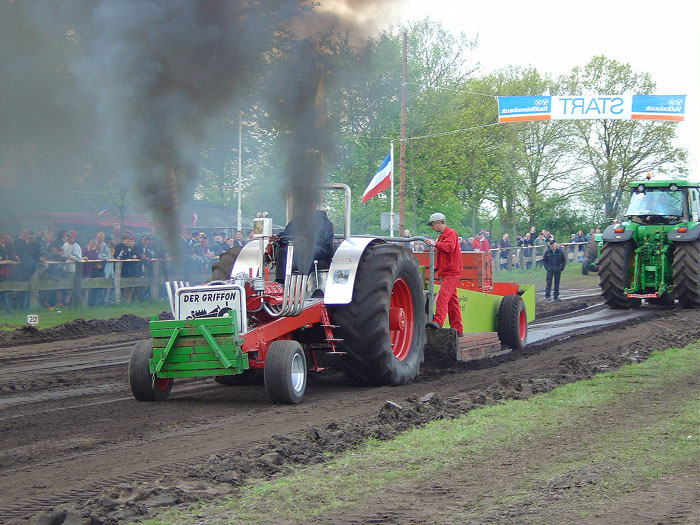
Image credits: C4 Corvette photo by Sicnag, CC BY 2.0; tractor pull photo by Nicogripp, CC BY 2.5, both via Wikimedia Commons. Video footage via YouTube.
About the Author