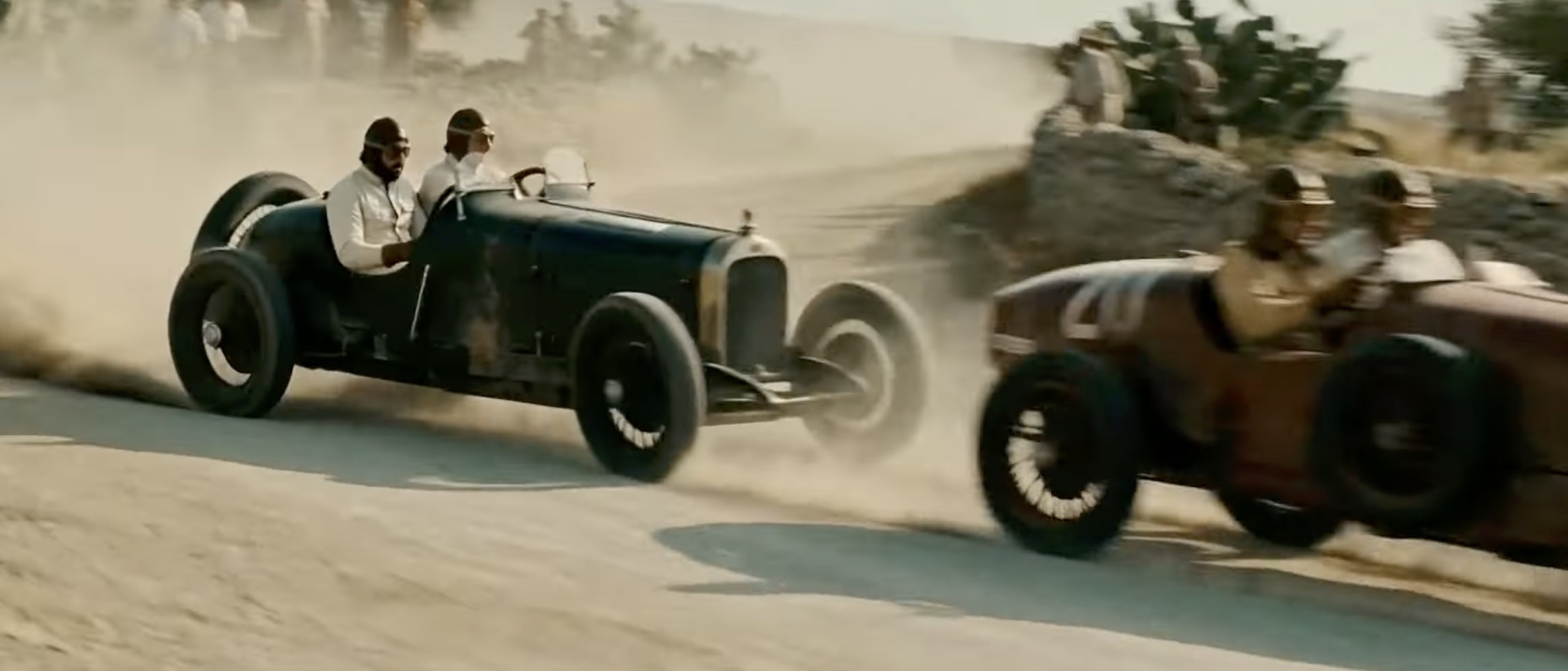
Andrea Iervolino’s production company posted the two-minute teaser for “Maserati: The Brothers” to a YouTube channel with all of 32 subscribers, and somehow Al Pacino, Anthony Hopkins, and Andy Garcia are all in it. That mismatch tells you more about how this movie got made than any press kit could. When you can land three generations of Academy Award pedigree for a story about spark plugs and hand-built race cars, you clearly don’t need a studio-sized marketing machine to get the phone calls answered.
What The Teaser Actually Shows
The trailer, posted August 25, dramatizes the founding of Officine Alfieri Maserati in a Bologna garage and follows the brothers as they push into grand prix racing. Michele Morrone plays Alfieri Maserati, Lorenzo de Moor plays Carlo, and Salvatore Esposito plays Bindo, while Pacino and Hopkins turn up as two financiers, Vincenzo Vaccaro and Luca Antonelli, bankrolling the brothers’ ambitions. Andy Garcia plays a corporate advisor named Mr. Rossini, and Jessica Alba plays Sandra, written in as Carlo’s love interest. Director Bobby Moresco, who won his Oscar co-writing “Crash,” is running the show from a script by Amanda Moresco and Stefano Torrisi.
The Financiers Who Never Existed
Here’s the wrinkle for anyone who actually knows Maserati history: there was no Vaccaro or Antonelli writing checks for the Maserati brothers. The real rescue came in 1937, when industrialist Adolfo Orsi bought the struggling company outright and moved its operations from Bologna to Modena, where Maserati still builds cars today. Composite characters are a biopic staple for a reason, and Vaccaro and Antonelli look exactly like that: dramatized stand-ins built to give two Oscar winners meaty scenes rather than a strict retelling of who actually cut the checks.
The Brother The Movie Skips
The cast list also shows what the film leaves out. Credits cover Alfieri, Carlo, Bindo, Ernesto, and Ettore, played respectively by Morrone, de Moor, Esposito, Leo Ferrari, and Matteo Bassi. Missing entirely is Mario Maserati, the artist brother who never touched an engine but gets credit for sketching the trident logo, inspired by the statue of Neptune in Bologna’s Piazza Maggiore. It’s an odd sibling to cut from a movie named after the brothers collectively, though it’s an easy one for a screenwriter to justify: Mario didn’t build the cars, he just designed the badge that has sat on the nose of every one of them since 1926.
The Racing Pedigree Is Real
The trailer leans hard into racing imagery, and for once the ambition on screen matches the record book. Maserati remains the only Italian manufacturer to ever win the Indianapolis 500, and it did it twice in a row, in 1939 and 1940, with Wilbur Shaw driving the twin-supercharged, 3.0-liter straight-eight 8CTF, nicknamed the Boyle Special after its sponsor. That’s a distinction Ferrari, for all its Formula 1 history, has never matched. Surviving examples of that era’s grand prix Maserati chassis change hands for seven-figure sums whenever one surfaces at auction, which says plenty about how far the brand’s racing credibility still carries collector interest today.
Small Channel, Big Names
What the film doesn’t have, at least not yet, is a major studio behind it. Production credits list The Andrea Iervolino Company, Bright White Light, and Eris Entertainment, three independent outfits with no Warner or Universal logo in sight. Iervolino’s own credits, per the trailer, include producing “Lamborghini” and “Ferrari,” making this his third pass at Italian supercar dynasty drama in a handful of years.
Don’t Mark A Release Date Yet
As for when you’ll actually get to see it, don’t circle anything on the calendar. IMDb still lists “Maserati: The Brothers” as being in post-production, and both the trailer and the film’s official Instagram account stick to “coming soon” without committing to a date. Independently financed prestige dramas like this one typically chase a festival run before any wide theatrical push, so a firm release date may not surface for months yet.
Why Enthusiasts Should Care
For readers here, the value isn’t the Pacino-Hopkins scenery-chewing, it’s the reminder of how thin the line was between a Bologna repair shop and a badge that still commands respect at Monterey Car Week auctions today. Whatever the film gets wrong about who actually financed the operation, it’s tapping into the same appetite that turns a survivor Ferrari 512TR into a six-figure storage-unit discovery or pushes a new Lamborghini Revuelto SV past $741,000 before options. Provenance and mystique sell, on screen and on the auction block alike. If Hollywood’s checkbook for badge-engineering nostalgia keeps growing, don’t be surprised to see more replica movie cars, like that VeilSide RX-7, rolling toward the auction block chasing a different kind of movie magic.
About the Author