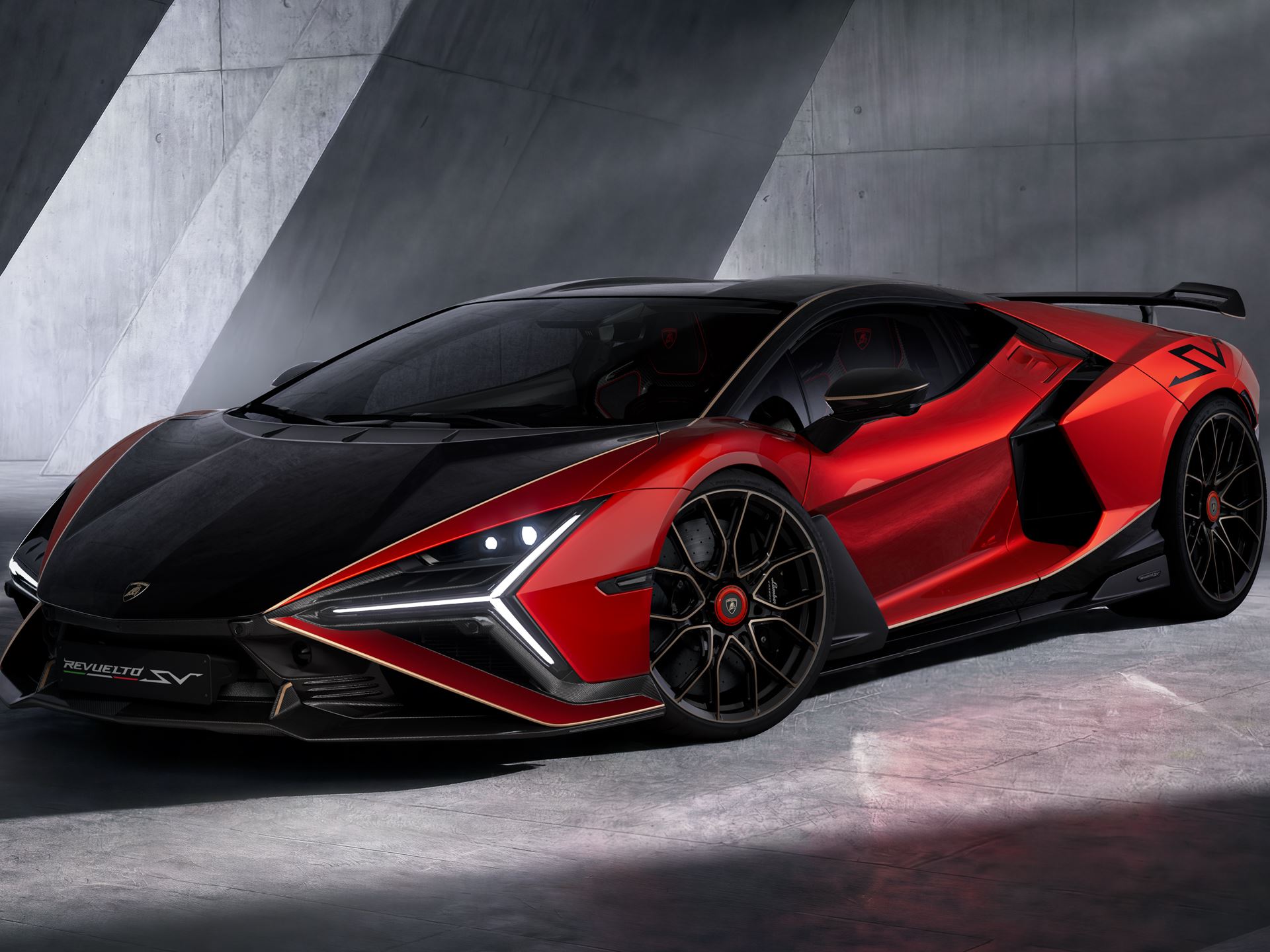
Lamborghini spent Monterey Car Week teasing the Revuelto SV’s Hockenheim lap record and its 1,065-metric-horsepower flex. What it didn’t do was hand out a price sheet. That job fell to the usual channel for six-figure options lists these days: a buyer posting his own paperwork online. Order sheets that surfaced within days of the car’s August 14 debut confirm a U.S. base price of $741,172, and one heavily optioned build, loaded with a full black livery and extensive exposed carbon, rang up at $948,121 before tax, tag, or a single trip through Lamborghini’s Ad Personam customization program.
That’s not a leak in the sense of stolen documents or corporate espionage. It’s simply how pricing on cars like this becomes public: the factory hands a build sheet to a customer, the customer is proud enough of a nearly seven-figure supercar to post it, and the number spreads before the automaker says a word. Lamborghini’s own newsroom announcement of the Revuelto SV runs deep on engineering and design and mentions price exactly zero times, which tracks for a brand that would rather you fall in love with the specs before you find out what they cost.
Context helps here. A standard Revuelto, Lamborghini’s first V12 plug-in hybrid and already a $608,358 proposition before options, sits roughly $133,000 below the SV’s base price. That premium buys a genuinely different car underneath the shared silhouette, not just a wing and some badges.
The Engineering Behind The Upcharge
Lamborghini didn’t touch the Revuelto’s basic recipe, a 6.5-liter naturally aspirated V12 paired with two front axial-flux electric motors and a third radial-flux motor mounted above the eight-speed dual-clutch gearbox, so much as turn every dial further right. The V12 alone now makes 825 metric horsepower at 9,250 rpm and will spin to 9,500 rpm, while a new 7.3-kWh lithium-ion battery capable of 190 kW brings total system output to 1,065 CV, or roughly 1,050 horsepower in the units Americans actually use. System torque climbs to 1,425 Nm, about 1,051 lb-ft. Run the weight-to-power figure Lamborghini published, 1.66 kilograms per CV, backward and you land on a dry weight in the neighborhood of 3,900 pounds for a car that hits 62 mph in 2.4 seconds and keeps pulling past 214 mph.
None of that would matter as much if the V12 weren’t naturally aspirated, which is increasingly the point. Emissions rules have pushed most of the industry toward turbocharging or electrification-only setups, and naturally aspirated engines are becoming an endangered species even among cars costing a fraction of this one. Lamborghini has doubled down anyway, pairing the electrified assist with a combustion engine that still wants to scream past 9,000 rpm rather than hide behind a turbo’s muffled shove, the same instinct behind the brand’s V12-only Fenomeno roadster.
Aero, Brakes, And A Suspension Borrowed From GT3
The SV upgrade isn’t just a power bump. Lamborghini quotes 80 percent more downforce than the standard Revuelto and 10 percent more than the outgoing Aventador SVJ, generated through a reworked front splitter, a double-element rear wing, and a Gurney flap that doubles as brake cooling. The suspension gets manually adjustable dampers pulled from Lamborghini’s GT3 racing program, good for a claimed 17 percent gain in agility and 10 percent more lateral grip. New CCM-R Plus carbon-ceramic brakes, 420mm rotors up front and 410mm out back, deliver an 11 percent improvement in peak deceleration and cut stopping distance from 124 mph to zero to roughly 361 feet. Carbon-ceramic rotors at this level aren’t a casual replacement item, and owners who actually use the Pilota driving mode and five-stage traction control Lamborghini built for the track should budget for brake service the way they’d budget for tires.
1,963 Reasons This Won’t Sit At MSRP
Production is capped at 1,963 units worldwide, a nod to the year Automobili Lamborghini was founded, and the company has said allocation goes to its most loyal customers and collectors first. That’s the same playbook driving demand at the very top of the market right now, see the reaction to Gordon Murray’s own allocation-only, eight-figure hypercar debut at Goodwood this summer, and it means the gap between sticker and street price on a Revuelto SV was never going to hold for long, if there was ever a true sticker price to begin with. Whether that translates into real appreciation is a separate question. Six- and seven-figure collector sales happen constantly a few miles from where this car was unveiled during Monterey’s auction week, but those results still favor naturally aspirated, non-hybrid Lamborghinis with a longer track record. A plug-in hybrid V12 with a 7.3-kWh battery pack is a newer, less proven proposition for that crowd than the Murcielagos and Aventadors that came before it.
For now, the real news isn’t the horsepower figure or even the Hockenheimring lap record Lamborghini factory driver Marco Mapelli set in testing, 1 minute, 41.6 seconds, officially the fastest lap ever recorded there by a production car. It’s that Lamborghini built a $741,172 starting point and didn’t need to announce it at all. The market did that job on its own, one order sheet at a time.
About the Author