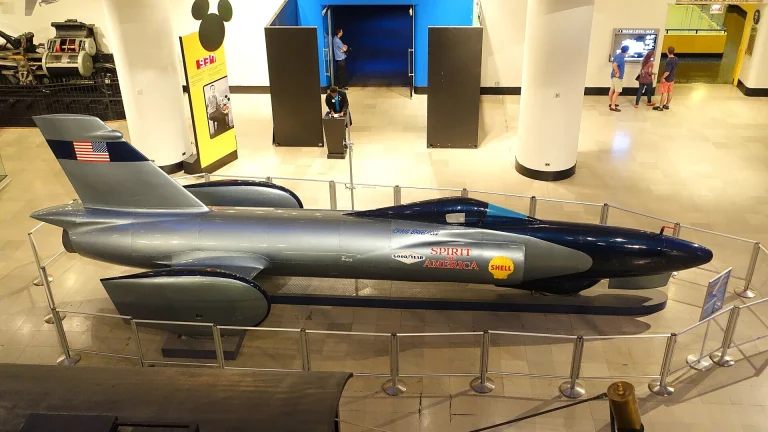
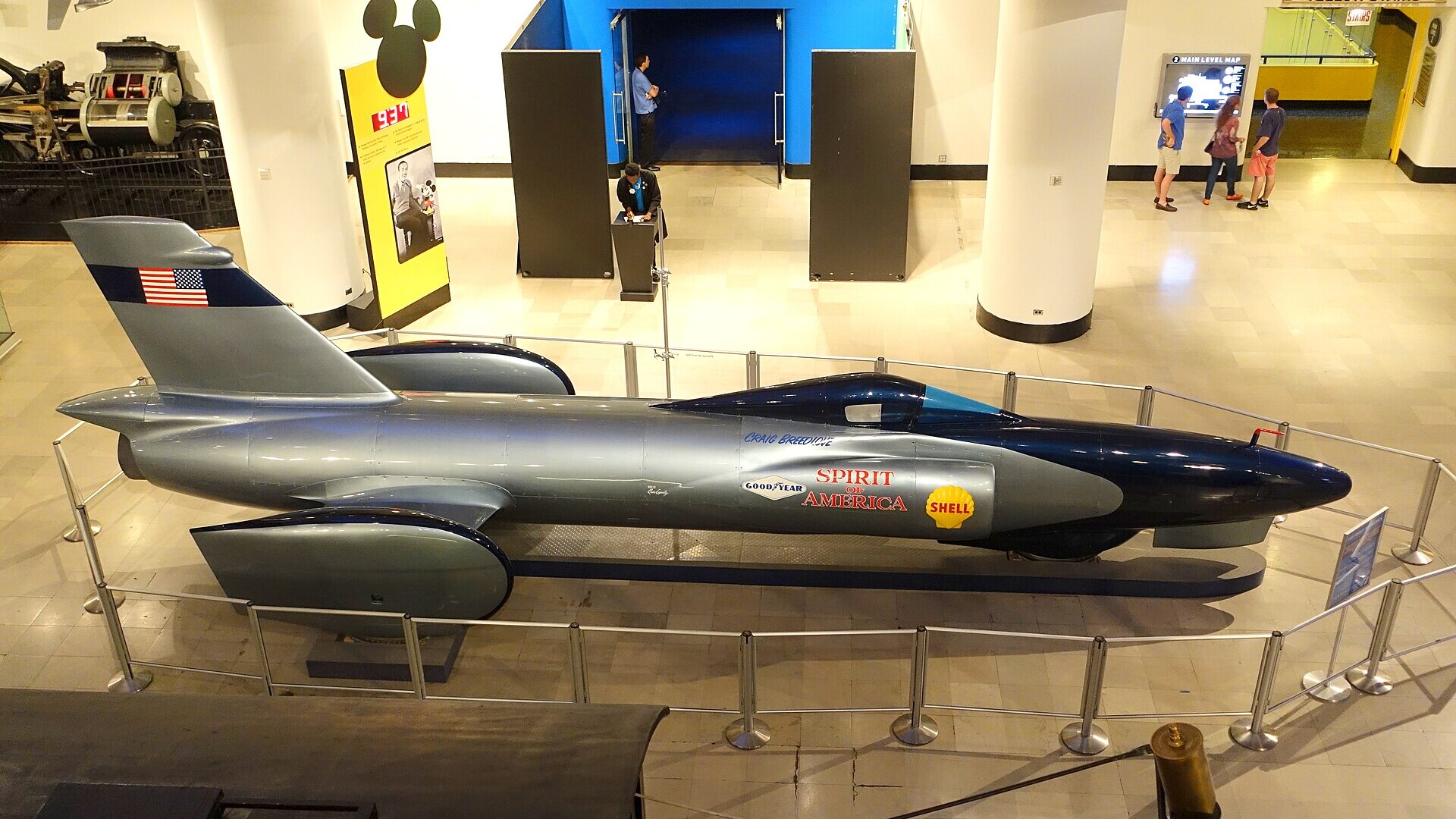
Spirit of America, the J47-powered three-wheeler Breedlove drove to 468.719 mph on October 13, 1964. Photo: Daderot via Wikimedia Commons (CC0)
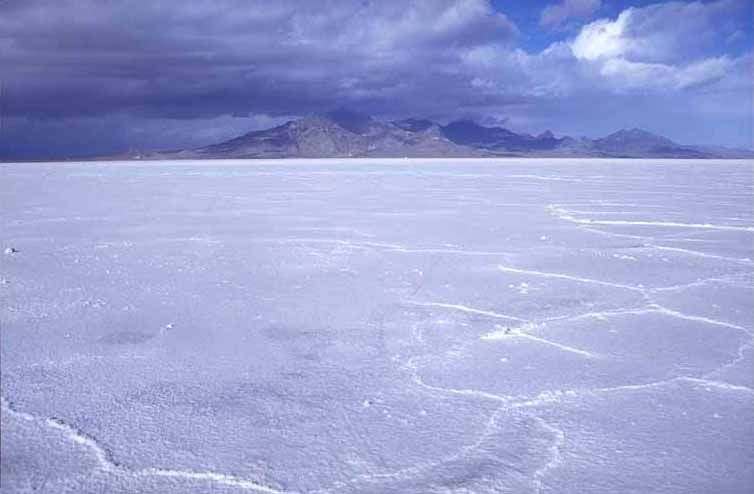
Sixty-two years ago today, a 27-year-old hot rodder from Southern California climbed into a three-wheeled jet fighter with no wings and took back the title of fastest man on Earth. On October 13, 1964, Craig Breedlove drove his Spirit of America to a two-way average of 468.719 mph on the Bonneville Salt Flats, wiping out the 434-mph mark Art Arfons had set just eight days earlier.
That’s the official headline. The real story is that October 1964 was the most unhinged month in land speed history, with three American jet cars trading the record like a hot potato on the Utah salt. Breedlove’s October 13 run was the punch that set up the knockout, and the knockout ended with his car upside down in a salt-water pond. Pull up a folding chair. This one has everything.
October 1964: Three Jets, One Salt Flat, Zero Chill
Going into the fall of 1964, Breedlove already owned the most famous number on the salt. In August 1963 he’d run 407.447 mph in Spirit of America, the first time anyone had averaged better than 400 mph in a land speed record attempt. The catch: the FIA, which governed car records, refused to recognize it because the wheels weren’t driving the car. A jet engine was. The motorcycle authority, the FIM, ratified it instead, technically classifying Breedlove’s rocket as a motorcycle and sidecar since it had three wheels. Hot rodders everywhere loved that.
A year later the rulebook loosened up for thrust-powered cars, and the salt turned into a shootout. On October 2, 1964, Tom Green drove Walt Arfons’ Wingfoot Express past Breedlove’s number. Three days later, on October 5, Walt’s brother and fierce rival Art Arfons fired up his own Green Monster, a homebuilt jet car powered by a surplus J79 engine, and pushed the record to 434 mph. Breedlove had been the fastest man on wheels for about a year. He’d now been knocked down to third in a single week.
What Exactly Was Spirit of America?
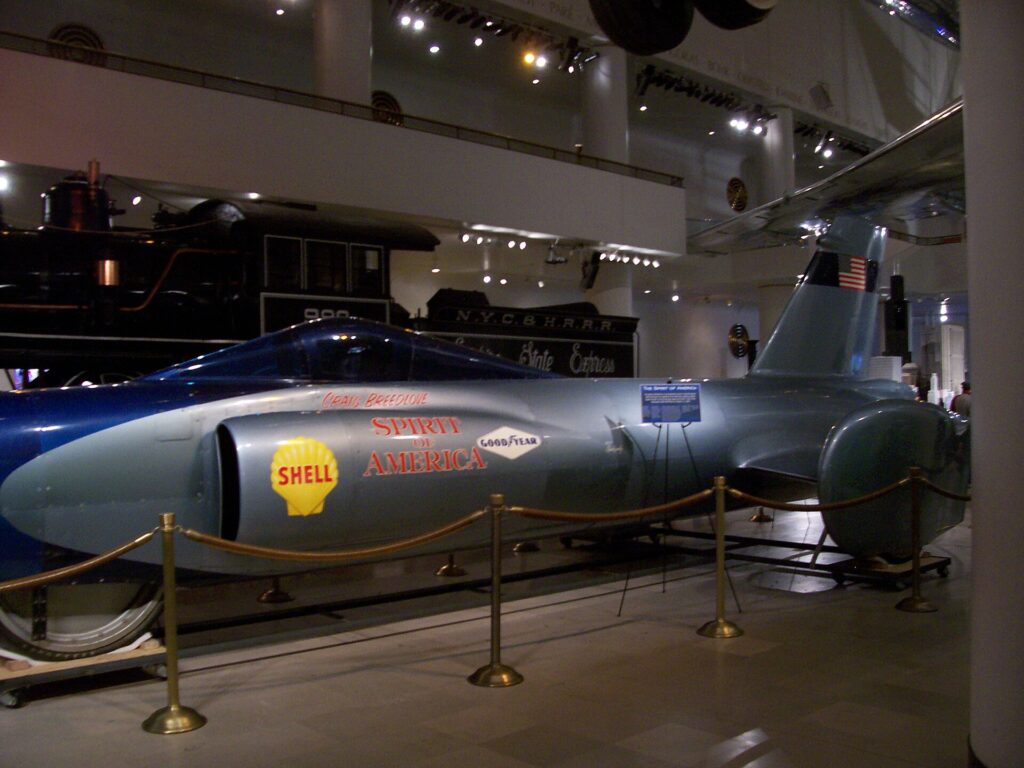
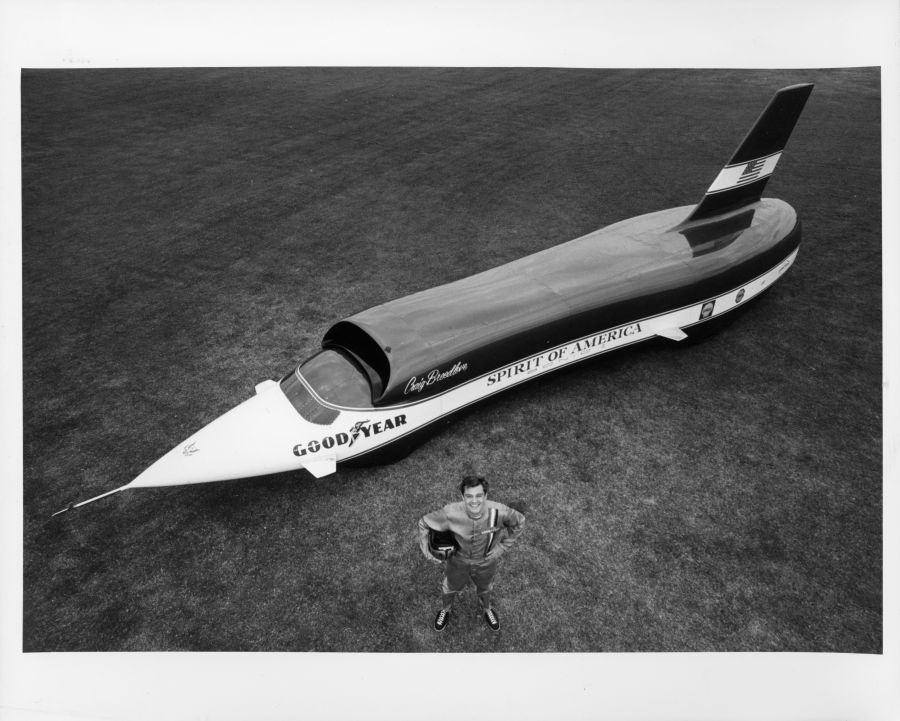
Picture a 1960s missile that somebody bolted three wheels to and painted in red, white and blue. Breedlove started building Spirit of America around 1960 with help from his father, and it was about as subtle as a sonic boom. Power came from a General Electric J47 turbojet, the same engine family that flew F-86 Sabre fighters over Korea. For 1964 the car got a fresh engine with an afterburner, which is the jet-age way of saying “more.”
The body was aluminum and fiberglass, the cockpit sat ahead of the jet intake, and the American flag rode on the tall tail fin. Shell and Goodyear signed on as sponsors, which is why Goodyear blue and the Shell scallop showed up in so many Bonneville photos that decade. What it didn’t have was brakes worthy of the speeds involved. The FIA has noted the car’s disc brakes were only designed for use below about 180 mph. Everything above that was parachutes and hope.
October 13, 1964: Breedlove Answers Back
Land speed records work on a two-way average. A driver has to make a run through the measured mile in one direction, turn around, and make a return run within an hour. That rule exists to cancel out any help from wind or slope, and it is why every record speed has those suspicious decimal places.
Eight days after Art Arfons grabbed the record, Breedlove lit the afterburner and made both passes count. The average came out to 468.719 mph, a jump of more than 34 mph over the Green Monster. In one afternoon, Spirit of America went from the third-fastest car in the world back to the top of the list, and the FIA would later ratify the speed. For a guy who had started out as a teenage hot rodder running dry lakes in Southern California, it was a statement: the record was his, and he’d come back for it as many times as it took.
Two Days Later, It All Went Sideways
Here’s where the story turns into legend. Breedlove didn’t wait around to celebrate. On October 15, 1964, he went back out to become the first driver to average more than 500 mph. He did it, too, running 526.277 mph. The trouble started after the timing lights.
On the return pass, the drag chute tore away, and the backup did no good. The brakes faded and melted. With the car still doing hundreds of miles per hour past the point where it should have stopped, Spirit of America ran out of salt, mowed down a telephone pole, flew over an embankment and splashed into a brine pond. Breedlove later described the car skipping across the water like a stone before it sank nose-first into a hidden trench.
He popped the canopy, remembered he was still hooked to his breathing mask, unplugged it, and swam to shore, where his crew and his father were sprinting to meet him. Then he gave the world one of the great one-liners in motorsport history, reportedly telling reporters that for his next act he’d set himself on fire. He had just set a world record and survived crashing a jet car into a lake in the same run. The man earned the joke.
The Arms Race Didn’t End There
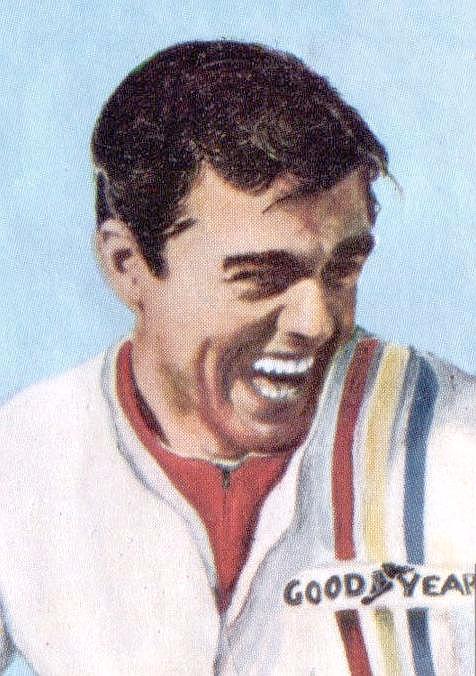
The 526-mph record lasted just 12 days. On October 27, 1964, Art Arfons answered with 536.710 mph in the Green Monster. Breedlove’s response was to build an entirely new car, the four-wheeled, coke-bottle-shaped Spirit of America – Sonic I, powered by a bigger J79 engine. His wife Lee Breedlove drove it to a women’s land speed record of 308.506 mph in 1965, and on November 15, 1965, Craig averaged 600.601 mph to become the first driver past 600. That record stood until 1970.
Breedlove and Arfons swapped the land speed record five times in barely over a year. It was the jet-age version of two guys at a stoplight who just keep going around the block for another run, except the stoplight was the Bonneville Salt Flats and the cars sounded like an air base.
Why Enthusiasts Still Care
Because it was garage-built. Breedlove and Arfons weren’t factory teams with government budgets. They were hot rodders who sourced military surplus jet engines, built cars around them and towed them to Utah. The October 13 run is the purest version of that spirit: a guy gets beat, goes back to the salt and beats the other guy by 34 mph a week later.
It also changed the culture. The Beach Boys had already recorded a song named after Breedlove’s car in 1963. His record-setting crash and wisecrack made the evening news. And the story of two American hot rodders dueling with jet engines is the template every land speed program since has chased, from Richard Noble’s British efforts to ThrustSSC finally breaking 700 mph in 1997. Even modern efforts like JCB’s 406-mph hydrogen Hydromax owe something to the 400-mph barrier Breedlove broke first.
If the jet-car era is your thing, don’t miss the story of Dr. Nathan Ostich’s Flying Caduceus, the first jet car to take a serious shot at Bonneville, or the banned Dodge Daytona that went to the salt and came home with 28 records.
Where Is Spirit of America Now?
The original three-wheeler was hauled out of the brine pond, repaired and donated to the Museum of Science and Industry in Chicago, where it spent decades wowing school field trips. Sonic I, the car that cracked 600 mph, crossed the auction block in 2025. Craig Breedlove died in April 2023 at age 86, still remembered as the first man past 400, 500 and 600 mph.
More From Today in Automotive History
Our series keeps digging up the days that shaped car culture. Catch up on how The Munsters gave TV its wildest hot rod hearse just three weeks before Breedlove’s run, and how F1’s first night race was won by a crash on purpose.
Sources: FIA, “Craig Breedlove: 1937–2023”; RM Sotheby’s, “Craig Breedlove: The Fastest Man on Wheels”; WBUR Only A Game, Breedlove interview on the 1964 crash; Magneto magazine, Breedlove obituary. Photos via Wikimedia Commons under the licenses noted in each caption.
About the Author