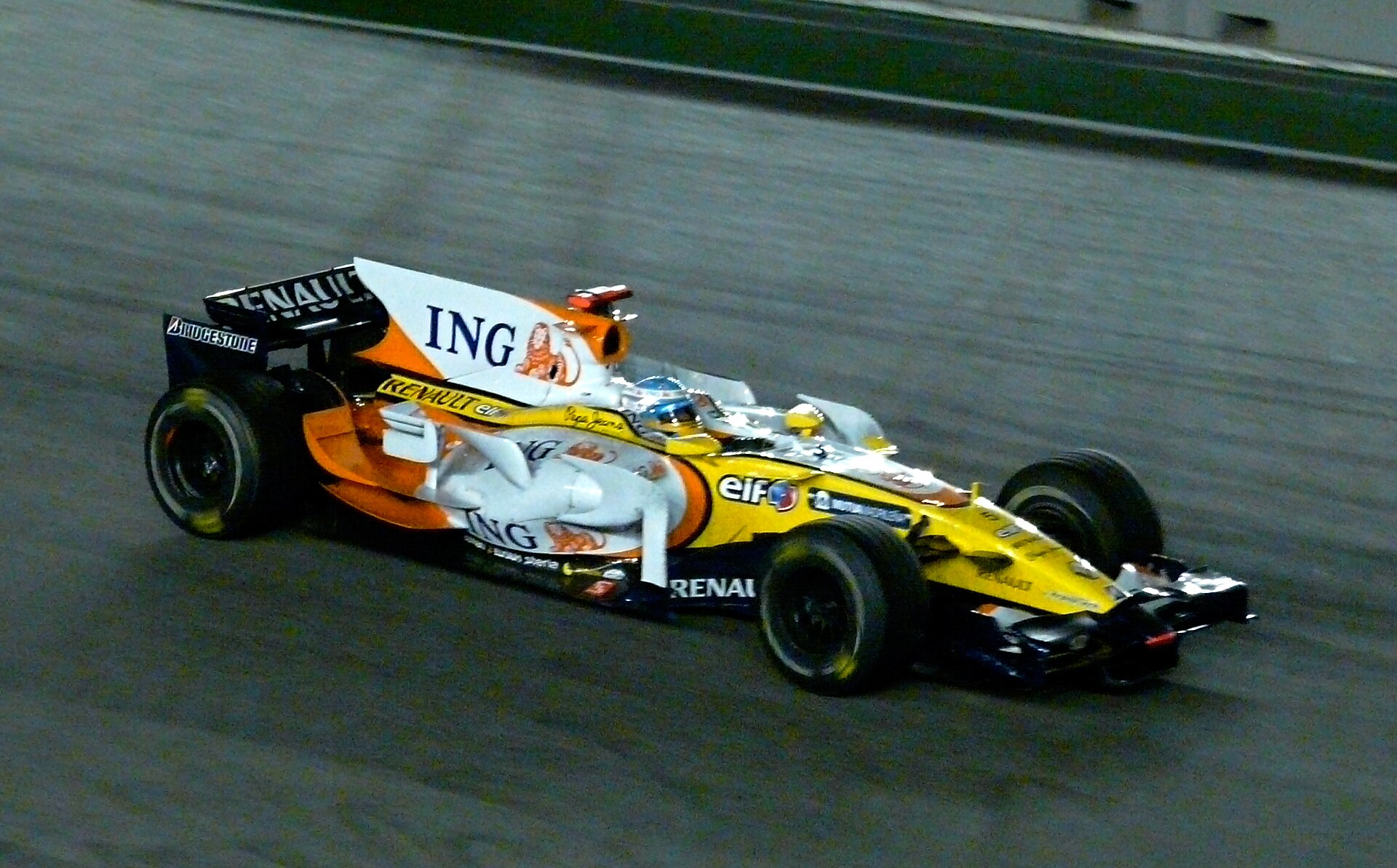
Fernando Alonso’s Renault R28 on its way to a win nobody saw coming at Marina Bay. Photo: chensiyuan via Wikimedia Commons (CC BY-SA 4.0)
Eighteen years ago tonight, Formula 1 threw the most glamorous party in its history, and somebody rigged the fireworks. On September 28, 2008, the sport ran its first-ever night race on the streets of Singapore’s Marina Bay. Fernando Alonso won it from 15th on the grid in a Renault that had no business being anywhere near the front. Everyone called it a strategic masterstroke. It took almost a year for the truth to come out: his teammate had crashed on purpose.
The scandal became known as Crashgate, and it hinged on one line in the sporting regulations. Eighteen years later, the race is still being argued over in a London courtroom.
A Night Race Built to Dazzle
Singapore went all in. The 5.067-km (3.148-mile) Marina Bay Street Circuit was lit by nearly 1,600 light projectors hung about 10 meters above the track, putting out roughly 3,000 lux, about four times brighter than a typical football stadium. Organizers reported around 300,000 spectators across the weekend. The race ran 61 laps between the barriers and the skyline, and F1 finally had the made-for-TV prime-time event it had been chasing for years.
The championship fight was tight going in. Lewis Hamilton led Felipe Massa by a single point, and Massa had just stuck his Ferrari on pole with a 1:44.801. Renault was nowhere. A fuel-system problem in qualifying left Alonso 15th on the grid, with teammate Nelson Piquet Jr. right behind him in 16th. On a street circuit where passing is a rumor, that should have been the end of Renault’s night.
The Loophole: A Closed Pit Lane
In 2008, cars refueled during pit stops, so strategy meant choosing how much fuel to start with. When the safety car came out, the pit lane was closed until the whole field had bunched up behind it. Drivers who needed fuel were stuck: pit anyway and you’d eat a penalty unless you were running on fumes, or wait and lose everything to anyone who’d already stopped.
Renault built Alonso’s race around that rule. They sent him out light on fuel, and he pitted absurdly early, on lap 12, dropping to the back. On a normal night, that’s a suicide strategy. But if a safety car came out a few laps later, everyone ahead of him would have to make their stops behind the pace car, and Alonso would be sitting pretty with a fresh load of fuel.
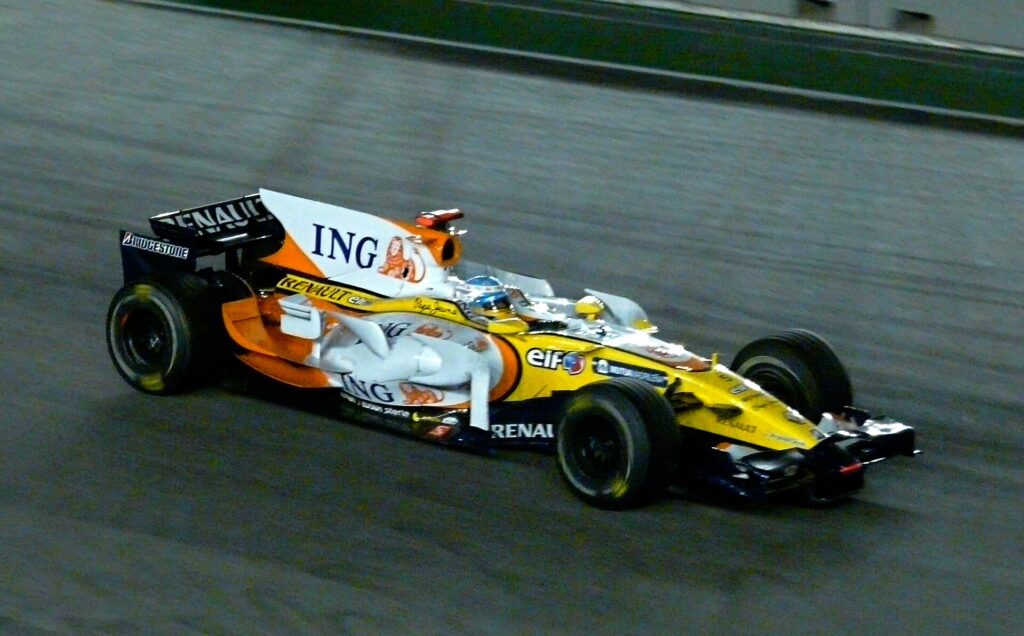
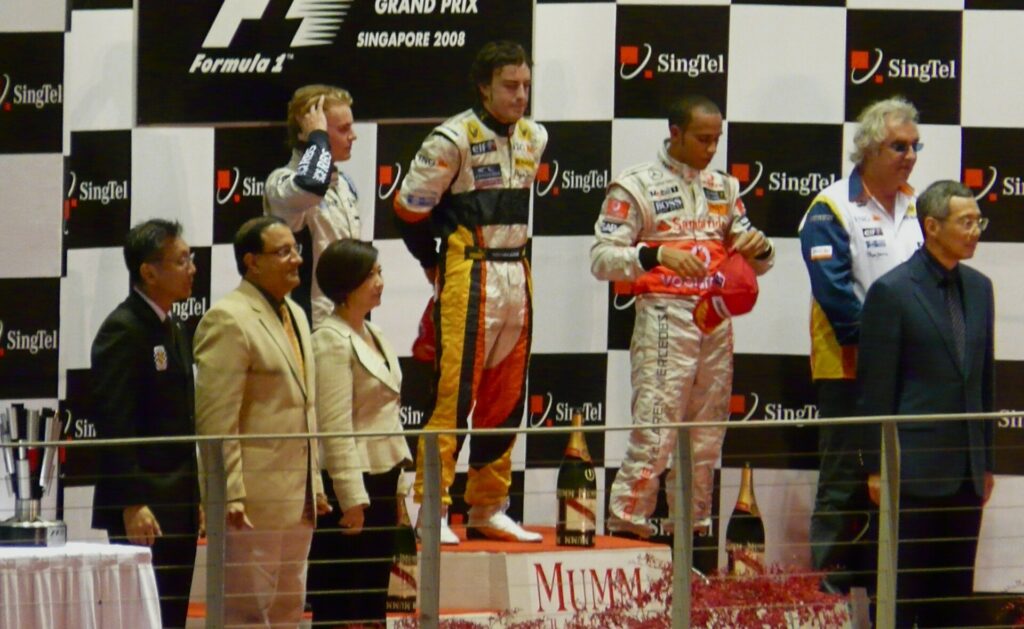
Three laps later, on lap 15, Piquet Jr. spun his Renault into the wall at Turn 17. Out came the safety car. Alonso cycled up to the front as everyone else pitted and then drove away from Nico Rosberg and Hamilton to win. Piquet Jr. told reporters it was a simple mistake.
Meanwhile, Ferrari Had a Night of Its Own
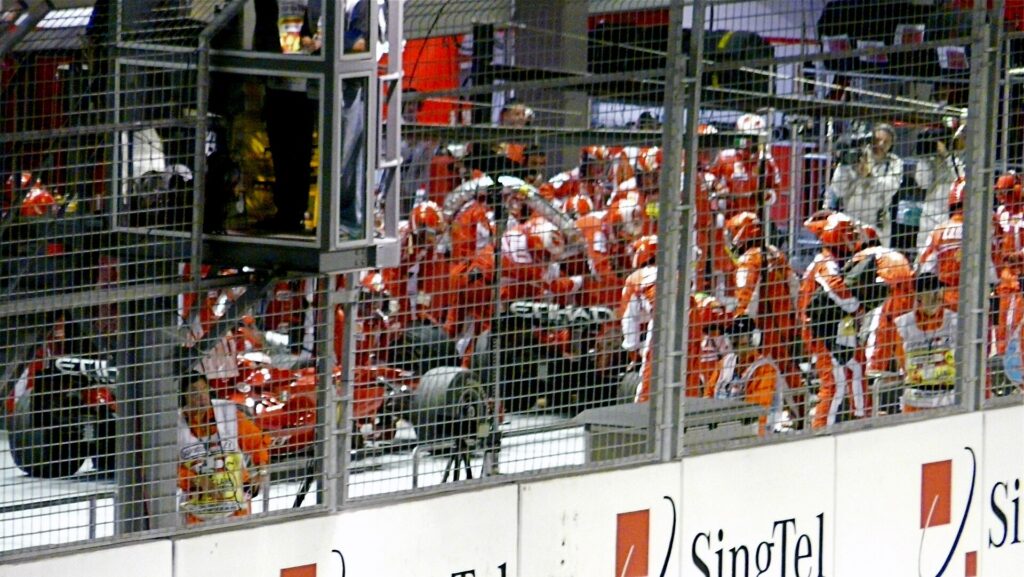
The safety car also blew up Massa’s race, with a little help from Ferrari. Ferrari’s pit stops used a traffic-light release system, and it gave Massa the green with the fuel hose still attached. He dragged it down the length of the pit lane before stopping, waited for mechanics to run down and yank it free, and rejoined at the back. He finished 13th with zero points. Hamilton took third and left Singapore with a seven-point lead, 84 to 77.
Five weeks later, Hamilton clinched the 2008 title at Interlagos by one point.
How the Truth Came Out
Renault dropped Piquet Jr. in early August 2009, after that year’s Hungarian Grand Prix. Before the month was out, Brazilian broadcaster Rede Globo reported that he’d been ordered to crash in Singapore. On September 4, 2009, the FIA formally charged Renault with conspiring with its driver to cause a deliberate crash. In his statements to the governing body, Piquet Jr. said team boss Flavio Briatore and executive director of engineering Pat Symonds had asked him to crash, down to the lap and the spot on the track.
The FIA’s World Motor Sport Council heard the case in Paris on September 21, 2009. The verdict was brutal. Renault was disqualified from Formula 1, with the penalty suspended for two years. Briatore was banned indefinitely from FIA-sanctioned events. Symonds, who had admitted his part and expressed his regret, got five years. Alonso was cleared, with the FIA finding no evidence that he or his crew knew. By then, title sponsor ING and backer Mutua Madrileña had already walked away from the team.
The Bans Didn’t Stick, but the Result Did
In January 2010, a French court overturned the bans on Briatore and Symonds. The FIA appealed. In April 2010 everyone settled: neither man would work in F1 until 2013, or in any FIA championship until the end of 2011. Later that year Piquet Jr. and his father won a libel case against the team in London’s High Court. Renault apologized and dropped its allegations of blackmail.
The race result was never touched, and Alonso’s win still counts. Both architects came back, too. Symonds rebuilt his career all the way to chief technical officer of Formula 1. Briatore is back running the same Enstone team, now racing as Alpine, which just re-signed Franco Colapinto through 2027. Alonso’s collection, meanwhile, now includes his machined-aluminum Bugatti Veyron.
Massa’s Day in Court
In 2023, Bernie Ecclestone said publicly that he and then-FIA president Max Mosley had heard about the crash allegations during the 2008 season and didn’t act. Massa’s argument is simple math: if Singapore had been thrown out in 2008, the single point that separated him from Hamilton might have gone the other way.
Massa sued Formula One Management, Ecclestone and the FIA in England’s High Court. On November 20, 2025, Mr Justice Jay dismissed his contract and negligence claims against the FIA, including his request for a declaration that he’d have been champion. But the court let an unlawful-means conspiracy claim against all three defendants go forward toward trial, on much narrower grounds. The judge also flagged serious obstacles on causation. Nobody is handing out a retroactive trophy, but a Grand Prix from 2008 is still a live legal case in 2026. If the F1 movie sequel needs a plot, it won’t have to dig far.
The Rule Change It Forced
Teams read the sporting regulations the way they read aero data, hunting for any edge. Renault found one in the closed-pit-lane rule and used it in the worst way possible. The rule was scrapped for 2009: the pit lane now stays open under the safety car, and drivers have to respect a minimum lap time instead. Refueling went away after 2009 too, and with it the fuel-load chess game that made Alonso’s early stop pay off.
Fans haven’t forgotten, either. Every time a midfield car brushes a wall right after its teammate pits, somebody online types “Singapore 2008.”
More From Today in Automotive History
Catch up on the day ThrustSSC hit 714 mph and how The Munsters gave TV its wildest hot rod hearse.
Sources: FIA World Motor Sport Council decision on the 2008 Singapore Grand Prix (Paris, September 21, 2009); FIA statement on Massa v Formula One Management Ltd, Ecclestone and FIA [2025] EWHC 3064 (KB) (November 20, 2025); official Formula 1 results for the 2008 Singapore and Brazilian Grands Prix. Photos via Wikimedia Commons under the Creative Commons licenses noted in each caption; photographers chensiyuan, Benjamin Chia and Morio.
About the Author