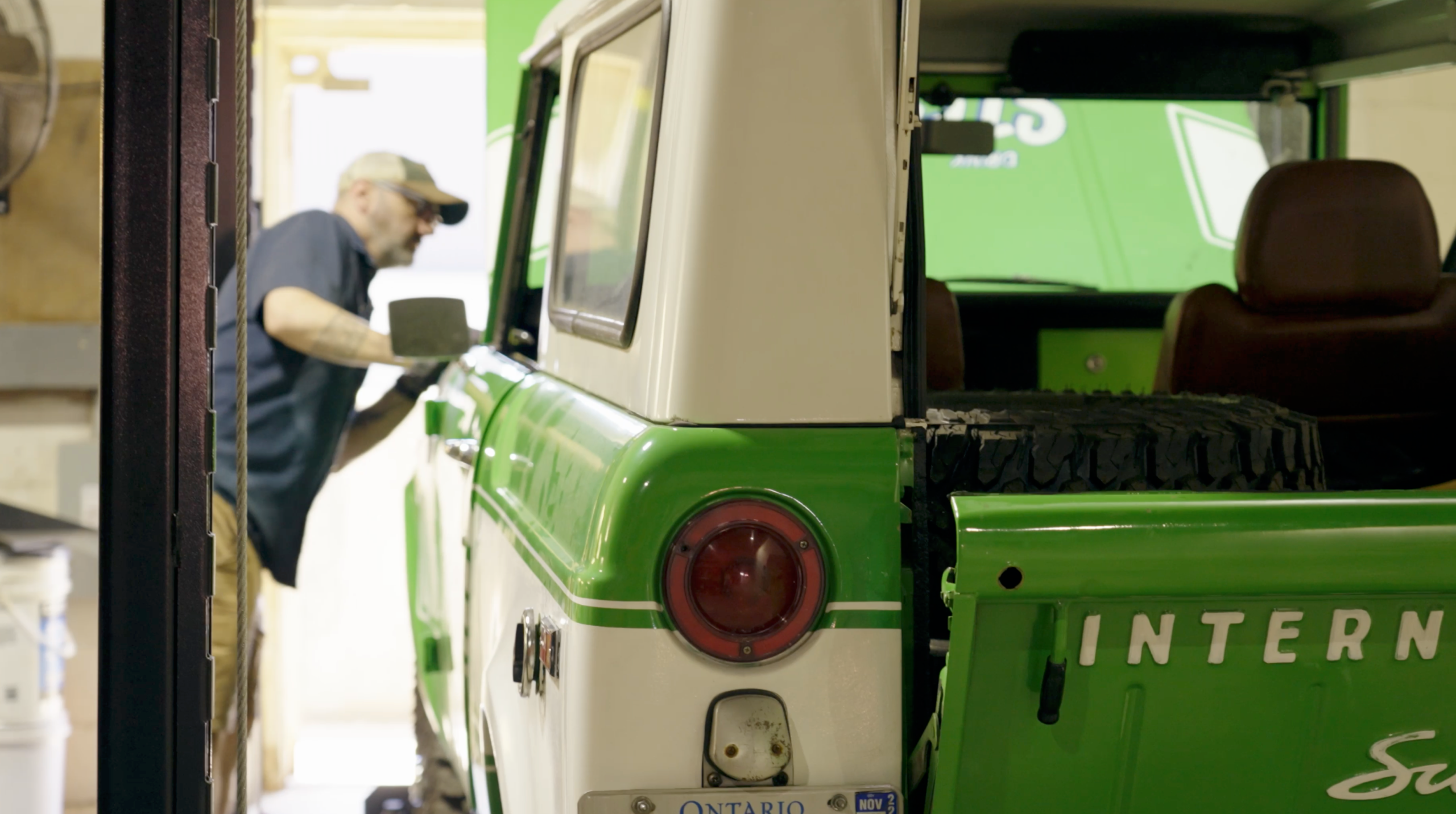
Steam Whistle Brewing’s 1970 International Harvester Scout 800A after its Beachman electric conversion. Photo: Steam Whistle Brewing
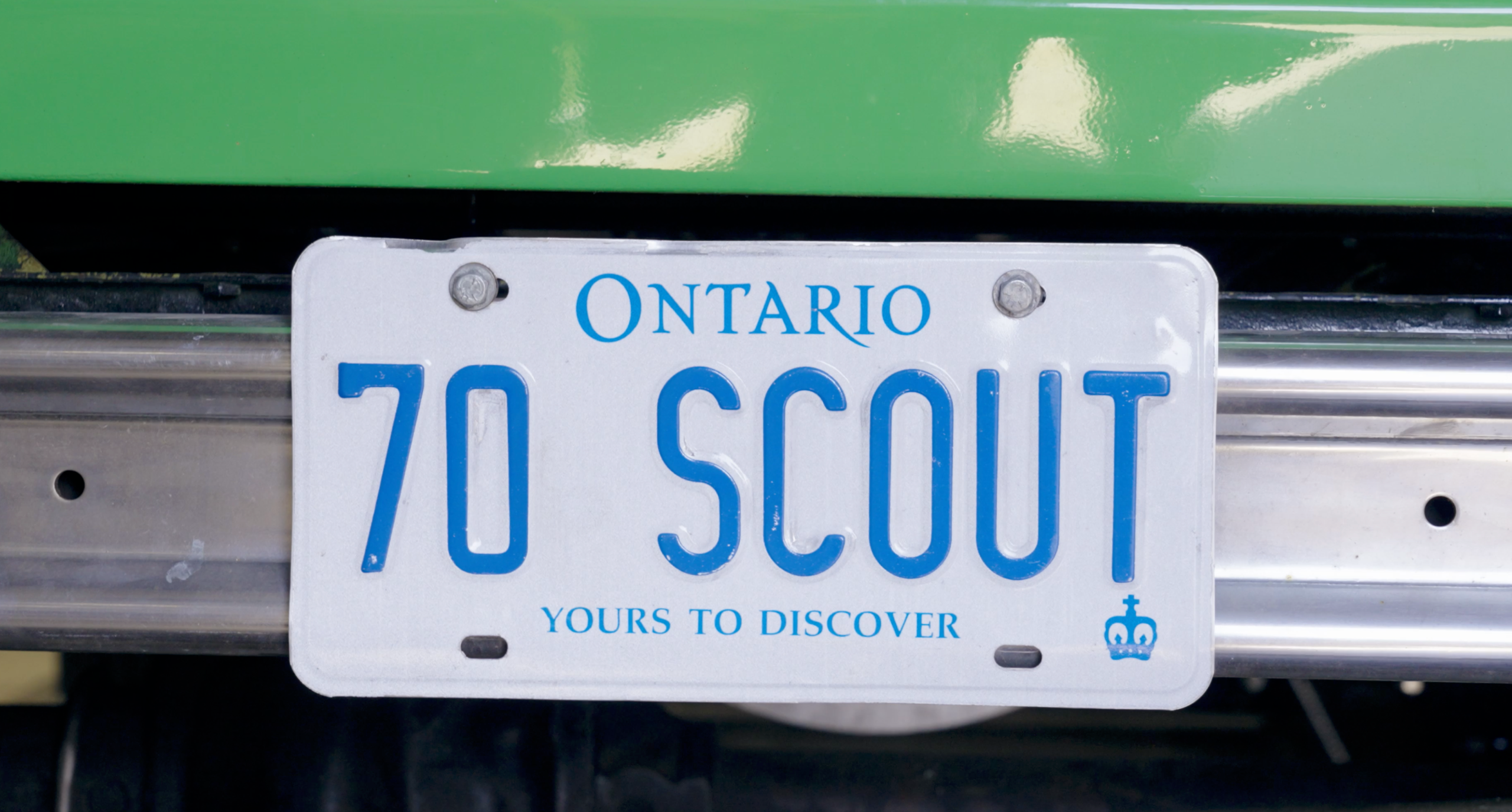
A green-and-white 1970 International Harvester Scout 800A now wears Ontario plates that read “70 SCOUT,” and it hasn’t burned a drop of gasoline since it came out of the shop. Steam Whistle Brewing found the truck on a horse farm in Newmarket, Ontario, and handed it to Beachman, a Toronto outfit better known for cafe-racer-style e-bikes, for a five-month restoration and electric conversion. What rolled out runs on the motor and battery from a salvaged 2019 Nissan Leaf.
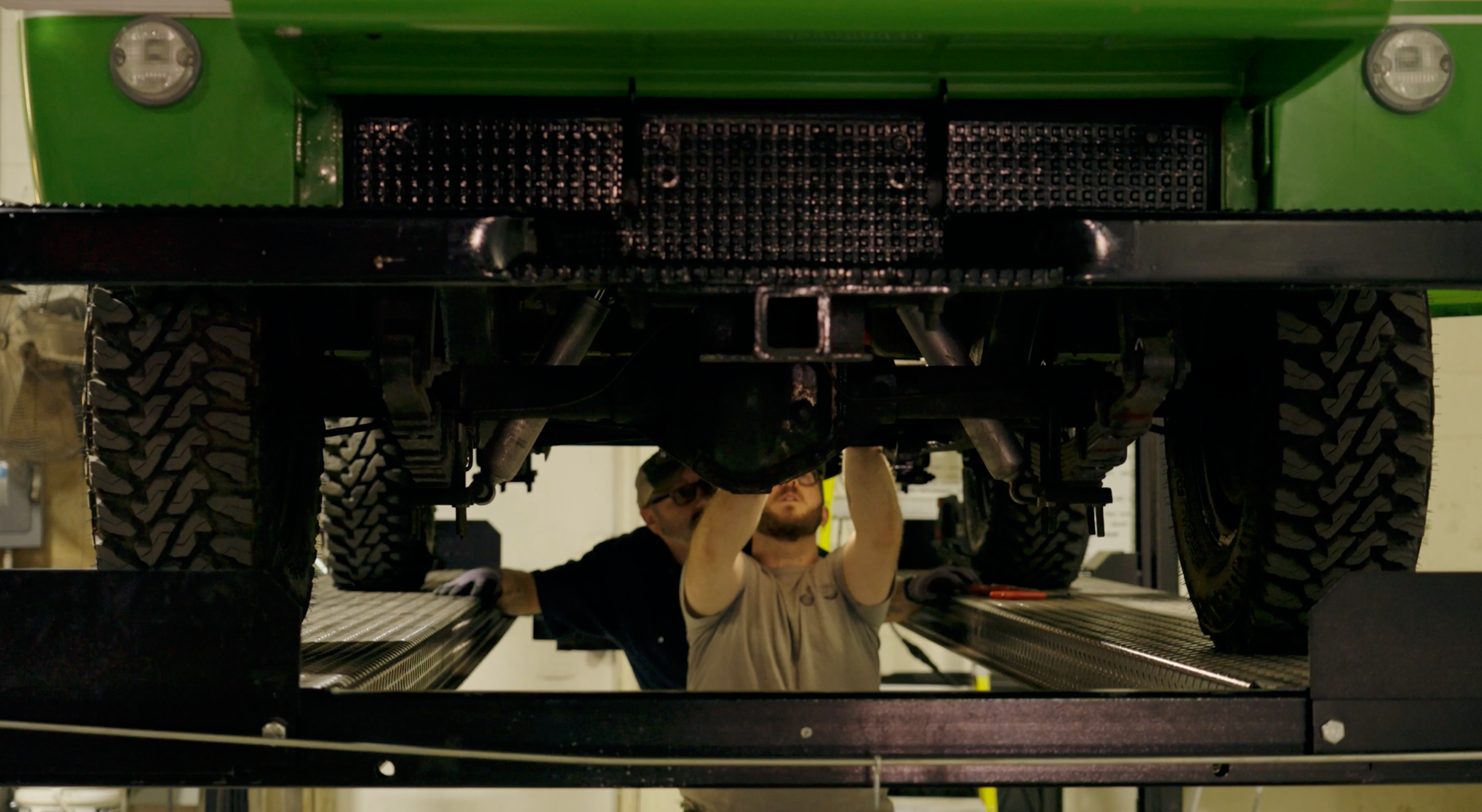
Pulling a gas engine and bolting in an electric motor is old news by now. What’s unusual here is how much of the Scout Beachman left alone: the original four-speed manual, the transfer case, the driveshafts and both axles all stayed. You still work a clutch, and you still pull a lever for four-wheel drive.
The build sheet
Steam Whistle published the specs in its own write-up of the project:
- Motor: 110 kW (147 hp) and 236 lb-ft, pulled from a 2019 Nissan Leaf
- Battery: 40-kWh, 400-volt Leaf pack
- Range: 150 to 200 km of real-world driving, or roughly 93 to 124 miles
- Charging: J1772 plug for Level 1 (120V) or Level 2 (240V); about eight hours for a full Level 2 charge
- Driveline: original four-speed manual, transfer case, driveshafts and axles, joined to the motor through what the brewery calls a proprietary gear and seal arrangement
- Restoration: original white steel wheels, restored tires, removable hardtop, reupholstered seats and a rebuilt dash
The brewery uses it as its warm-weather vehicle, which is about right for those range figures.
Why the stick shift stayed
Conventional wisdom says an electric motor makes a multi-speed gearbox pointless. On pavement, that’s mostly true. On a trail, it isn’t.
International built the 800A from 1969 to 1971 as an update of the Scout 80 that launched in 1961, and its base engine was a 196-cubic-inch four-cylinder making roughly 110 horsepower. The Leaf motor out-torques that engine and makes all 236 lb-ft from a standstill. Run that through the Scout’s low first gear, then through the transfer case’s low range, and the torque reaching the tires gets multiplied far beyond anything the Leaf ever sent to its front wheels through its single fixed reduction gear. That’s what you want when you’re crawling over rocks or easing a trailer up a wet boat ramp.
Keeping the factory driveline also saves money. There’s no custom single-speed reduction box to build, no driveshafts to re-length and no 4×4 system to rethink. The only real engineering is the adapter between the motor and the bellhousing. Everything after that is decades-old IH hardware, and the Scout parts aftermarket is deep, so if a U-joint or an axle shaft gives up, that’s a trip to the parts counter, not a call to the builder.
Expect to shift less than you did with gas, though. An electric motor doesn’t idle and spins far higher than the old IH engines did, so conversions that keep a manual usually end up treating one or two gears as the everyday setting and the rest as range selectors. The clutch stays useful for smooth take-offs and gear changes, not for keeping the motor from stalling, because it can’t stall.
Doing the range math
Forty kilowatt-hours over 150 to 200 km works out to about 200 to 265 watt-hours per kilometer, or somewhere around 2 to 2.5 miles per kWh. The EPA rated the 2019 Leaf with the same size pack at 150 miles. The Scout gives up a big chunk of that because it’s a tall box on solid axles and knobby tires, with all the aerodynamic grace of a filing cabinet.
The eight-hour Level 2 figure lines up with the Leaf’s 6.6-kW onboard charger. Plug into a regular 120-volt outlet from empty and you’re looking at well over a full day. Steam Whistle lists only Level 1 and Level 2 charging, so don’t plan on DC fast charging.
The donor pack is air-cooled. The 40-kWh Leaf battery has no active liquid thermal management, and Leaf batteries have long had a reputation for being sensitive to heat and repeated fast charging. On a truck doing summer errands around town and charging slowly overnight, that barely matters. If you plan to drive a similar build through hot climates, ask the builder how the pack is protected.
What a conversion costs
Beachman now sells this work through its Special Vehicles Division. Its conversions page lists cars starting at $35,000 and motorcycles starting at $10,000. The base car package uses upcycled Leaf drivetrains, and custom builds are quoted separately.
The parts list also covers two problems people forget about when going electric. Old power-brake boosters run on engine vacuum, and old power-steering pumps are driven by an engine belt, so pulling the engine kills both. Beachman’s fixes are Tesla iBooster brake conversions and Prius electric power steering.
Read the fine print before getting attached to the Steam Whistle truck’s finish, though. Beachman says it prefers pre-1990 vehicles with manual transmissions and rust-free bodies, that four-wheel drive adds complexity and cost, and that it does conversions, not restorations. This Scout got both. If yours has the rotted floors, rockers and cab corners old Scouts are known for, set aside a separate body-work budget and handle it before the conversion.
Insurance, registration and resale
Beachman says Hagerty certifies its conversions as acceptable classics. That helps, but call your own insurer about your specific build before you sign anything, and keep every receipt, component serial number and the builder’s spec sheet. An agreed-value policy on a modified classic comes down to paperwork.
Registration rules for converted vehicles differ by state and province. Some want the fuel type updated on the title or registration, and some require an inspection. Check with your local motor vehicle agency before the truck goes on the lift, not after.
Then there’s the collector question. Purists pay for original, numbers-matching drivetrains, and pulling the engine erases that for good unless you keep it. If you convert, crate the original engine and store it. It costs very little and leaves a future buyer the option to go back. Old 4x4s aren’t automatic money-makers either, as two classic 4x4s that sold for $10 at no reserve showed.
The Scout name is going electric from both ends
This isn’t Beachman and Steam Whistle’s first collaboration. Beachman lists a 1958 Chevy Apache it converted for the brewery with a 24-kWh Leaf battery. Meanwhile, Volkswagen-backed Scout Motors is bringing the nameplate back from the other direction with new trucks offered as full EVs or with a gas range extender. We’ve covered the Traveler concept on 35-inch tires and the more than 160,000 reservations, most of them for the hybrid.
One Scout will get its battery power from a new factory in South Carolina. Another got it from a junkyard Leaf and a shop in Toronto. Only one of them comes with a clutch pedal.
Photos: Steam Whistle Brewing. Specifications from Steam Whistle Brewing and Beachman.
About the Author