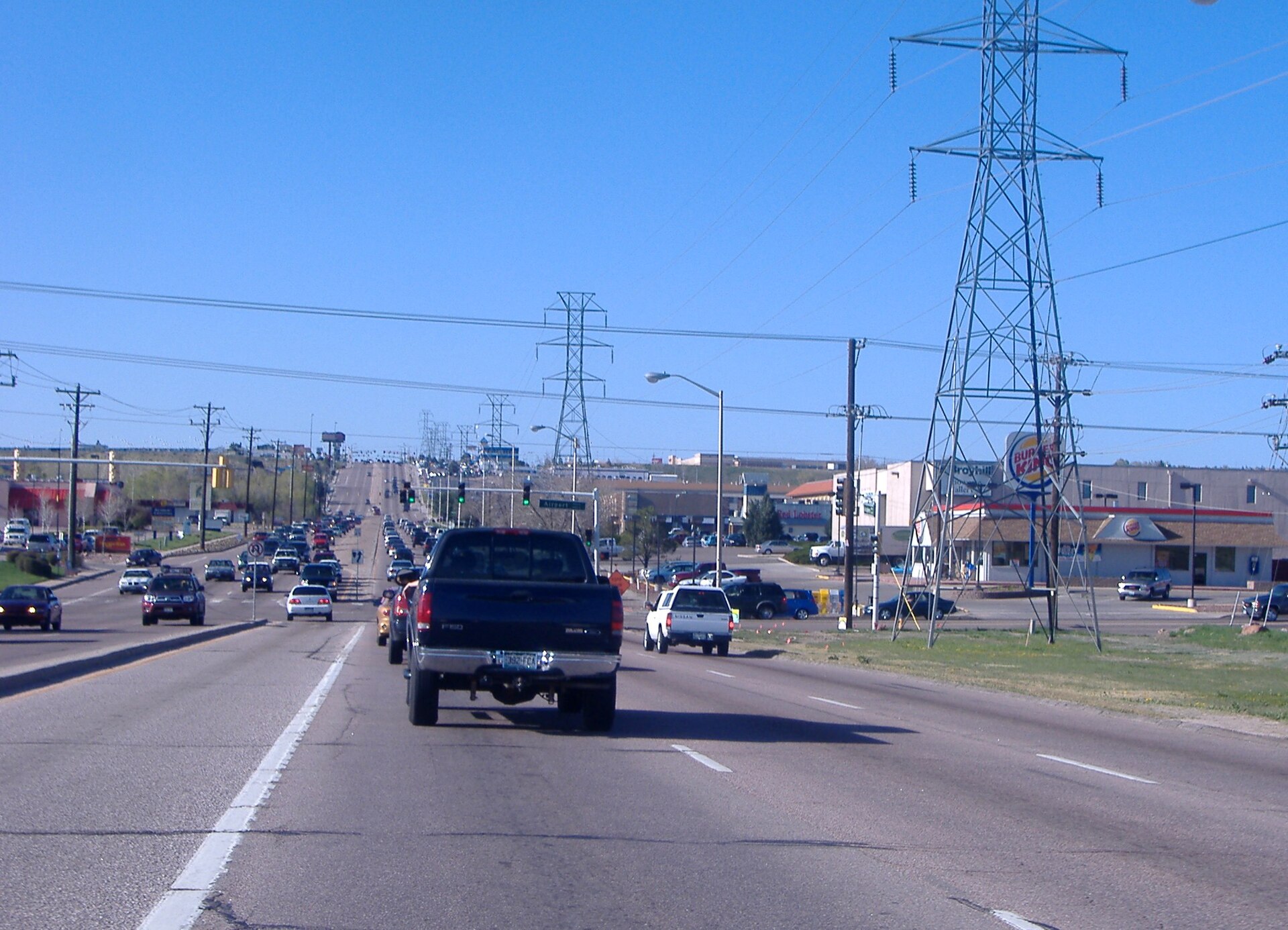
Academy Boulevard in Colorado Springs, Colorado. Photo: Idawriter via Wikimedia Commons, CC BY-SA 3.0
Colorado Springs police had a camera over a stolen company car early Thursday morning, watched it head the wrong way down Academy Boulevard, and then made the call most chase-happy viewers never want to hear: stop following it. A short while later the car turned up anyway, in a crash a few miles north.
The incident, logged in the Colorado Springs Police Department blotter as a motor vehicle theft and pursuit arrest, is a good look at how modern policing handles a car being driven dangerously at 3 a.m.
What CSPD says happened
According to the department’s blotter entry, Stetson Hills patrol officers were notified around 3 a.m. on Thursday, Sept. 24, that a naked man was inside a business in the 2400 block of North Academy Boulevard. Police said the man initially appeared erratic and confused, then took keys from a person inside the business. Those keys belonged to the business and to a Ford Taurus, and police said he left in that car.
An officer in CSPD’s Real Time Crime Center was already flying a drone on the call and radioed the Taurus’s location to officers on scene. Police said the drone operator saw multiple traffic violations, including wrong-way driving on Academy. A pursuit was authorized near Academy and Union Boulevard, then terminated shortly after over roadway conditions, speeds and overall public safety.
Once the chase ended, the drone lost sight of the car. A little later, a crash was dispatched near Austin Bluffs Parkway and Meadowland Boulevard involving a vehicle matching the description. Police said the suspect was found nearby and taken into custody without further incident, and the Taurus was recovered. CSPD lists the adult arrested as Christopher Gonzales. FOX21 News in Colorado Springs placed the business near Maizeland Road.
The drone did the job a cruiser’s bumper used to do
For decades, the only way police could keep track of a fleeing car was to stay right behind it, which is exactly what makes a pursuit dangerous. The police car that pushes the suspect to go faster is also the one keeping the suspect in sight.
CSPD’s drone program changes that. The city says its drones are flown remotely by FAA-certified operators in the Real Time Crime Center. Its “drone as first responder” aircraft launch from permanent sites around the city to certain call types within a set radius, and smaller mobile units can be deployed from vehicles elsewhere. The department also says every flight is logged and that the flight paths can be viewed by the public, which is more transparency than a helicopter ever offered.
In this case the drone spotted the car, relayed its position and saw the wrong-way driving before a single cruiser had to put its lights on the Taurus’s tail. It still lost the car after the pursuit ended, police said, and the Taurus was next found in a crash scene rather than parked quietly.
Why “wrong way” ends the chase
Calling off a pursuit here was simple risk math. A wrong-way driver turns every oncoming lane into a head-on collision waiting to happen, and every police car following adds more speed and more metal to the same stretch of road. CSPD cited roadway conditions, speed and public safety, which covers pretty much everything.
The national numbers make the case. The AAA Foundation for Traffic Safety’s study of fatal wrong-way crashes on U.S. divided highways found their yearly count roughly doubled, from 278 in 2014 to 520 in 2023, with 5,730 deaths over the decade. Darkness was among the risk factors it identified. That study covers the whole country, not Academy Boulevard specifically, but 3 a.m. on a multi-lane arterial fits the profile no agency wants to test.
We’ve covered how chases end when police don’t back off, including a fleeing sedan that lost a wheel near Mannheim Road and kept going and a Georgia department’s low-speed PIT maneuver. The Colorado Springs approach sits at the other end: watch from above, back off on the ground and let the suspect run out of road.
What the record doesn’t tell us
Plenty. The blotter entry doesn’t list specific charges, the suspect’s age, how fast the car was going, the Taurus’s model year, whether anyone was hurt in the crash on Austin Bluffs, or what other vehicle was involved. It also offers no explanation for the man’s condition beyond describing him as erratic and confused, and we’re not going to guess. The arrest is an allegation, not a conviction.
If your business has a company car
For businesses, this is a key-control story. Police said the keys were taken from a person inside the business, so the car’s weak point was a set of keys within reach of the wrong person, not the lock or the immobilizer. A locked key cabinet, a lockbox or a sign-out log costs very little compared to a claim.
And that claim may be smaller than you’d hope. On a commercial auto policy, physical-damage coverage for the company’s own vehicles is typically optional. A business that carries liability only is on its own for theft and crash damage to its car. Even with coverage, the math gets unfriendly on older fleet sedans. Ford ended Taurus production in North America in 2019, so every Taurus still working for a business is several years old, and a crash-damaged older sedan can easily cost more to fix than its actual cash value. That usually means a total loss. If you’re weighing insurance paperwork, this case shows how closely insurers read timestamps, and this Toledo shop case shows what can happen when keys end up in the wrong hands, even for police.
For recovered stolen vehicles more broadly, our look at a stolen trailer and 1970 Pontiac GTO Judge recovered in Dayton covers what owners face after the car comes home.
The Colorado Springs Taurus is back with its owner, one way or another. And a department that could see the danger from overhead chose not to feed it, and still ended the night with an arrest.
Featured image: Academy Boulevard in Colorado Springs, Colorado. Photo by Idawriter via Wikimedia Commons, licensed under CC BY-SA 3.0.
About the Author